
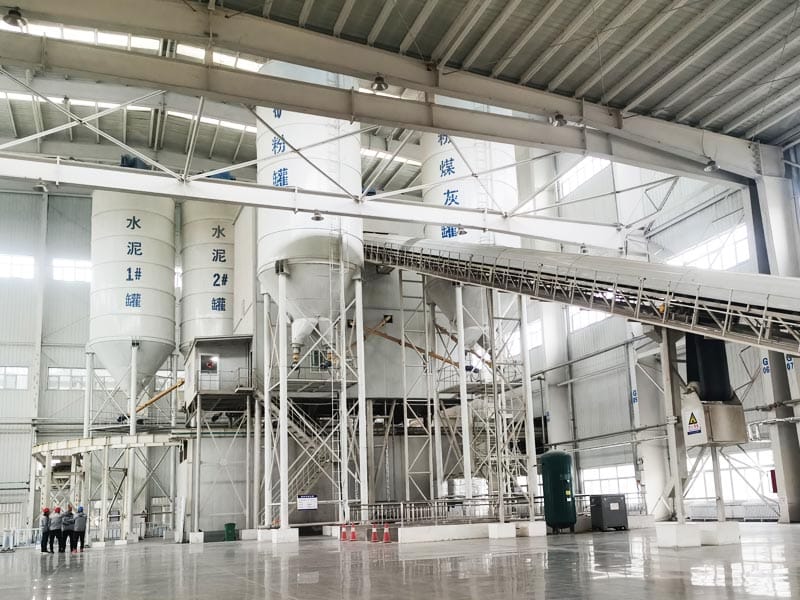
Precast bridge beams place demanding requirements on concrete batching because the plant must support repetitive production of large structural members, often with prestressing, controlled curing, strict dimensional tolerances and a fixed casting schedule. A batching plant that works well for general ready-mix production may not automatically fit a beam yard.
For buyers, the important question is not only how many cubic meters per hour the plant can produce. The plant also needs to maintain batch-to-batch consistency, support the required concrete family, deliver the right batch size to long casting beds, manage aggregate moisture and temperature, and preserve traceability from the batching record to the individual beam production lot.
Unser Betonfertigteil-Rollanlage uses a planetary mixer, multiple discharge doors, moisture and temperature monitoring, and production-line software interfaces. This guide explains how those functions relate to the real production requirements of precast bridge beams.
Why Precast Bridge Beams Need a Dedicated Batching Strategy
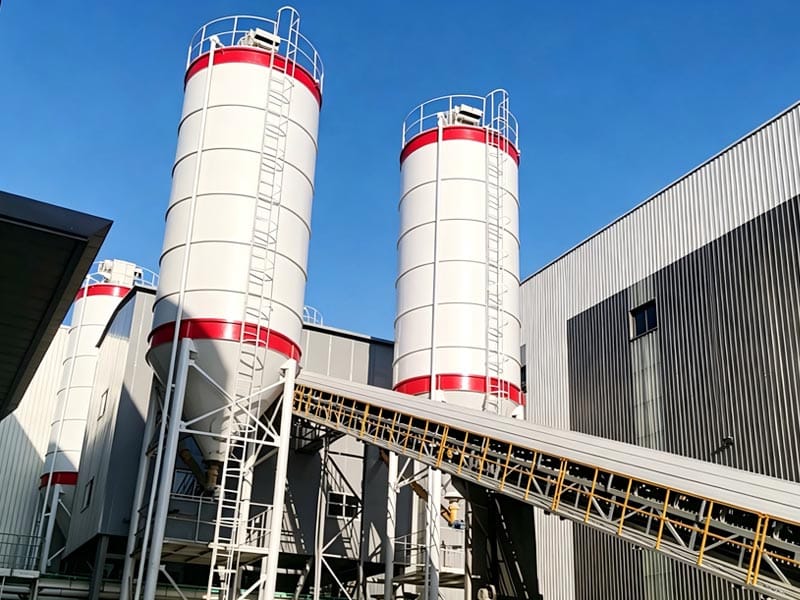
Precast bridge beams are large structural elements produced under controlled plant conditions. Depending on the bridge system, the yard may manufacture I-girders, box beams, deck beams or other prestressed members.
The Federal Highway Administration notes that precast and prestressed beam systems are manufactured in controlled facilities and that fabrication quality, mix design, curing, transport and dimensional control all influence project performance.
For precast bridge beams, the batching plant should be reviewed together with:
- beam type and geometry;
- concrete volume per beam;
- casting-bed length;
- prestressing sequence;
- concrete placement method;
- curing cycle;
- release-strength schedule;
- quality-control testing.
This is a production-system decision, not just a mixer-capacity decision.
Start with the Beam Yard Production Schedule
Beam yards often operate around long casting beds and prestressing schedules. The batching plant should therefore be sized from the real casting program.
| Production input | Warum es wichtig ist | Batching implication |
|---|---|---|
| Beam type | Different members use different concrete volumes and molds | Changes batch schedule and delivery sequence |
| Beam length | Long beams may require sustained placement | Controls number of batches per member |
| Beams per shift | Defines daily demand | Influences storage and productive hours |
| Peak casting window | Several beds may require concrete close together | Controls plant and transport capacity |
| Prestress release plan | Production may depend on early-age strength | Requires consistent concrete and curing schedule |
For precast bridge beams, peak casting demand is often more important than average daily tonnage.
Continuous Placement Can Be More Important Than Headline Output
A long beam may need several batches placed in sequence. If concrete delivery is interrupted, the production team can lose the intended placement rhythm.
Suppose one beam requires 12 m³ of concrete and the mixer delivers 2 m³ per batch. The beam needs six batches.
If the complete batch-and-delivery cycle is five minutes, the theoretical placement window is about 30 minutes before additional waiting or placement time is considered.
If the beam yard requires a shorter uninterrupted placement period, the batching and transport system must be reviewed together.
This example is illustrative only. It shows why precast bridge beams should be evaluated by continuous casting demand rather than rated m³/h alone.
Batch Size Should Match the Beam Pour Sequence
Large precast bridge beams may use repeated full batches, but the final completion quantity can be smaller.
The plant should therefore validate:
- Normale Losgröße;
- smallest completion batch;
- largest production batch;
- mixing uniformity at each batch size;
- weighing performance at low ingredient quantities.
A mixer that performs well at full load may not provide identical mixing behavior at a much lower fill level.
For precast bridge beams, small completion batches should be part of commissioning rather than treated as an unusual exception.
Planetary Mixing Can Fit Beam-Yard Production
Our precast concrete batching plant uses a vertical-shaft planetary mixer.
For precast bridge beams, planetary mixing can be useful where the plant needs repeatable batch uniformity and flexible handling of different concrete consistencies.
However, mixer architecture alone does not guarantee suitable production.
Verify performance with the actual:
- aggregate grading;
- cementitious system;
- water-cementitious ratio;
- admixture package;
- batch size;
- mixing sequence.
Unser planetary vs twin-shaft mixer guide explains why mixer choice should follow the product and batch range.
Prestressed Beam Concrete Requires Stable Batch-to-Batch Control
Precast bridge beams are commonly prestressed, so concrete consistency can affect both placement and the production schedule.
If the yard depends on a target release condition before prestress transfer or demolding, large variation in concrete production can disrupt the planned cycle.
For precast bridge beams, the batching plant should control:
- aggregate quantities;
- cementitious materials;
- Wasser;
- admixtures;
- mixing duration;
- concrete temperature.
The plant should also keep batch records so the quality team can link material quantities and production conditions with test results.
Trial Batches Should Represent Actual Production Conditions
FHWA sample specifications for precast and prestressed members require new concrete mixtures to be qualified through trial batches and require production batching and handling to follow the approved procedures.
The same source also notes that SCC mixtures should be trial batched to demonstrate the required fresh properties.
For precast bridge beams, the trial should use representative:
- Aggregate;
- cementitious materials;
- admixtures;
- Mischpult;
- batch size;
- curing approach.
Laboratory success alone is not enough if the full-scale plant behaves differently.
Aggregate Grading Should Be Controlled Before Production Starts
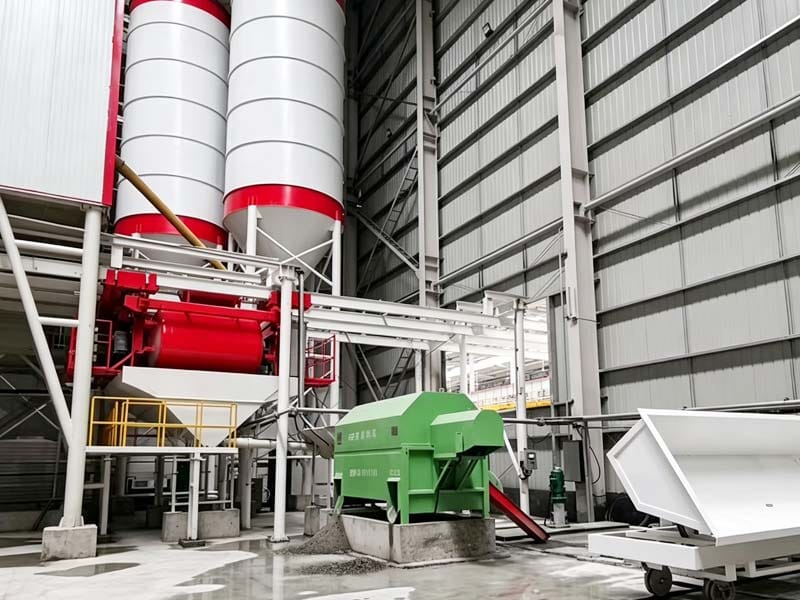
FHWA bridge fabrication guidance includes aggregate grading among the mix-design information used for precast concrete approval.
For precast bridge beams, aggregate grading influences workability, packing and mixture repeatability.
The batching plant should receive aggregate from separated, controlled sources.
Rezension:
- stockpile separation;
- bin contamination;
- segregation during handling;
- source changes;
- fine-aggregate grading;
- coarse-aggregate maximum size.
A stable batching process cannot fully compensate for uncontrolled aggregate supply.
Aggregate Moisture Needs Active Correction
Fine aggregate moisture can change the wet sand quantity and the amount of separate batch water needed.
This matters for precast bridge beams because changes in total water can alter fresh concrete behavior and strength development.
The batching plant should therefore support:
- representative moisture measurement;
- wet aggregate correction;
- batch-water correction;
- reference moisture checks;
- recording of moisture values.
Unser aggregate moisture correction guide explains why moisture should be treated as a material-balance issue rather than only a water-setting adjustment.
Concrete Temperature Can Affect the Beam-Yard Schedule
Temperature affects setting, early-age strength development and the timing of curing operations.
For precast bridge beams, this can influence:
- finishing;
- steam or accelerated curing where used;
- test results;
- prestress release timing;
- form turnover.
Our precast batching plant includes moisture and temperature monitoring in its published configuration.
The quality plan should define which temperature values are measured, where they are recorded and what action is required when the concrete moves outside the approved production range.
Water and Admixture Dosing Need Production-Scale Verification
Prestressed beam concrete may use water reducers, accelerators, retarders or other admixtures depending on the project specification.
For precast bridge beams, validate the dosing system across the actual production range.
Prüfen:
- minimum routine dose;
- normal dose;
- multiple admixture products;
- delivery line residue;
- batch-record traceability.
A display showing a target value is not independent proof that the complete dispenser delivered the intended quantity.
SCC Can Be Useful for Reinforced or Complex Beam Sections
Self-consolidating concrete may be used in some precast or prestressed bridge applications when approved by the project specification.
FHWA guidance for precast work references trial batching and fresh-property testing for SCC, including evaluation of flow and segregation behavior.
For precast bridge beams using SCC, pay close attention to:
- sand moisture;
- water correction;
- admixture dosage;
- mixing sequence;
- transport waiting time;
- fresh-property testing.
Unser precast concrete consistency guide explains why SCC should be controlled as a complete production chain.
Transport from Mixer to Casting Bed Can Limit Output
The beam yard still needs to move concrete from the mixer to the mold or casting bed.
Depending on the factory, transport may use buckets, distributors, trucks or another approved system.
For precast bridge beams, compare:
- mixer batch size;
- transport-bucket capacity;
- travel distance;
- number of transport units;
- waiting time at the bed;
- return-cycle time.
Unser precast concrete transport guide explains how a slow delivery loop can become the real capacity bottleneck.
Long Casting Beds Need Route Planning
Bridge beam yards can have long production beds with substantial travel distance between the batching plant and the far end of the casting area.
The plant layout should therefore consider:
- transport route length;
- route crossings;
- crane activity;
- reinforcement staging;
- prestressing equipment;
- personnel walkways;
- return path.
For precast bridge beams, the shortest theoretical route is not always the safest or fastest practical route.
Multiple Discharge Doors Can Support More Than One Beam-Yard Route
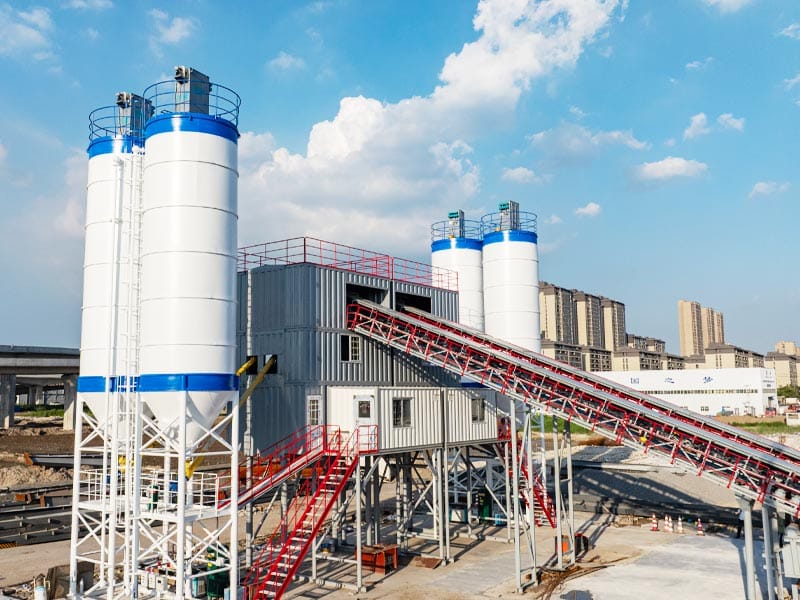
Our precast batching plant uses multiple discharge doors.
For precast bridge beams, this can support different transport routes or casting zones within the yard.
Definieren:
- which discharge door serves each route;
- which transport unit receives each batch;
- how receiver readiness is confirmed;
- what happens if one route is unavailable.
Multiple discharge doors improve routing flexibility but do not create multiple independent mixers.
Batch Traceability Should Reach the Individual Beam or Lot
Beam fabrication benefits from strong production traceability.
For each batch used in precast bridge beams, the plant can record:
| Batch record field | Beam-yard link |
|---|---|
| Batch ID | Beam number or production lot |
| Rezeptrevision | Approved mix design |
| Actual ingredient quantities | Quality-control record |
| Moisture values | Water-correction history |
| Concrete temperature | Curing and production context |
| Alarm oder manuelle Übersteuerung | Corrective-action review |
Unser Smart Beton-Chargenanlage-Leitfaden explains how batch records can be linked to production destinations.
Production Software Integration Should Be Defined Early
Our precast batching plant supports software interfaces for coordination with PC production lines.
For precast bridge beams, define whether the batching plant needs to exchange:
- beam ID;
- recipe request;
- batch quantity;
- casting-bed destination;
- batch completion status;
- quality-control data.
The interface should be agreed before commissioning rather than added after the yard begins production.
Storage Capacity Must Support the Peak Beam Pour
Large structural beams can consume significant quantities of aggregate and cementitious materials during a concentrated casting period.
For precast bridge beams, calculate:
- aggregate consumption per beam;
- cementitious consumption per beam;
- beams produced in one casting window;
- usable silo and bin storage;
- replenishment time.
The plant should not run short of a critical material during a continuous beam pour.
Quality Control Space Should Be Close to Production
Bridge beam production often requires frequent fresh-concrete and strength testing.
The yard layout should provide practical access for:
- sampling;
- temperature testing;
- air testing where required;
- slump or slump-flow testing;
- specimen preparation;
- record storage.
For precast bridge beams, QC sampling should be integrated with the casting schedule so testing does not unnecessarily delay production.
Maintenance Windows Should Follow the Beam-Yard Cycle
A plant shutdown can interrupt a complete casting program.
Maintenance should therefore be scheduled around:
- prestressing operations;
- casting windows;
- curing cycles;
- form preparation;
- non-production shifts.
Unser Wartungsleitfaden für Betonmischer und batching plant lubrication guide explain why inspection and lubrication should be planned from actual equipment duty.
Commissioning Should Include a Representative Beam-Yard Trial
A new plant should not be accepted only from an empty-cycle test.
For precast bridge beams, commissioning should include:
- representative aggregates;
- normal and small batch sizes;
- Feuchtigkeitskorrektur;
- Wasser - und Beimischungsdosierung;
- mixing sequence;
- concrete temperature;
- discharge to the actual transport system;
- delivery to a casting bed;
- batch-record generation.
Where project specifications require trial batches, the production team should align plant commissioning with those quality-control requirements.
What Should Buyers Send for a Beam-Yard Plant Review?
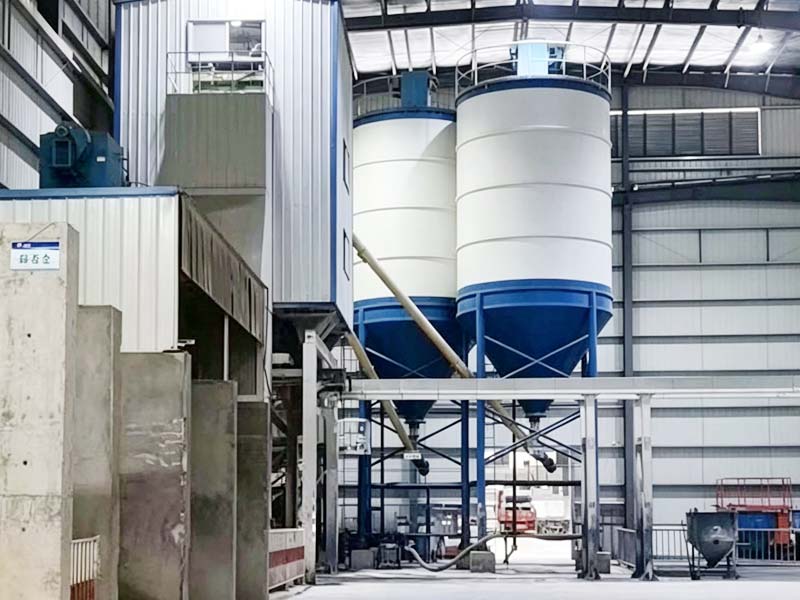
A useful equipment review needs the actual precast bridge beam production plan.
Bereitstellen:
- beam types;
- beam dimensions;
- concrete volume per beam;
- number of casting beds;
- beams per shift;
- peak casting demand;
- normal and minimum batch sizes;
- concrete mix families;
- transport method;
- yard layout;
- curing approach;
- software-interface requirements.
Unser Betonfertigteillösungen can then be reviewed around the real beam-yard production schedule rather than a generic precast plant specification.
Send your beam production plan and yard layout through our Kontaktseite for a project-specific batching plant review.
Schlussfolgerung
Precast bridge beams require a batching plant that can support sustained casting, repeatable concrete quality and the production rhythm of a prestressed beam yard.
Batch size, aggregate grading, moisture correction, admixture dosing, mixer performance, concrete temperature, transport cycles, storage and batch traceability all affect the final plant configuration.
The strongest equipment selection starts with the beam production schedule and follows the concrete all the way to the casting bed. When the batching plant is designed around real beam-yard conditions, production becomes easier to control, test and repeat.
FAQ
What batching plant is suitable for precast bridge beams?
A precast-focused batching plant should support repeatable weighing, moisture correction, controlled mixing, suitable batch sizes, efficient transport and traceable production records. The exact configuration depends on beam type and yard schedule.
Why are small batches important in bridge beam production?
A beam may need a final completion batch smaller than the normal mixer load. The plant should therefore be validated at both normal and minimum routine batch sizes.
Can SCC be used for precast bridge beams?
Yes, where the project specification approves it. The plant should then provide stable moisture, water and admixture control and should validate the mixture through representative trial batches and fresh-property testing.
How can concrete transport limit a beam yard?
If buckets or other transport equipment take longer to deliver and return than the batching plant takes to produce the next batch, transport becomes the practical production bottleneck.
What information should I provide before selecting a batching plant for precast bridge beams?
Provide beam types, concrete volume, casting-bed layout, production schedule, batch sizes, concrete mixes, transport method, curing approach and required data interfaces.


