
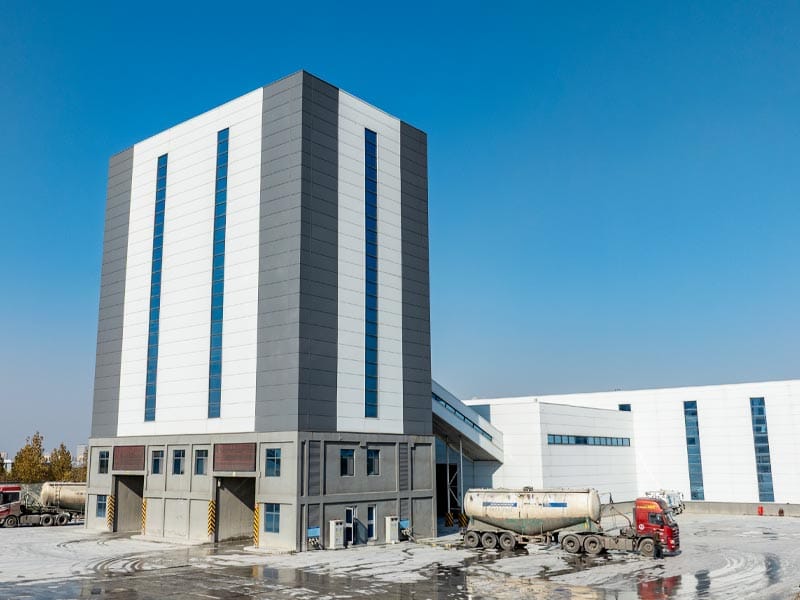
Overhead vs side-mounted silos is primarily a plant-layout decision. It describes where cement, fly ash and other powder silos are positioned relative to the main mixing building. It does not describe how aggregates reach the mixer, because aggregate transfer can use belt conveyors or skip hoists under either general layout concept.
For buyers, this distinction matters because silo position changes footprint, structure height, powder transfer routes, tanker access, maintenance space and future expansion. A compact site may benefit from more vertical integration, while another project may prefer side-mounted silos for easier ground-level access and a lower central structure.
Our pabrik pencampuran beton overhead belt and pabrik pencampuran beton sabuk yang dipasang di samping illustrate these two layout approaches while using the same general belt-fed aggregate concept. This guide explains how to compare overhead vs side-mounted silos without confusing silo position with aggregate feeding method.
What Do Overhead and Side-Mounted Silos Mean?
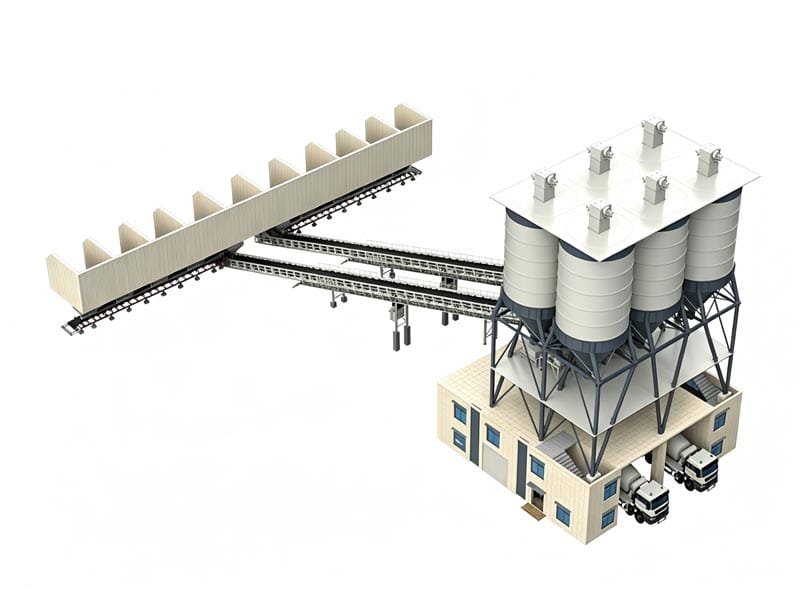
In an overhead arrangement, powder silos are positioned above or integrated vertically with the main mixing structure. In a side-mounted arrangement, the silos stand independently beside the main mixing building.
The difference changes the way powder moves toward the weighing and mixing stages.
| Layout factor | Overhead silos | Side-mounted silos |
|---|---|---|
| Silo position | Above or vertically integrated with main structure | Beside the main mixing building |
| Horizontal footprint | More vertically concentrated | Uses more space beside the main building |
| Overall structure height | Generally higher | Central structure can remain lower |
| Powder transfer route | Can use more gravity-assisted downward flow | Usually requires side-to-main-building transfer |
| Maintenance geometry | More elevated service access | More equipment distributed around ground-level site area |
Overhead vs side-mounted silos should therefore be evaluated as two different site-integration strategies rather than simply two versions of the same drawing.
Silo Position Is Independent from Aggregate Feeding Method
One of the most common terminology mistakes is treating “overhead” as if it means belt conveyor and “side-mounted” as if it means skip hoist.
These are separate classification dimensions.
A plant can combine:
- overhead silos with belt-fed aggregates;
- side-mounted silos with belt-fed aggregates;
- overhead silos with skip-hoist aggregate feeding;
- side-mounted silos with skip-hoist aggregate feeding.
Our product range includes all four combinations.
When comparing overhead vs side-mounted silos, keep the silo decision separate from the belt conveyor vs skip hoist decision. This produces a clearer plant-selection process.
Overhead Silos Can Reduce the Central Horizontal Footprint
The main advantage of an overhead silo arrangement is vertical concentration.
By positioning powder storage above the main mixing building, the central production area can use less horizontal land than a layout where several silos stand beside the plant.
This can be useful when:
- the property is narrow;
- truck roads consume much of the available ground area;
- the customer wants a compact main production zone;
- side expansion space is limited.
However, the space saved horizontally is exchanged for greater vertical structure.
Overhead vs side-mounted silos should therefore be compared using both footprint and height, not footprint alone.
Overhead Silos Increase Vertical Engineering Requirements
Placing powder storage higher in the structure changes the load path and access requirements.
The project team should review:
- foundation loads;
- structural support;
- wind conditions;
- seismic requirements where applicable;
- elevated maintenance platforms;
- safe access to silo accessories;
- height restrictions.
Overhead vs side-mounted silos is therefore partly a civil and structural engineering decision.
Do not select the overhead arrangement simply because the plan view looks more compact.
Side-Mounted Silos Use More Ground Area but Can Simplify Access
Side-mounted silos stand beside the main building and usually require more horizontal space.
The tradeoff is that several powder-handling components can remain closer to ground-level service zones.
This can make it easier to arrange:
- cement tanker access;
- silo-bottom inspection;
- screw conveyor access;
- dust-collector maintenance;
- future addition of another silo.
For a large or irregular site, the extra footprint may not be a disadvantage.
Overhead vs side-mounted silos should be matched to the actual property rather than judged from compactness alone.
Cement Tanker Access Can Decide the Layout
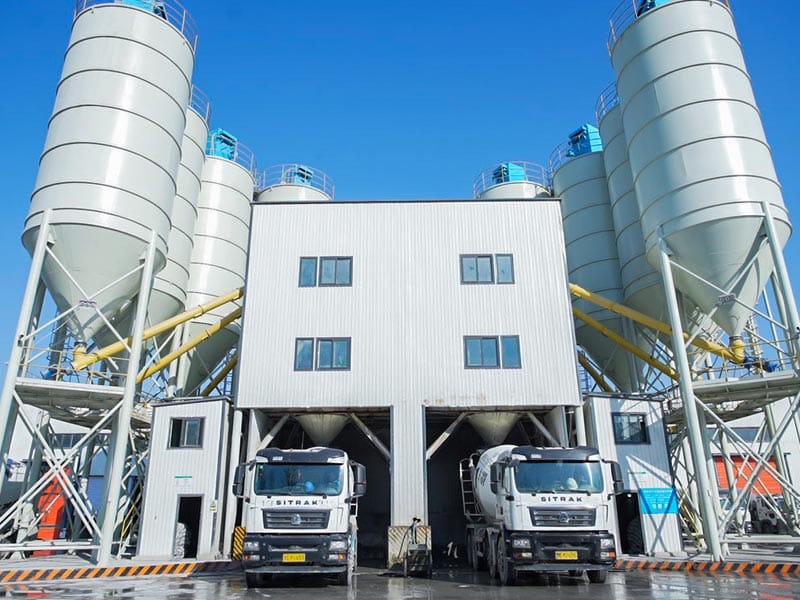
Powder silos need reliable filling access.
Cement, fly ash and other materials are often delivered by bulk tanker, which needs room to enter, position, connect, unload and leave.
For overhead vs side-mounted silos, compare:
- tanker turning radius;
- hose routing;
- lokasi mengisi-pipa;
- akses operator;
- clearance from truck queues;
- interaction with aggregate delivery.
A compact overhead plant can still create poor tanker logistics if the filling point is positioned where every delivery blocks the main truck route.
The best layout separates powder delivery from concrete dispatch where practical.
Powder Transfer Route Changes with Silo Position
Silo arrangement influences how powder reaches the weighing hopper.
In an overhead layout, powder can move downward through a shorter gravity-assisted route after leaving the silo.
In a side-mounted layout, screw conveyors or other transfer equipment may move powder horizontally or upward before it reaches the main building.
For overhead vs side-mounted silos, review:
- number of transfer stages;
- panjang konveyor;
- inclination;
- access for maintenance;
- cleaning requirements;
- residual material risk.
A shorter transfer route can reduce mechanical complexity, but elevated structures create other engineering requirements.
Side-Mounted Layouts Can Support Easier Silo Expansion
Some plants begin with two powder silos and later add another material such as fly ash, slag or another cementitious powder.
A side-mounted arrangement can make expansion easier when unused land is reserved beside the existing silo row.
For overhead vs side-mounted silos, ask:
- How many powders are needed today?
- How many may be needed in three to five years?
- Is there space for another foundation?
- Can the new screw conveyor reach the weighing system?
- Does the control system have spare I/O?
An overhead structure can also be expanded, but the future structural load and access need to be considered at the original design stage.
Maintenance Access Is Different in Each Layout
Maintenance should be planned before the plant is built.
Overhead silos can require more work at elevated positions. Side-mounted silos distribute equipment around a larger ground footprint.
For overhead vs side-mounted silos, compare access to:
- dust collectors;
- pressure-relief devices;
- level indicators;
- silo-bottom valves;
- konveyor sekrup;
- menimbang hopper;
- support structures.
Our panduan tata letak pabrik batching beton explains why maintenance zones should remain usable after roads, barriers and other equipment are installed.
Plant Height Can Be a Hard Constraint
Some sites have strict height limits because of planning rules, nearby infrastructure, airport zones, overhead utilities or visual-impact requirements.
In these cases, overhead vs side-mounted silos may be decided before many other plant details.
Menyediakan:
- maximum permitted structure height;
- nearby power lines;
- bridge or crane clearances;
- wind exposure;
- local planning constraints.
A side-mounted arrangement can sometimes help keep the main central structure lower, while an overhead arrangement uses more vertical space to save ground area.
Foundation Planning Changes with Silo Arrangement
Silos impose significant concentrated loads, so foundation locations matter.
For side-mounted silos, individual foundations can be distributed beside the main plant.
For overhead silos, more of the powder-storage load is integrated into the main structural system.
Overhead vs side-mounted silos should therefore be reviewed with:
- geotechnical data;
- foundation concept;
- groundwater conditions;
- existing underground utilities;
- site excavation constraints.
The final foundation design belongs to the qualified project engineer and must reflect local structural requirements.
Truck Flow Should Be Drawn Before the Silo Row Is Fixed
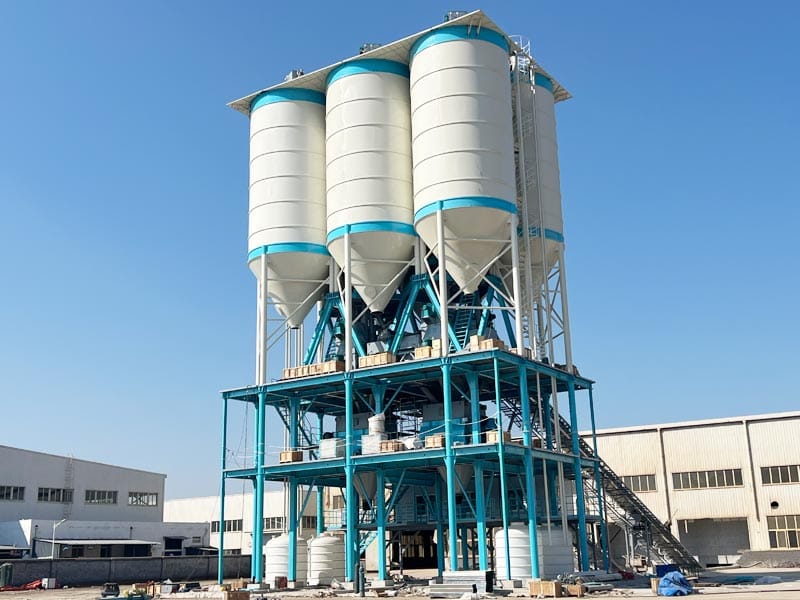
Powder silos occupy land that can otherwise be used for mixer-truck queues, tanker roads or loader movement.
For overhead vs side-mounted silos, draw the full vehicle routes before fixing the silo foundations.
Check whether:
- cement tankers can reach the silos;
- mixer trucks can queue without conflict;
- aggregate loaders can move freely;
- emergency and maintenance vehicles retain access;
- future silos would block traffic.
A silo location that looks efficient in isolation can create a serious yard-layout problem.
Dust Collection Must Be Accessible in Both Layouts
Powder filling and transfer can generate dust, so silo dust collectors and transfer-point controls need both effective placement and service access.
Overhead vs side-mounted silos can change:
- dust-collector elevation;
- filter replacement access;
- duct length;
- inspection platforms;
- collected-material handling.
Do not optimize the plant so tightly that filters become difficult to inspect or replace.
Our panduan desain lingkungan batching plant covers dust-control planning in more detail.
Side-Mounted Silos Can Make Individual Equipment Isolation Easier
When silos are arranged independently beside the main building, each unit may be easier to isolate physically for service or modification.
This can be useful when the plant handles several powder materials.
For overhead vs side-mounted silos, ask how one silo can be taken out of service without affecting:
- adjacent silos;
- penimbangan bubuk;
- truck access;
- main building maintenance;
- other active recipes.
The exact answer depends on the final piping and conveyor layout, but the question should be asked during engineering.
Overhead Silos Can Reduce Powder Conveyor Length
When powder storage is positioned vertically closer to the weighing system, the plant may need less long-distance mechanical transfer.
This can simplify some powder-handling routes.
However, overhead vs side-mounted silos should not be reduced to “short screw conveyor versus long screw conveyor.”
The full comparison also includes:
- tinggi struktur;
- foundation load;
- access platforms;
- tanker filling routes;
- future expansion;
- construction complexity.
The most compact powder path is not automatically the best overall plant.
Wind and Weather Exposure Deserve Review
Elevated silo structures can experience significant wind exposure.
Side-mounted silos can also be exposed, especially on open sites, but the overall structural geometry differs.
For overhead vs side-mounted silos, provide local:
- design wind conditions;
- temperature range;
- snow or ice requirements where applicable;
- corrosion environment;
- seismic data where required.
These conditions influence structural engineering, enclosure, access and maintenance planning.
Do Not Compare Silo Layout Without Comparing the Whole Plant
The silo decision interacts with aggregate feeding, truck roads, plant height and maintenance.
A useful comparison should therefore include the full configuration.
| Kondisi proyek | Overhead layout may suit when | Side-mounted layout may suit when |
|---|---|---|
| Ground space | Horizontal area is highly constrained | More side area is available |
| Height | Higher structure is acceptable | Lower central profile is preferred |
| Powder transfer | Vertical concentration is desirable | Longer side transfer is acceptable |
| Maintenance | Elevated access can be supported | Distributed access is preferred |
| Ekspansi | Future structural provisions are planned | Additional ground area can be reserved |
This table is a planning framework, not a universal rule.
Belt-Fed Plants Show the Silo Difference Clearly
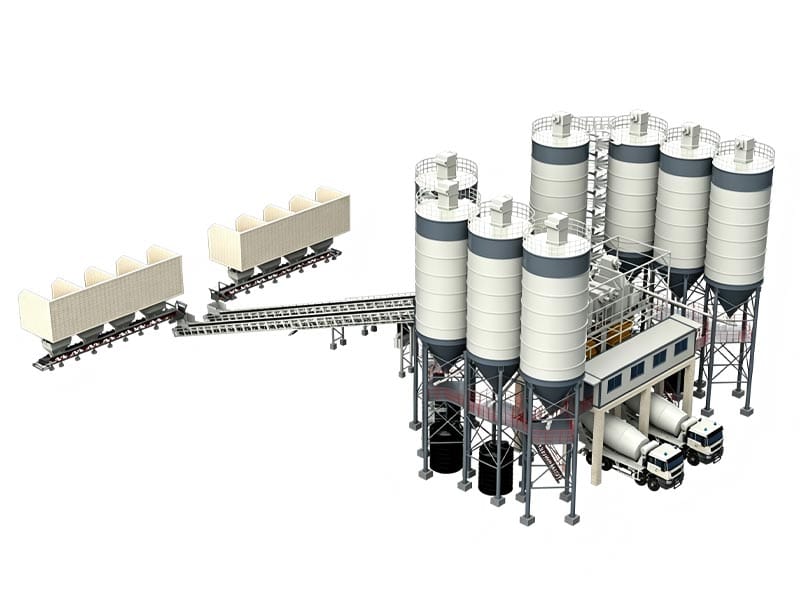
Our overhead belt and side-mounted belt plants are useful examples because aggregate feeding remains belt-based while silo arrangement changes.
This allows buyers to isolate the effect of overhead vs side-mounted silos from the separate question of aggregate feeding method.
The side-mounted belt plant uses independently arranged powder silos beside the main building and continuous aggregate transfer by flat and inclined belts.
The overhead belt plant retains the belt-fed aggregate concept while concentrating powder storage vertically above the main mixing structure.
That makes these two configurations a more meaningful comparison than comparing one belt-fed plant with one skip-hoist plant.
Skip-Hoist Plants Use the Same Silo Classification Logic
The same overhead vs side-mounted silos distinction also applies to skip-hoist plants.
Our pabrik pencampuran beton ember di atas kepala positions cement, fly ash and other powder silos above the main building, while the pabrik pencampuran beton ember yang dipasang di samping places them beside the main building.
Both use intermittent skip-hoist aggregate lifting.
This confirms that silo position and aggregate transfer are independent design choices.
What Should Buyers Send for Silo Layout Selection?
A useful overhead vs side-mounted silos review needs real site information.
Menyediakan:
- dimensi properti;
- maximum structure height;
- jumlah bahan bubuk;
- required silo storage;
- cement tanker access;
- aggregate feeding preference;
- mixer-truck routes;
- maintenance requirements;
- foundation or geotechnical information where available;
- future silo expansion plan.
Our solusi produksi yang disesuaikan can compare different arrangements against these project conditions.
Send your site drawing and powder-storage requirements through our halaman kontak for a project-specific layout review.
Kesimpulan
Overhead vs side-mounted silos is a site-layout and powder-handling decision, not an aggregate-feeding classification.
Overhead silos can reduce the central horizontal footprint and shorten some powder-transfer routes, but they increase vertical structural and maintenance requirements. Side-mounted silos use more ground area but can simplify ground-level access, tanker logistics and future expansion.
The right choice depends on the whole project: site dimensions, height restrictions, powder materials, vehicle routes, maintenance, foundations and long-term expansion. Compare the complete plant layout before fixing the silo position.
FAQ
What is the difference between overhead and side-mounted silos?
Overhead silos are positioned above or vertically integrated with the main mixing structure. Side-mounted silos stand independently beside the main building. The difference mainly affects footprint, height, powder transfer and maintenance access.
Does an overhead silo plant always use belt conveyors?
No. Silo position and aggregate feeding are separate design choices. MixingPlantPro offers overhead silo configurations with both belt-fed and skip-hoist aggregate systems.
Are side-mounted silos easier to maintain?
They can simplify access to some silo-bottom and transfer components because the equipment is distributed beside the plant. The actual maintenance advantage depends on the final layout and access design.
Which silo layout uses less land?
An overhead arrangement generally concentrates more equipment vertically and can reduce the central horizontal footprint. However, the complete site still needs space for tanker access, truck circulation, maintenance and environmental controls.
What information is needed to choose between overhead and side-mounted silos?
Provide site dimensions, height limits, powder-material count, silo storage requirements, tanker access, aggregate feeding method, truck routes, maintenance needs and future expansion plans.


