
Dry mortar plant types are usually compared by height, footprint and hourly output. Those features matter, but they leave out a more revealing question: what happens when your production schedule changes from a long run of masonry mortar to several smaller batches of tile adhesive?
The answer lies in material routes, ingredient dosing, cleaning access and packing arrangements. A layout that suits one product range may become awkward when another binder, sand grade or packaging format enters the schedule.
This guide compares dry mortar plant types through those production decisions, helping you choose between tower, step and workshop layouts without treating the largest structure as the automatic winner.
目次
What Are the Main Dry Mortar Plant Types?
The three layouts considered here are tower, step and workshop. A tower concentrates the process vertically. A step arrangement combines elevated stages with mechanical conveying. A workshop arrangement distributes the equipment within a factory building. Our 乾式モルタル製造ソリューション cover all three configurations.
These labels describe equipment arrangement, not separate mortar chemistries or guaranteed automation levels. Establish the material flow first, then specify controls and operating duties.
Also distinguish dry mortar from ready-to-use wet mortar. The mortar industry’s guidance on factory-produced silo mortar describes a premixed combination of dried sand, cement and other specified ingredients, with water added during preparation for use. The manufacturing line discussed here produces the dry blend, not wet mortar for immediate placement.
Tower, Step and Workshop Layouts Compared
Use this comparison of dry mortar plant types to develop a shortlist. The final choice still requires a configuration drawing and a production review.
| Layout | Typical material arrangement | When to consider it | Resolve before approval |
|---|---|---|---|
| Tower | Elevated storage with a largely downward process route | A permanent facility where vertical integration fits the production plan | Structural loads, storage replenishment, elevated access and discharge routes |
| Step | Staged equipment combining gravity flow and mechanical transfers | A site requiring a balance between installation height and layout flexibility | Transfer capacity, intermediate storage and space for modifications |
| Workshop | Equipment distributed within a workshop, connected by conveying systems | An existing building or a specialty-product operation | Clear height, floor loading, material segregation and packing space |
Capacity and product suitability overlap across these arrangements. Do not assign a universal output ceiling or a fixed product list to a layout name.
Tower Layout: Organize Production Around Gravity
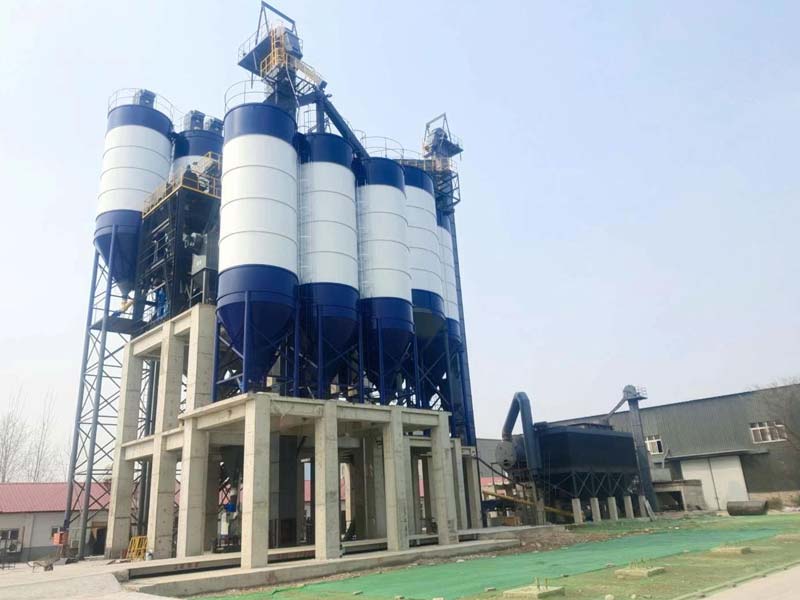
Among dry mortar plant types, the tower uses the most concentrated vertical arrangement. A タワー型乾式モルタル混合プラント routes materials downward through batching, mixing, intermediate storage and packaging after they reach the elevated storage system.
The practical attraction is a coherent material path. Review it on a process drawing: identify how each silo is replenished, where ingredients are weighed, and which outlet receives each finished blend.
Gravity does not remove the need for controlled discharge. Request confirmation that the proposed bins and outlets suit the actual materials. Include access for inspecting valves, replacing weighing components and removing major equipment.
Tower-based dry mortar plant types deserve consideration for a permanent installation with a defined product program. However, assess the whole site, not only the tower footprint. Deliveries, finished-goods storage and maintenance lifting zones still need working space.
Step Layout: Balance Height and Material Transfer
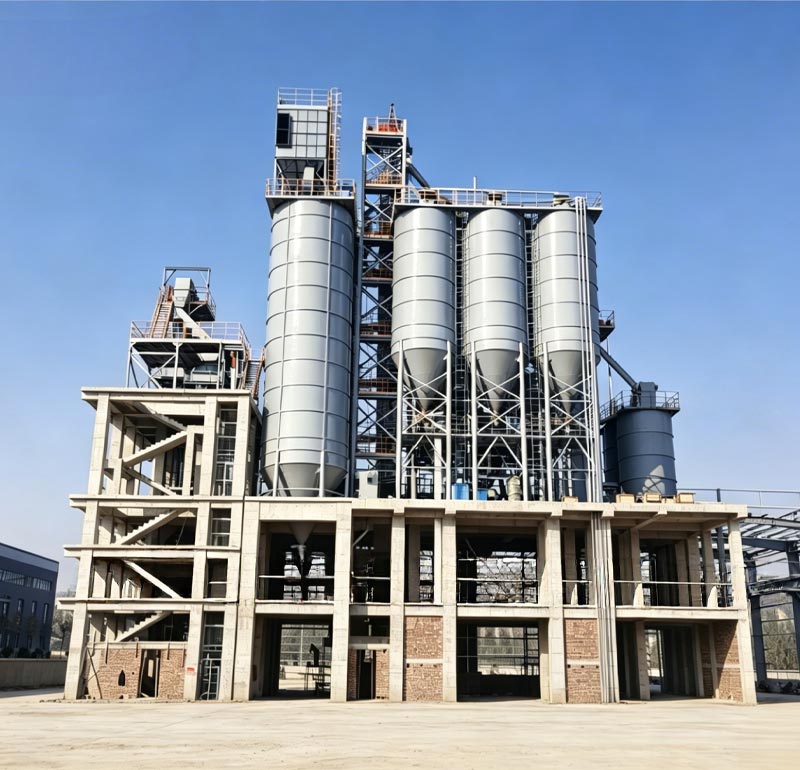
Step configurations sit between fully vertical and more horizontally distributed dry mortar plant types. The ステップ式乾式モルタル混合プラント combines platforms at different elevations with gravity flow and mechanical conveying.
This arrangement is worth evaluating when site height is constrained or the production plan requires room for later changes. Its usefulness depends on the proposed routes, not simply on being lower than a tower.
Follow one complete batch through every transfer. Establish whether an intermediate hopper holds a full batch, whether ingredient preparation overlaps mixing, and what happens when the next stage is unavailable.
When comparing dry mortar plant types, count transfer duties rather than assuming that all step layouts use the same number of lifts. A clear sequence diagram will reveal where equipment must wait and where additional storage could help.
Workshop Layout: Fit the Line Around the Building
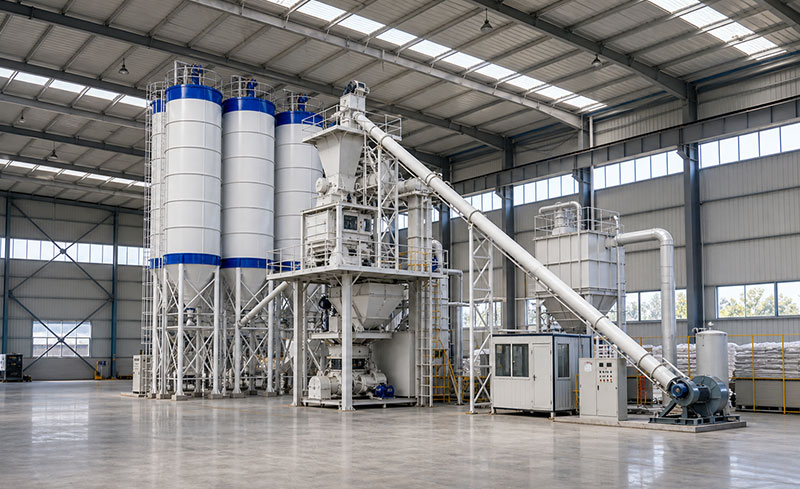
Workshop configurations bring dry mortar plant types into the context of an existing factory. Our ワークショップタイプのドライモルタル混合プラント uses a distributed arrangement connected by screw conveyors and is intended for applications including putty powder, tile adhesive and gypsum-based mortar.
Begin with a measured building survey. Check usable height below beams and services, door openings, column positions and the space available for material delivery. Have the proposed equipment loads checked against the building design.
Installation height is only part of the review. The drawing should accommodate ingredient storage, bag opening, quality-control sampling, packing and pallet movement without forcing unrelated activities into the same aisle.
Workshop-based dry mortar plant types should not be selected merely because the mixer fits inside. Confirm that the complete operation fits, including access to withdraw screws, service drives and move replacement components.
Start with the Mortar Products, Not the Plant Model
Product requirements are a useful first filter for dry mortar plant types. Prepare a product matrix showing each binder system, required sand grades, small-ingredient range, planned batch size and packaging format.
Conventional masonry and rendering mortars
For these products, establish the aggregate specifications and the performance tests used to release production. The mortar testing guidance from MPA Mortar explains how changes in sand grading can affect water demand and fresh mortar behavior. Layout selection cannot compensate for uncontrolled incoming materials.
Tile adhesives and other specialty powders
Define the intended finished-product requirements before specifying the equipment. ISO 13007-1 on ceramic tile adhesives sets out product performance requirements; a plant layout does not itself demonstrate that an adhesive meets them.
Here, tile adhesive production means dry cementitious powder. Do not assume that the same dry blending line also manufactures ready-to-use dispersion or reaction-resin adhesives. For specialty products, evaluate dosing, mixing trials and changeover arrangements alongside throughput.
Match Sand Preparation to the Material You Receive
Comparisons of dry mortar plant types often start at the ingredient silo. Start earlier: what condition is the sand in when it arrives?
When buying dried, graded sand, define delivery acceptance checks, storage protection and how different fractions remain identifiable. When receiving damp or unclassified material, establish where drying and grading will occur before it enters the dry blending process. Do not assume that these preparation systems are included with every mixing plant.
Agree the required moisture condition, grading and acceptable temperature at the storage inlet. Put sampling points on the process drawing and define what happens to material that fails incoming checks.
All dry mortar plant types need a clear boundary between raw-material preparation and mortar manufacture. Otherwise, two apparently comparable proposals may cover different parts of the production chain.
Specify Small-Ingredient Dosing Separately
When evaluating dry mortar plant types for specialty products, separate the major-material weighing duty from the smallest additive dose. One overall batch-accuracy figure can conceal an important difference.
Consider a hypothetical 1,000 kg batch containing a 2 kg additive dose. A 20 g dosing deviation equals 1% of that additive quantity, but only 0.002% of the total batch. These are illustrative arithmetic values, not equipment tolerances or recommended acceptance limits.
The example explains why the denominator matters. Specify the intended dose range, measurement basis and verification method for each ingredient. Check repeatability at the smallest working dose, not only near maximum scale capacity.
For all dry mortar plant types, the handoff from weighing to mixing also needs attention. Establish how the system confirms that the measured quantity reaches the mixer and how an incomplete addition is recorded and resolved.
Follow the Mix All the Way to the Bag
A useful comparison of dry mortar plant types continues beyond the mixer. Finished powder may pass through a receiving hopper, transfer equipment and intermediate storage before packing.
Research on powder segregation during silo filling and discharge identifies particle properties, free-fall distance and silo geometry as relevant variables. A blend that is uniform at mixer discharge should therefore also be checked after subsequent handling.
Agree a sampling plan that covers the beginning, middle and end of a production run, including material leaving intermediate storage. Use tests appropriate to the product rather than relying on one conveniently collected mixer sample.
For specialty dry mortar plant types, this makes the packing route part of the quality review. Discuss how the proposed layout limits unnecessary handling and how trials will establish whether the final packaged product remains consistent.
Design for Product Changeovers, Not Just Long Runs
Frequent recipe changes can alter the choice between dry mortar plant types. Compare the time and work needed to move from the last acceptable bag of one product to the first acceptable bag of the next.
Mark shared equipment on the drawing: ingredient feeders, weighing hoppers, mixer, finished-product storage and packer. Then identify where residual material can remain and how operators can inspect those locations.
For a proposed line handling different binder systems or colors, review material compatibility and residual carryover with the formulation team. Decide whether dedicated routes are needed. Do not treat an automatic recipe change as proof that the physical line is ready.
Consider a hypothetical schedule alternating gray masonry mortar and a pale finishing powder. Review which shared surfaces need inspection before the pale product starts, where remaining gray material will go, and how the first packaged output will be checked. Then repeat the review in the opposite direction. The two transitions may need different procedures; counting both as an identical recipe change would hide that distinction in the production plan.
Put the changeover sequence into the trial plan. Include cleaning, inspection, verification samples and release of the next product. A flexible production line is one with a demonstrated transition procedure, not simply a long recipe list on its control screen.
Read Capacity Figures Against the Production Schedule
Published output alone is not enough to compare dry mortar plant types. Request an expected production schedule for representative products using the intended batch size, ingredient sequence and packing format.
The complete repeat cycle includes preparing ingredients, charging, mixing and discharging. Some activities may overlap; others may wait. Ask for those assumptions to be shown rather than calculating hourly output from mixing time alone.
For bagged products, translate the proposed tonnage into the required bags per hour and check the downstream handling arrangement. A mixer cannot keep discharging indefinitely into a storage hopper when packing removes material more slowly.
Compare dry mortar plant types over a realistic shift as well as during uninterrupted operation. Include planned changeovers, refilling and product-release activities. Distinguish material processed from acceptable finished product available for dispatch.
Keep Dust Extraction and Service Access in the Drawing
Across dry mortar plant types, include dust-control review at ingredient charging, transfer points and packing. Treat each operating task separately rather than accepting a general claim that the line is enclosed.
The HSE’s guidance on commissioning local exhaust ventilation calls for performance verification under defined operating conditions. Apply that principle to the proposed installation: identify the substances handled, emission points, extraction arrangement and evidence needed to confirm effective control.
Maintenance also needs planned space. Show access to filters, motors, weighing assemblies and inspection openings. Discuss isolation and safe access with the responsible engineers. A component shown on a drawing is not necessarily accessible once surrounding machinery and stock are in place.
How to Compare Proposals Before Choosing a Layout

To compare dry mortar plant types fairly, give each proposed configuration the same operating brief. Include the product matrix, raw-material specifications, production schedule, site drawing and packing requirements.
Request a customized plant layout and configuration review that identifies equipment scope, material routes, interfaces and assumptions. Separate confirmed requirements from conditions still needing tests.
The acceptance plan should address ingredient dosing, representative batch performance, changeovers, packed-product consistency and production records. Define which checks can be completed before delivery and which require the installed line and your materials.
During the control-system demonstration, trace a sample batch from the selected recipe through ingredient targets, recorded additions and finished-product identification. Test how an authorized correction is documented and how the system handles an interrupted batch. Agree who may edit recipes, who releases a changed formulation and what information remains available for investigation. These are requirements to specify and demonstrate, not capabilities to assume from the word “automatic.”
Finally, distinguish installed features from possible future additions. Spare floor area is not the same as a provisioned material connection or available control capacity. Written interfaces make later expansion easier to evaluate.
結論
The right choice among dry mortar plant types follows the product range and material flow. Tower, step and workshop arrangements each offer a different way to organize production; none replaces accurate dosing, controlled handling or a workable changeover plan.
Send MixingPlantPro your mortar product list, raw-material information, target output and available building dimensions. Contact our team for a dry mortar line configuration review based on the products you intend to manufacture.
よくある質問
What are the main dry mortar plant types?
Tower, step and workshop layouts are the three configurations covered here. They differ primarily in equipment arrangement and material transfer. Automation, capacity and product suitability must be established for the actual configuration rather than inferred from its name.
Is a tower layout always the best choice for high output?
No. Compare the complete process under the same product and operating conditions. Ingredient supply, mixing, storage, packing and changeovers all belong in the assessment. A tower layout is not, by itself, proof of a particular production rate.
Can a workshop plant manufacture tile adhesive?
Yes, a suitably configured workshop line can manufacture dry cementitious tile adhesive. Confirm the raw-material requirements, additive dosing, mixing performance and packaging arrangement. Product testing remains necessary; equipment selection alone does not establish the adhesive’s performance classification.
Does every dry mortar plant need a sand dryer?
Not necessarily within its supply scope. A line receiving suitable dried and graded sand may not need an on-site dryer. When the incoming sand does not meet the required condition, preparation must be arranged before dry blending.
What information is needed to select a suitable layout?
Provide the mortar product range, ingredient specifications, smallest and largest batches, expected shift schedule, packing formats and site dimensions. Include relocation or expansion plans. These details are more useful than an hourly capacity target alone.

