
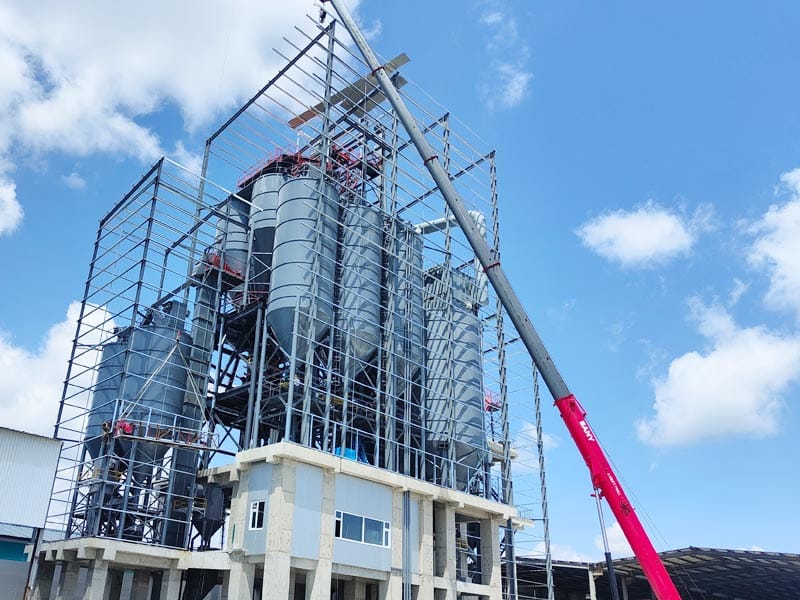
Manufactured vs natural sand is not a simple quality comparison for dry mortar production. Natural sand can offer smoother particles and familiar workability, while manufactured sand gives producers more direct control over crushing, grading and powder content. Either material can perform well—or poorly—depending on its source, particle distribution, fines, moisture and the mortar formulation.
For dry mortar manufacturers, the useful question is not “Which sand is better?” It is “Which sand can be supplied consistently, meet the product specification and fit the production line without forcing unstable recipe corrections?”
Nosso linha de produção de areia fabricada e planta integrada de areia manufaturada e argamassa especial are designed for projects that want to control sand preparation before dry mortar production. This guide explains how to compare manufactured vs natural sand from the viewpoint of mortar performance and plant design.
What Is the Real Difference Between Manufactured and Natural Sand?

Natural sand is produced by geological weathering and erosion, then collected from approved deposits or other natural sources. Manufactured sand is produced by mechanically crushing and classifying suitable rock.
The manufacturing route creates several practical differences. Natural sand particles are often smoother and more rounded because they have been transported and weathered over time. Manufactured sand particles are usually more angular and have rougher surfaces, although actual shape depends strongly on the parent rock and crushing process.
Research comparing natural and manufactured sands in mortar has shown that particle shape, surface texture and void structure can influence mortar flow and mechanical behavior even when grading is controlled. A widely cited study in Cement and Concrete Research found that manufactured and natural sands with the same grading could still produce different rheological behavior because aggregate shape changes packing and paste demand.
For manufactured vs natural sand selection, origin matters—but origin alone does not determine suitability.
Start with the Mortar Product, Not the Sand Label
Different dry mortar products place different demands on fine aggregate. A sand suitable for masonry mortar may not automatically be ideal for tile adhesive, repair mortar or self-leveling products.
| Dry mortar product | Sand-related property to define | Por que isso importa |
|---|---|---|
| Argamassa alvenaria | Approved grading and deleterious-material limits | Influences workability, strength and bond |
| Reboco ou reboco de argamassa | Maximum size, grading and surface texture | Affects finishing behavior and water demand |
| Tile adhesive | Controlled fine grading and powder fraction | Must fit the validated adhesive formulation |
| Self-leveling mortar | Narrow grading and fine-particle control | Supports flow and segregation control |
| Repair mortar | Application-specific grading and material quality | Supports thickness, placement and hardened performance |
ASTM C144, for example, addresses natural and manufactured aggregates used in masonry mortar. It recognizes both material routes rather than treating one as inherently superior. See the current ASTM C144 specification scope.
Manufactured vs natural sand should therefore be judged against the actual mortar product and test program.
Grading Matters More Than Whether the Sand Is Natural or Manufactured
One of the strongest controls in dry mortar production is particle-size distribution. A sand with an unsuitable grading can create poor packing, unstable workability or unnecessary binder demand regardless of whether it is natural or manufactured.
For manufactured vs natural sand comparison, request complete sieve results rather than a single maximum particle size or fineness modulus.
A corrente ASTM C136/C136M sieve-analysis method is one common way to determine particle-size distribution. For dry mortar producers, the important point is practical: compare the whole grading curve.
Two sands can share a similar fineness modulus while distributing particles differently across key sieve sizes. That difference can matter when a formulation depends on a specific combination of coarse, medium and fine particles.
Manufactured vs natural sand selection should therefore begin with grading consistency over time, not one favorable sample.
Particle Shape Changes Water and Paste Demand
Particle shape is one of the most visible differences in manufactured vs natural sand.
Natural sand often contains smoother and more rounded grains. Manufactured sand is often more angular and rougher. Angularity can increase interparticle friction and void content, which may increase the amount of paste or water needed to achieve the same mortar flow.
The comparative mortar research by Cortes and co-authors showed that flow behavior was strongly related to particle shape and loose packing. The same nominal grading did not eliminate the effect of aggregate geometry.
This does not mean manufactured sand automatically needs an unacceptable amount of water. Good grading and controlled fines can improve packing, and the formulation can be designed around the actual aggregate.
For manufactured vs natural sand, the correct approach is to run mortar trials at the intended formulation rather than adjusting water by intuition.
Rougher Manufactured Sand Can Improve Mechanical Interlock
Manufactured sand can also offer advantages. Angular particles and rougher surfaces can increase mechanical interlock and change the aggregate-paste interface.
Recent research on different manufactured-sand parent rocks found that lithology and surface characteristics significantly affected mortar strength. The study reported that rougher, sharper aggregate surfaces could improve strength under the tested conditions. See the 2023 study on manufactured-sand lithology and mortar strength.
However, these results should not be generalized into a claim that manufactured sand always produces stronger mortar. Parent rock, grading, void structure, binder system and water demand all interact.
The manufactured vs natural sand decision should therefore use the actual product test results, not a broad assumption about angular particles.
Stone Powder and Clay Are Not the Same Thing
Fine particles are often one of the biggest concerns in manufactured vs natural sand comparison.
Manufactured sand can contain stone powder generated by crushing. Natural sand can contain silt, clay or other fine contaminants depending on the source and washing process.
These materials should not be treated as equivalent simply because they pass the same fine sieve. Fine mineral powder produced from sound parent rock can behave differently from active clay minerals.
ASTM C117 determines material finer than the 75 μm sieve by washing and is commonly used alongside grading tests. See the current ASTM C117 scope.
For manufactured vs natural sand, the production team should define both the amount of fine material and whether that fine fraction is acceptable for the intended mortar.
Manufactured Sand Gives the Producer More Process Control
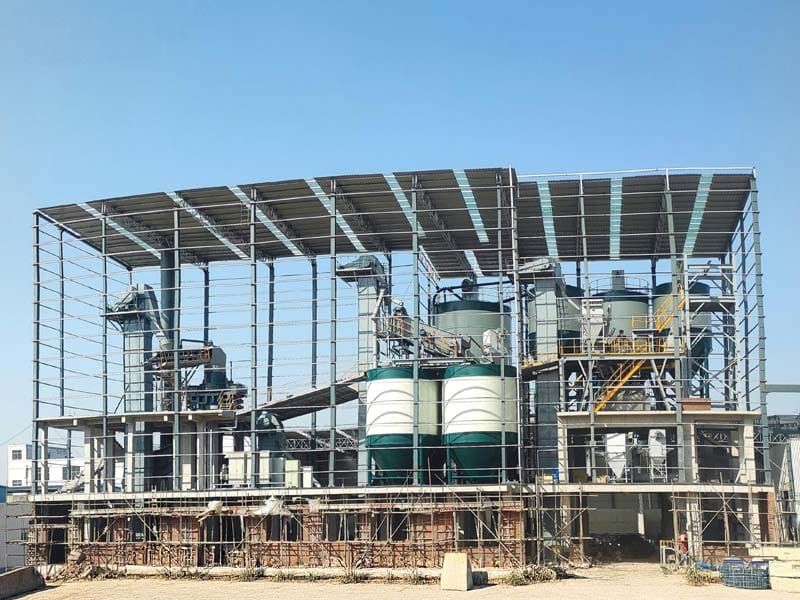
One practical advantage of manufactured sand is that the producer can adjust the crushing, screening and classification process.
Our integrated sand and mortar line combines manufactured-sand preparation with dry mortar production and allows the sand-making section to control grading, fineness modulus and powder content within the equipment’s published operating range.
This means a dry mortar producer can potentially control the upstream aggregate rather than relying entirely on a purchased natural-sand source.
However, that control only has value when the plant is operated against a defined target. An adjustable classifier does not automatically create the right sand; the mortar laboratory still needs to define the acceptable grading and fines condition.
For manufactured vs natural sand, manufactured sand offers more direct process control, while natural sand may require more supplier qualification and incoming inspection.
Natural Sand Can Offer Simpler Processing When the Source Is Stable
Natural sand can be a strong option when a qualified, consistent source already meets the mortar specification.
If the sand arrives with acceptable grading, moisture and cleanliness, the dry mortar plant may not need a dedicated crushing and classification section. That can simplify the upstream process.
The challenge is source variability. Changes in deposit, seasonal water conditions, washing practice or blending can alter the material entering the factory.
For manufactured vs natural sand, the buyer should therefore compare not only the average laboratory result but also the supply system:
- How consistent is the source?
- How often is grading tested?
- How is clay or silt controlled?
- How is moisture managed?
- Can the supplier maintain the same material over the product lifecycle?
A naturally occurring sand can be excellent, but it still needs production control.
Moisture Control Is Different for the Two Supply Routes
Dry mortar production needs dry aggregate. Moisture is therefore a major issue in manufactured vs natural sand planning.
Natural sand often arrives with variable moisture depending on extraction, washing, storage and weather. Manufactured sand may also be wet if the upstream process uses washing or if the stockpile is exposed.
For either material, the dry mortar line should define the maximum acceptable moisture entering storage and mixing.
If drying is required, the dryer should be sized around the real moisture load rather than only the mass throughput. A sand arriving at 6% moisture creates a different drying duty from the same sand arriving at 2%.
Manufactured vs natural sand does not remove the need for moisture management. The better material is the one whose moisture condition can be controlled consistently within the production plan.
One Sand Source May Not Fit Every Mortar Product
A factory producing several dry mortar families should not assume one sand can serve every formula unchanged.
Tile adhesive may use a different particle distribution from masonry mortar. Self-leveling mortar may need tighter control of fine fractions. Repair mortar may require another maximum size.
This is where manufactured vs natural sand becomes a production-system question rather than a material-only question.
A natural sand source may need screening into separate fractions. Manufactured sand can be produced and classified into controlled fractions upstream. In either case, the mortar plant needs enough storage bins to keep the required fractions separate.
Nosso planta integrada de areia manufaturada e argamassa especial is designed around this type of link between sand preparation and special mortar production.
Compare Sand by Void Content and Packing, Not Only Shape
Particle shape affects mortar partly because it changes how densely the aggregate packs.
A well-graded manufactured sand can sometimes achieve efficient packing despite its angular shape. A poorly graded natural sand can contain more void space than expected despite smoother particles.
Research comparing natural and manufactured sands showed that mortar flow and strength were strongly related to the balance between paste volume and aggregate void space.
For manufactured vs natural sand evaluation, consider bulk density, void content and grading together.
This is especially useful when one material appears to require more binder or water than another. The cause may be packing rather than simply the label “manufactured” or “natural.”
Do Not Ignore Parent Rock in Manufactured Sand
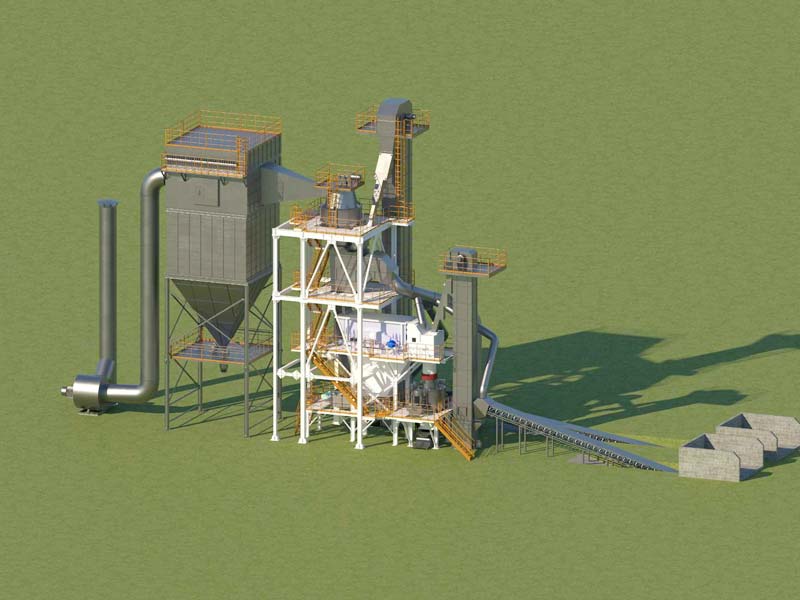
Manufactured sand inherits mineralogical and mechanical characteristics from the parent rock.
Limestone, granite, basalt and other sources can produce different particle shapes, absorption and surface characteristics after crushing.
The 2023 lithology study on manufactured sand found that parent-rock characteristics significantly affected mortar behavior. That reinforces an important manufactured vs natural sand principle: manufactured sand is not one uniform material category.
Nosso linha de produção de areia fabricada is designed to process several rock types, but final suitability still needs to be confirmed for the actual source and downstream mortar.
When evaluating manufactured sand, record the quarry or feed source alongside grading and product-test results.
Natural Sand Also Needs Source Qualification
Natural sand can vary by deposit just as manufactured sand can vary by parent rock.
For manufactured vs natural sand, do not treat natural sand as the neutral benchmark that never changes.
Source qualification should consider:
- grading;
- fines;
- clay or deleterious material;
- mineral composition;
- moisture variation;
- seasonal changes;
- supplier blending practices.
If the natural-sand source changes, repeat the relevant validation before assuming the existing mortar formulation will behave identically.
Run Side-by-Side Mortar Trials Before Changing Sand Type
The strongest manufactured vs natural sand decision comes from side-by-side testing using the intended mortar formula.
Keep the binder system, additives and testing procedure consistent so the sand effect can be interpreted clearly.
Comparar:
| Trial result | Por que isso importa |
|---|---|
| Dry bulk density | Shows packing differences in the dry blend |
| Water demand | Shows how the sand affects workable consistency |
| Fresh flow or workability | Relates directly to application behavior |
| Segregation or bleeding | Shows fresh stability |
| Strength | Confirms hardened performance |
| Bond or product-specific tests | Confirms suitability for the intended mortar |
A 2021 study comparing mortar made with manufactured and alternative natural sands showed that aggregate angularity and surface texture significantly influenced mortar properties. This reinforces the need for performance testing rather than assumptions based on source type alone.
Compare Production Consistency, Not Just One Laboratory Result
One successful laboratory test is not enough for a long-term manufactured vs natural sand decision.
The production team should ask whether the material can remain within specification across weeks and seasons.
For natural sand, monitor incoming grading and moisture from the supplier. For manufactured sand, monitor feed rock, crusher settings, screen condition, classifier settings and finished-sand grading.
Build control charts or trend records for the variables that matter most to the mortar formulation.
The better sand source is often the one the factory can control and reproduce, even if both materials achieve similar laboratory performance in a one-time trial. That is why manufactured vs natural sand should be judged over repeated production, not one sample.
Manufactured Sand Can Support Integrated Quality Control
An integrated sand-and-mortar plant can connect upstream aggregate control directly with downstream mortar production.
Our integrated line allows manufactured sand preparation, classification, storage, batching and mortar mixing to be planned as one material flow. That can reduce the gap between sand production and mortar quality control.
For example, if one sand fraction begins drifting coarse, the production team can identify the upstream process variable before the mortar plant consumes large quantities of off-target material.
This does not mean integration automatically guarantees better mortar. The plant still needs testing, control limits and operator procedures.
For manufactured vs natural sand, integration is an advantage only when it creates better control of the properties the mortar actually needs.
Natural Sand May Still Be the Better Choice for Some Projects
There are projects where natural sand remains the more practical option.
If a reliable local source already meets the product specification, is available in stable quantities and requires minimal preparation, adding a manufactured-sand line may not be necessary.
Manufactured vs natural sand should therefore include:
- material quality;
- source reliability;
- grading consistency;
- moisture control;
- required processing;
- product portfolio;
- available site and equipment.
This is a technical selection, not a rule that every modern dry mortar factory must replace natural sand. A sound manufactured vs natural sand decision should reflect the actual product portfolio and supply conditions.
When Manufactured Sand Becomes More Attractive
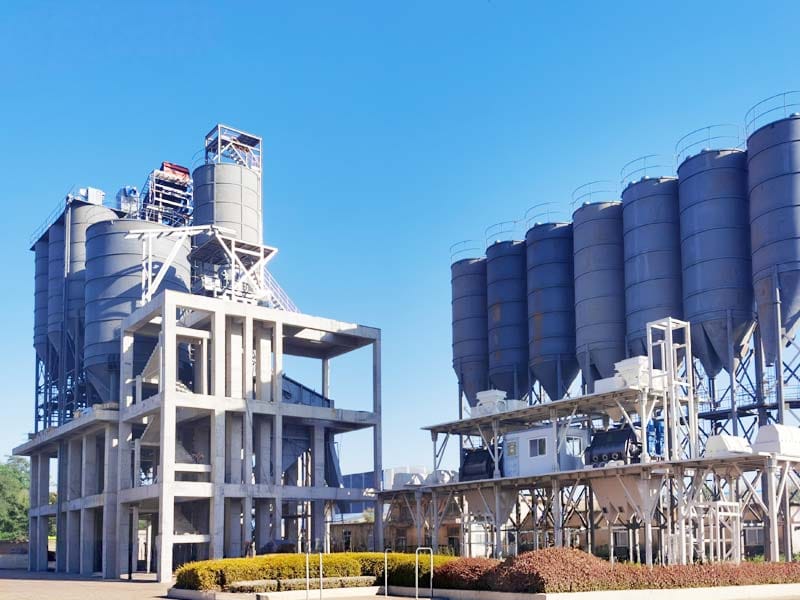
Manufactured sand can become more attractive when the factory needs tighter control of grading, several classified fractions, stable integration with special mortar production or independence from a variable natural-sand source.
It can also be useful when suitable crushed-rock feed is available near the factory and the project is large enough to justify integrated processing.
For manufactured vs natural sand, ask whether in-house sand production solves a real production problem. If it improves grading control, source security or product consistency, the added upstream process may have clear technical value.
Nosso soluções de areia fabricadas can be configured around raw material characteristics, target sand specifications and site conditions.
What Should Buyers Send for a Sand and Mortar Line Review?
A useful manufactured vs natural sand comparison needs data from both materials.
Fornecer:
- sieve analysis for natural and manufactured sand candidates;
- fines and clay-related test results;
- faixa de umidade;
- bulk density or packing data where available;
- manufactured-sand parent rock;
- natural-sand source information;
- planned mortar products;
- required sand fractions;
- target production rate;
- site conditions and available space.
For manufactured sand, also provide the feed-rock size and upstream crushing condition. For natural sand, provide supplier consistency data if available.
Nosso soluções de produção de argamassa seca can then be reviewed together with the sand-supply strategy.
Envie as informações do projeto através do nosso página contato for a material and production-line review.
Conclusão
Manufactured vs natural sand is not a contest with one universal winner. Natural sand can offer smooth particles and a simple supply route when the source is stable. Manufactured sand can provide stronger control over grading, powder content and integration with dry mortar production.
The right choice depends on the mortar product, sand grading, fines quality, particle shape, parent material, moisture, supply consistency and the production system available to control those variables. In practice, manufactured vs natural sand is a process-control decision as much as a material choice.
Compare both materials through representative mortar trials and long-term supply data. The best sand is the one that helps the factory reproduce the approved mortar consistently—not the one with the more familiar name.
Perguntas frequentes
Is manufactured sand better than natural sand for dry mortar?
Not automatically. Manufactured sand can offer controlled grading and powder content, while natural sand may provide smoother particles and simpler processing. The correct choice depends on the mortar formulation and the consistency of the actual sand source.
Does manufactured sand require more water than natural sand?
It can, especially when particles are more angular or the void content is higher, but grading and fines also influence water demand. The effect should be measured in the actual mortar formulation rather than assumed from sand type alone.
Can manufactured sand replace natural sand completely in dry mortar?
Potentially, if the manufactured sand meets the required grading, fines, cleanliness and product-performance criteria. The replacement should be validated through laboratory and production trials for the specific mortar.
Why can natural sand vary between deliveries?
Natural deposits can vary by source zone, washing, blending, moisture and seasonal conditions. Incoming grading and quality should therefore be monitored even when a supplier has been used for a long time.
What is the main advantage of an integrated manufactured sand and mortar plant?
Integration allows the factory to control sand preparation, classification, storage, batching and mortar mixing as one process. This can improve traceability and make it easier to maintain the sand properties required by specific mortar products.

