Table of Contents
Sand stockpile drainage affects the material arriving at a concrete or mortar plant long after a rainstorm has passed. Water collects unevenly through a pile, drains toward its base and changes as the loader exposes different layers. A single moisture result cannot describe all of those conditions. A useful storage plan combines drainage, pile management, sampling and a clear response when material conditions change.
The objective is not to make every stockpile dry. Concrete producers can work with damp aggregate when moisture is measured and accounted for correctly. A dry mortar operation has a different requirement because its process may need drying and controlled dry storage. In both cases, the storage system should make incoming moisture more predictable and prevent uncontrolled mixing of wet and relatively dry material.
Set sand stockpile drainage requirements for the destination process
Define whether sand will feed concrete batching, a dryer, a grading line or finished dry-sand storage. These destinations tolerate and manage moisture differently. Sand stockpile drainage should support the next process rather than follow a generic yard arrangement. A concrete plant needs representative moisture information, while a dryer also needs a credible range of incoming moisture for its capacity review.
For manufactured sand, record the processing method and the condition at discharge. Wet processing can introduce a different storage challenge from a dry crushing and classification line exposed to rain. Avoid assuming that the phrase “manufactured sand” identifies a single moisture condition. Describe the actual material route from processing to loading, storage and plant feed.
If sand is intended for dry mortar, distinguish outdoor raw-sand stockpiles from protected dried-sand bins. Improving outdoor drainage can reduce variation entering a dryer, but it does not establish that the material is suitable for direct dry mixing. The finished material must meet the production specification, supported by measurement at the relevant process point.
Read the yard as a water-management system
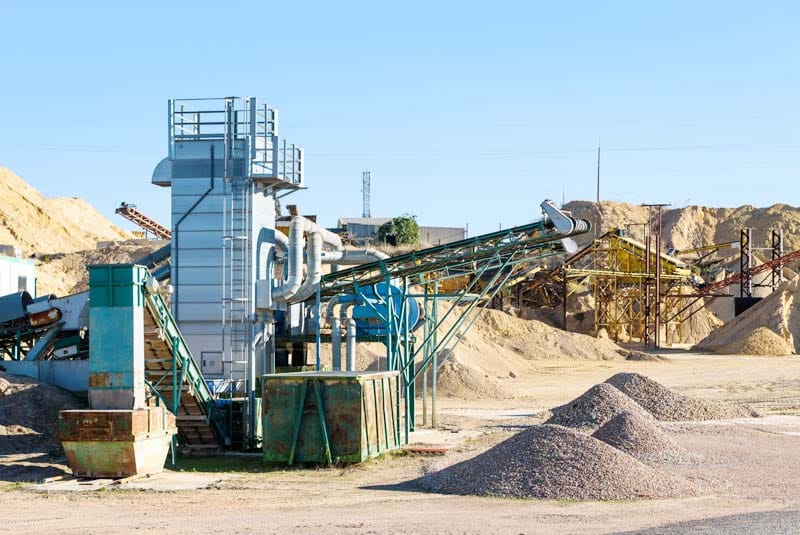
Review the grades of the storage pad, surrounding roads, drains and receiving hoppers. Water arriving from an upstream road can overwhelm an otherwise sensible stockpile arrangement. Sand stockpile drainage needs a site-wide view that includes runoff arriving from outside the pile. A layout should show where water comes from, where it can collect and where it is directed.
The civil designer should consider the foundation, surface condition, drainage route, sediment handling and expected vehicle loading. Avoid prescribing a universal pad slope from a general article. The correct design depends on rainfall conditions, ground characteristics, available discharge arrangements and local requirements. What the buyer can specify is a performance objective: water should not pond beneath the working stockpile or flow uncontrolled into the plant receiving area.
Inspect the yard after rainfall as well as during dry weather. Note ponding, blocked channels, erosion and material washed across compartment boundaries. A drainage drawing describes the intended system. Observations show whether grading, housekeeping and maintenance allow it to perform. Photograph recurring trouble locations so that corrective work is based on a pattern rather than a single complaint.
Separate incoming lots and material fractions
Different fractions and sources should remain identifiable through storage and reclaim. Mixing them casually makes both grading and moisture harder to interpret. Sand stockpile drainage becomes less effective when loaders repeatedly move material across wet ground, drag fines between bays or bury a wet incoming lot beneath a drier one without recording the change.
Use a storage layout that gives the loader room to work without crossing drainage paths unnecessarily. Mark the source, fraction and receiving date where those details matter to production control. The storage system does not need complex software to begin with, but it needs a consistent way to identify which pile supplied a particular production period.
Avoid building a pile in a way that promotes uncontrolled segregation. Stockpiling and reclaim affect grading as well as water distribution. If the base becomes wetter and contains a different fines distribution, a loader moving from the face to the bottom can change several material properties at once. A moisture adjustment alone may not explain the resulting production behavior.
Define the reclaim method
A loader operator should know which face is available for reclaim and which area is held for drainage or inspection. Sand stockpile drainage gains practical value when it is paired with a consistent reclaim method. Random loading from the easiest available corner can defeat attempts to make material condition predictable.
Agree how newly delivered wet material enters production. Depending on the process, the team may need to hold the lot, blend it under a controlled plan or update moisture measurements before release. Do not use an arbitrary waiting time as proof that every pile has drained. Rainfall, pile geometry, particle distribution and the underlying pad all affect the actual outcome.
Where the plant has several feed bins, avoid changing the source behind one bin without notifying the control and quality teams. Record the transition so that a change in moisture or grading can be related to batch records. The aim is a traceable material change, rather than a mysterious shift in mixer consistency or dryer performance.
Compare storage and monitoring measures
| Measure | What it helps control | What it cannot establish alone |
|---|---|---|
| Graded storage pad and maintained drainage | Ponding and uncontrolled surface-water movement | Uniform moisture throughout a pile |
| Covered receiving or storage area | Direct rainfall exposure | Moisture already carried in incoming material |
| Separate bays and lot identification | Mixing of sources or fractions | Suitability of each lot for the end product |
| Consistent loader reclaim | Abrupt changes in the working face | A fixed moisture value without measurement |
| Representative moisture sampling | Material condition at the sampling point | Future conditions after rain or a source change |
| Calibrated process moisture measurement | Faster observation of changes during operation | Validity outside its calibration and application range |
These measures work together. Sand stockpile drainage should not be sold internally as a substitute for moisture control, nor should a sensor be treated as a substitute for a well-managed yard. A practical project review identifies the role and limitation of each measure, then connects the observations to an operating decision.
Sample where the decision is made
A sample from the top of a stockpile may differ from the material entering the feed hopper. Define the sampling point according to the decision being made. A receiving inspection evaluates an incoming lot. A feed sample supports the production condition. A dryer outlet sample checks the result of drying. Confusing these points can create apparently contradictory results that actually describe different material states.
Use an appropriate sampling and moisture-test procedure for the intended application. Keep the method, basis of reporting and timing consistent. Sand stockpile drainage records are more useful when they include the weather, source, reclaim location and process status alongside the test result. Without that context, a sequence of percentages may be difficult to interpret.
When comparing a sensor with a reference test, ensure the observations describe comparable material and time. Material delay between the sensor and the sampling point can matter during a source transition. Investigate differences with the equipment provider and quality team rather than changing calibration to make an unrelated sample match.
Connect moisture to dryer performance
For a mortar plant that dries raw sand, specify a range of incoming moisture and the expected feed behavior. Higher water loading can affect the drying duty, but it is only one part of the assessment. Feed rate, material temperature, particle characteristics and the dryer configuration also matter. Ask the supplier to evaluate the proposed operating range using the actual process data.
Sand stockpile drainage can reduce unnecessary water entering the dryer, but it does not justify a guaranteed fuel-saving percentage without measurements. Compare like operating periods and account for production rate and material condition. An energy figure per operating hour can move differently from energy per tonne of acceptable dried sand.
Plan for the wettest credible receiving condition. Determine who can reduce feed, hold incoming material or change the production plan when conditions exceed the agreed range. A clear response is more useful than expecting operators to maintain the same output through every storm. Include dried-sand cooling and protected storage in the process review so that moisture is not reintroduced after drying.
Connect moisture to concrete batching
Concrete production needs to account for the water carried by aggregates according to the approved mixture-control procedure. The quality team must define the reporting basis and correction method. Sand stockpile drainage helps reduce abrupt variation, while representative measurement supports the actual correction. A yard improvement cannot establish the free-water contribution of a particular batch by itself.
Distinguish moisture from absorption when discussing calculations. These terms describe different aspects of aggregate condition. Operators should follow the plant's approved method rather than copying a percentage adjustment from a general guide. Record source changes and unusual weather alongside production records to help the quality team investigate consistency problems.
For a broader reference on relevant laboratory methods, ASTM lists aggregate standards including moisture, absorption and sieve analysis. Select the method and edition required by the project specification. This reference does not impose one universal moisture limit on every sand use.
Make drainage maintenance part of production planning
Assign responsibility for inspecting channels, sediment traps and the working pad. The frequency should reflect actual weather and material movement. After heavy rain or yard changes, inspect the affected routes before assuming they remain clear. Sand stockpile drainage often fails through accumulated sediment or a blocked path, even when the original civil design was adequate.
Keep access for cleaning and sediment removal in the layout. A drainage feature that can only be reached by removing a full stockpile is difficult to maintain during busy production. Coordinate housekeeping with loader traffic, receiving schedules and safe access procedures. Record recurrent obstructions and redesign the local arrangement where cleaning alone does not resolve the cause.
When reviewing Yunguan's manufactured sand solutions or dry mortar solutions, include the raw-material yard in the project brief. Provide source characteristics, expected incoming moisture, receiving method and available drainage information. Sand stockpile drainage should be discussed as part of the complete material route, not left outside the equipment conversation.
Send your material flow, site plan and intended sand application through the form below. These details help an equipment discussion address storage, feed consistency and the process interfaces that determine usable production.
Frequently asked questions
Does sand stockpile drainage alone make sand ready for dry mortar?
No. Sand stockpile drainage addresses water movement in storage. Dry mortar suitability depends on the measured material condition and the product specification, with drying and protected storage where required.
Is a covered stockpile enough to control moisture?
A cover can reduce direct rainfall exposure, but incoming material can already contain water. Receiving control, reclaim practice and representative measurement are still needed.
Where should moisture be measured?
Choose the point that represents the operating decision, such as incoming material, plant feed or dryer discharge. Record the sampling method and timing so results can be compared meaningfully.
Can drainage improvements guarantee lower dryer fuel use?
Sand stockpile drainage may reduce water loading, but an energy claim needs comparable operating data. Evaluate fuel use against acceptable output and actual feed conditions rather than assuming a fixed saving.
What information should a plant buyer provide about the yard?
Provide the site layout, receiving and reclaim methods, sand sources, expected moisture range and drainage constraints. Include photographs of ponding or recurring wet areas when reviewing an existing site.