Πίνακας Περιεχομένων
Dry mortar mixing time should be established through a controlled trial for the actual product, mixer and batch size. Extending a timer does not automatically improve every mortar, and shortening it to increase output can move a quality problem into packaging. A useful trial measures the result at several points, separates mixing from filling and discharge, and produces a practical operating window rather than one unexplained number.
This guide focuses on setting up that trial. It is intended for equipment buyers, production managers and quality teams comparing a new line or reviewing an existing recipe. The examples describe a method of investigation rather than a universal recipe. Product acceptance tests and production settings must come from the manufacturer's formulation work and the applicable product specification.
Define the dry mortar mixing time reference events

Start by agreeing when dry mortar mixing time begins and ends. A controller may display the time after the last ingredient enters the mixer, while another supplier may describe a complete cycle that includes feeding and discharge. Those are different quantities. A quotation comparison is unreliable until the timing boundaries are written down.
Map the cycle into filling, any staged ingredient addition, active blending, discharge and readiness for the next batch. Identify operations that overlap, such as preparing the next weigh batch while the mixer is running. The output calculation should use the complete cycle, while the uniformity trial should identify the actual blending interval being changed.
Record the control logic as well as the operator's description. For example, determine whether a timer starts from a valve command, a valve-position signal or a material-arrival condition. Material may still be entering the mixer after a feeder stops. This difference becomes particularly important when small additives arrive through a separate route.
Choose an acceptance measure before testing
The trial needs a measurable definition of acceptable blending. Depending on the product, a quality team may use a suitable tracer, chemical analysis or another validated indicator together with finished-product performance tests. Dry mortar mixing time cannot be validated by looking at powder color alone, especially where the important ingredient is present in a small proportion.
Agree how samples will be taken, prepared and tested. The analytical method needs enough repeatability to distinguish a process change from testing noise. If the measurement method varies substantially, a trial can wrongly conclude that the mixer is inconsistent. Check the measurement process before making a large series of production tests.
Keep the acceptance criterion tied to the intended product. A test suitable for an ordinary cement-sand mortar may not answer the relevant question for a polymer-modified adhesive or a lightweight formulation. Ask the formulation specialist what variation would matter to product behavior and how the selected indicator relates to that concern.
Hold the other variables steady
Use the same raw-material lots or document changes that cannot be avoided. Record batch mass, ingredient proportions, moisture condition, mixer condition and feed sequence. When investigating dry mortar mixing time, changing several of these factors together makes it difficult to identify the cause of a result.
Check the actual loading against the mixer supplier's operating range. A larger nominal mixer does not guarantee effective blending of every small batch. Bulk density also matters because equal masses of two formulations can occupy different volumes. Record the product and fill condition instead of treating tonnes per batch as the complete description.
Inspect the mixer before testing according to the equipment instructions. Worn components, accumulated material or an incomplete discharge can affect the next batch. Record the condition and any maintenance performed. A trial carried out immediately after major cleaning may not represent an ordinary production shift unless that condition is part of the standard operating procedure.
Test a useful range of times
Choose trial intervals with the equipment supplier and quality team. They should bracket the expected operating region without placing equipment or product outside its permitted conditions. The goal is to see how the measured result changes, not to force a short cycle to pass. Record unsuccessful trials as well as successful ones.
Repeat promising settings. One acceptable batch does not establish a robust dry mortar mixing time. Repetition helps reveal whether a result can be reproduced under comparable conditions. If neighboring settings give inconsistent results, investigate feed variation, sampling and measurement before selecting a timer value.
Consider the sequence of testing. If all short trials use one material lot and all long trials use another, time is confounded with material. A planned trial can vary the order or include repeated reference conditions to detect drift. The quality team should choose a design suited to the available production and laboratory resources.
Sample beyond the center of the mixer
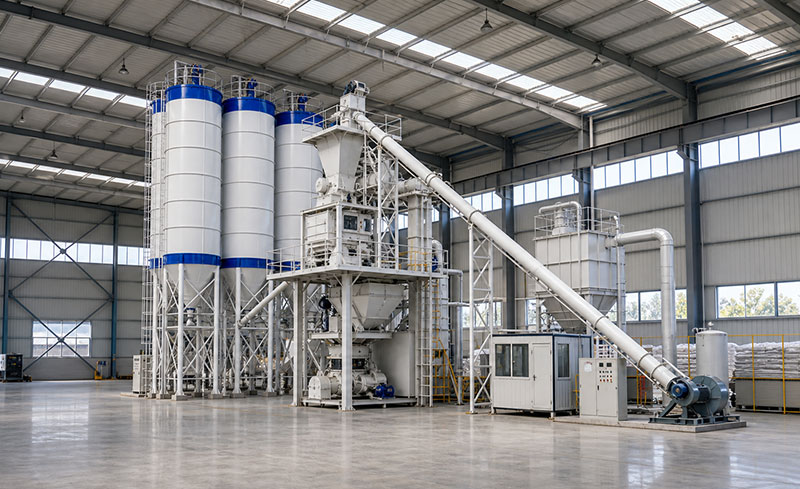
A sample from one convenient location can hide poor distribution elsewhere. Plan sampling with the equipment provider so that collection is representative and can be performed safely. Do not reach into operating equipment. Where direct mixer sampling is impractical, a defined discharge-sampling procedure can provide useful information about what the downstream line actually receives.
Collect samples from different portions of the discharge where the test plan requires it. Early, middle and late discharge samples can reveal variation that one combined sample would average away. Dry mortar mixing time is only one possible cause of a difference. Discharge behavior and subsequent transfer can also change the distribution of ingredients.
Keep individual samples identifiable. Record the batch, discharge position, time and laboratory result. Composite samples can be useful for some purposes, but they should not replace the individual observations needed to investigate variation. Agree the plan before the trial so that apparently inconvenient results are not discarded afterward.
Compare the evidence from each test
| Observation | Possible interpretation | Next check |
|---|---|---|
| Variation falls as time increases | Additional blending may improve distribution | Repeat the promising interval with the same method |
| Results scatter without a consistent trend | Feeding, sampling or testing may dominate | Check ingredient arrival and analytical repeatability |
| Mixer discharge is acceptable but bag samples vary | A downstream stage may alter the product | Sample transfers, storage and packing separately |
| Small batches perform differently from normal batches | Fill condition or minimum dosing may matter | Review mixer loading and scale operating ranges |
| A longer interval changes product behavior | The formulation may be sensitive to processing | Review with the formulation specialist before adopting it |
| One test passes and the repeat fails | The setting may lack operating margin | Investigate uncontrolled variables rather than averaging away failure |
The table is a troubleshooting framework, not proof of a particular fault. Dry mortar mixing time should be selected from a consistent pattern of results with a known test method. A spreadsheet that marks only the mean as acceptable can conceal the very variation that the trial is meant to investigate.
Distinguish blending problems from dosing problems
A mixer cannot distribute an ingredient that did not arrive in the correct quantity. Compare the commanded recipe, recorded weight and material path for small additives. Look for delayed feeding, retained material and carryover between batches. If an additive sometimes remains in a chute, increasing dry mortar mixing time may conceal the symptom without correcting the process.
Review scale suitability at the actual dose. A scale selected for a large maximum load may need a separate assessment for a small addition. Ask how the weighing system is verified over the intended operating range. Keep static scale verification separate from an evaluation of dynamic feeding and overshoot.
During the trial, retain the relevant batch records and operator observations. If one sample set is unusual, the associated record can help identify whether feeding behavior also changed. The quality team should be able to trace each laboratory result back to a specific production event instead of relying on a handwritten average for the entire day.
Check the line after the mixer
Follow the product through conveying, intermediate storage and packaging. Differences in particle size, density and handling behavior can affect distribution during transfers. A successful mixer trial does not establish that every bag will match the mixer sample. Include downstream verification when the purpose is to release a production process.
Use paired sampling points where practical. For example, compare the defined mixer-discharge sample with a later packing sample from the same traceable batch. Keep material residence time and mixing of batches in mind. Dry mortar mixing time can then be evaluated within a complete line rather than being blamed for every result observed at dispatch.
Review the actual storage route during ordinary production. A trial that bypasses the finished-product bin may miss problems that appear only after a long hold or a different discharge pattern. Document the route used for each test and identify any differences from the intended commercial operating sequence.
Turn the trial into an operating window
Select a setting with practical margin inside the acceptable region, rather than choosing the shortest passing result automatically. Define the products, batch sizes and material conditions for which the setting was validated. If those conditions change, the production team needs a clear rule for review or requalification.
Document the approved dry mortar mixing time alongside the feed sequence, batch range and quality checks. Restrict recipe changes to the agreed authorization process and retain the previous approved version. An operator should not have to guess whether a value was deliberately changed or accidentally overwritten during troubleshooting.
Include the result in supplier discussions for Yunguan's dry mortar mixing plants και customized production systems. Ask how trial materials, sampling access, batch records and downstream equipment will be accommodated in the proposed configuration.
For general information about cementitious product applications, the American Cement Association's applications overview describes the diversity of cement-based materials. It provides context for why one processing assumption should not be applied to all formulations. It does not specify a universal dry mortar mixing time.
Send the intended products, batch sizes, raw-material descriptions and available test methods through the form below. These inputs support a discussion about a meaningful mixer trial and the line interfaces needed to preserve the result.
Frequently asked questions
Does a longer dry mortar mixing time always improve uniformity?
No. The appropriate dry mortar mixing time depends on the formulation, mixer, loading and feed sequence. Validate the setting against product-relevant measurements rather than assuming that more time always improves quality.
Can a supplier’s brochure value be used directly?
Treat it as a starting point for discussion. Confirm what the value measures and the conditions behind it, then evaluate the proposed product and batch range through an agreed trial.
How many samples should a trial use?
The quality team should define the number and sampling locations according to the measurement method and decision. The plan should capture relevant variation and include repeat tests where needed.
What if mixer samples pass but packed material fails?
Investigate the downstream route, including transfers, storage, discharge and packing. Changing dry mortar mixing time alone may not correct variation introduced after the mixer.
When should the setting be reviewed?
Review it after relevant changes in formulation, material characteristics, batch range, feed sequence, equipment condition or line configuration. Keep the approved setting tied to documented validation conditions.