
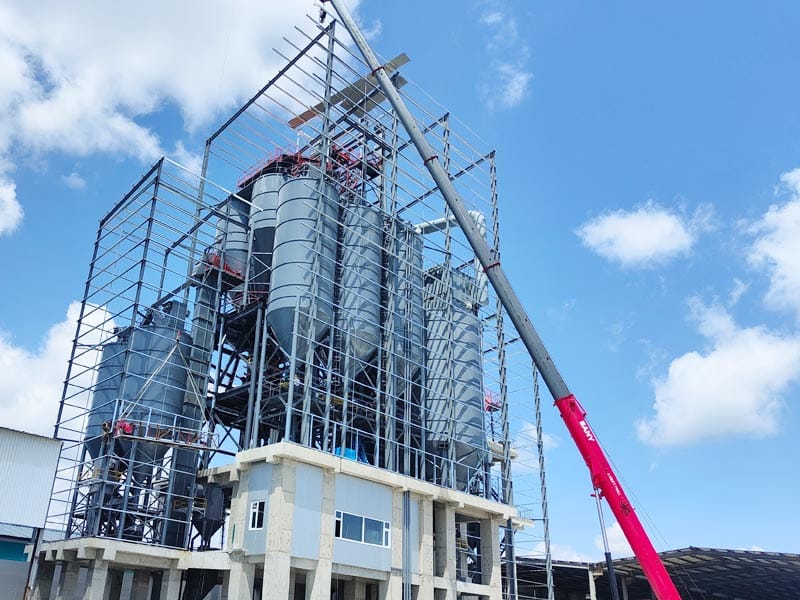
Manufactured sand for dry mortar must do more than pass through a screen. It has to match the approved mortar formulation, remain consistent through storage, and reach the mixing line in the quantities each product needs.
Our integrated manufactured sand and special mortar plant connects sand preparation with ingredient metering, mixing, and packaging or bulk delivery. The important selection question is how those stages work together—not simply how much material the sand maker can process.
This guide explains how to specify manufactured sand for dry mortar and translate the material requirements into a practical production-line configuration.
Table of Contents
What Makes Manufactured Sand for Dry Mortar Suitable?
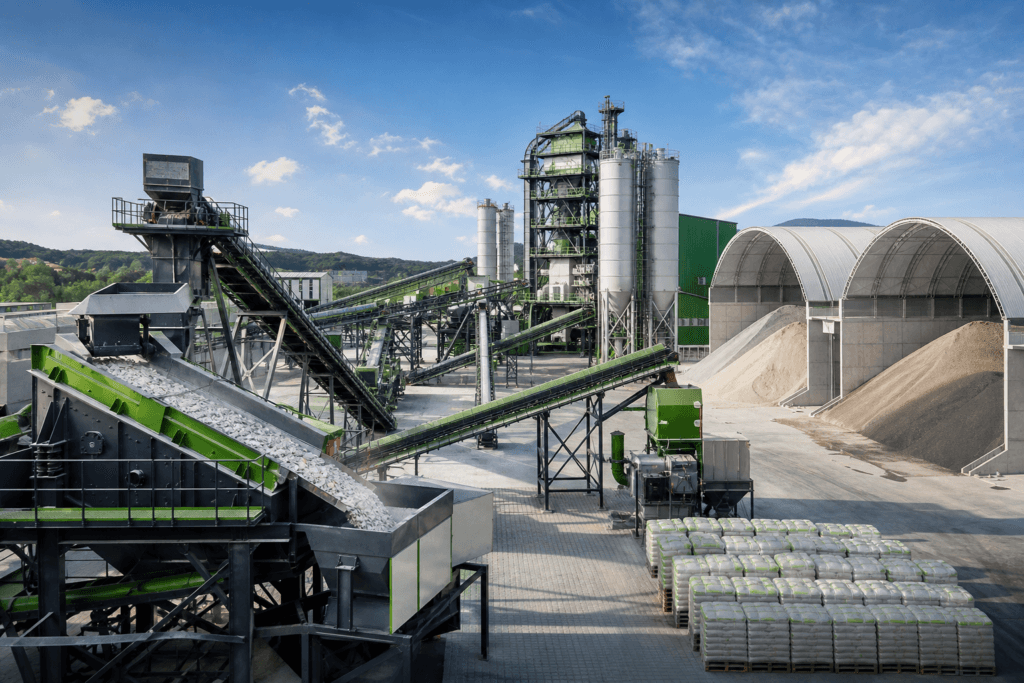
Manufactured sand is produced by processing suitable rock or other approved mineral feed. For a mortar producer, suitability comes from documented material properties and successful formulation trials, not the label “M-sand.”
Our manufactured sand production line combines vertical-shaft impact crushing, screening, powder classification, and material return, with a stated focus on 0–3 mm products. That describes the equipment’s product range; it does not mean every blend within that range suits every mortar.
When assessing manufactured sand for dry mortar, distinguish prepared aggregate from the finished dry blend containing binder and additives. Approving one does not approve the other. For the upstream equipment sequence, see our guide to the manufactured sand production process.
Start with the Mortar Product, Not a Universal Sand Limit
Specify manufactured sand for dry mortar against the products you intend to manufacture. Masonry mortar, render, tile adhesive, and self-leveling products should not automatically receive an identical aggregate specification.
ASTM C144 on aggregates for masonry mortar recognizes natural and manufactured sand and addresses grading and material quality. Its scope is masonry mortar, not a universal approval route for all special mortars. Agree the applicable product requirements with the responsible technologist.
Use the following questions to turn a product range into an equipment brief. They are specification prompts, not prescribed formulations.
| Mortar application | Sand-related requirement to define | Equipment question |
|---|---|---|
| Masonry mortar | Approved grading, workability, and material-quality limits. | Which fractions need separate storage and metering? |
| Plastering or rendering mortar | Layer thickness, finish, and application method. | How will oversize and grading variation be controlled? |
| Cement-based tile adhesive | Validated particle distribution and adhesive performance. | Can the approved sand blend be reproduced after product changes? |
| Self-leveling or repair mortar | Application-specific flow, stability, and strength requirements. | What preparation and dosing arrangement does the validated formulation require? |
This approach keeps manufactured sand for dry mortar tied to saleable products rather than a single impressive fineness figure.
Specify a Grading Envelope, Not Just a Fineness Modulus
A grading envelope states the acceptable proportion passing each selected sieve. It provides more detail than a fineness modulus, which summarizes the distribution in one number.
ASTM C136/C136M describes aggregate sieve analysis for determining particle-size distribution and supporting production control. Select the sieve series and acceptance limits appropriate to the intended product.
For manufactured sand for dry mortar, request complete sieve results from representative production samples. Two sands can have a similar summary value while differing at the particle sizes important to a particular formulation. Keep the individual results in the acceptance record.
Ask the equipment designer how the proposed screen arrangement, classifier, return circuit, and storage bins will maintain that envelope. An adjustable setting is useful only when the resulting material is verified. Also establish what happens to out-of-specification production before it reaches an approved-material bin.
Distinguish Rock Fines from Clay Contamination
“Powder content” is incomplete without a particle-size boundary and test method. When evaluating manufactured sand for dry mortar, separate the quantity of fine material from its characteristics.
ASTM C117 measures material finer than 75 micrometers by washing. That quantity does not, by itself, identify how much harmful clay is present. A fines percentage should not be treated as a clay percentage.
ASTM C1777 addresses methylene blue testing, whose result reflects the amount and characteristics of clay minerals. It also cautions that results from different methylene blue methods are not directly interchangeable and does not prescribe one maximum value for every application.
For manufactured sand for dry mortar, agree both the test method and a performance-based acceptance limit. Do not transfer an unexplained methylene blue number from a machinery brochure into a material specification. Likewise, do not assume that removing every fine particle produces the best mortar; the approved blend must be established through testing.
Check Particle Shape Through Controlled Mortar Trials
Particle shape and surface texture deserve attention alongside grading. ASTM C1252 on uncompacted fine-aggregate void content explains how controlled measurements can indicate these characteristics and inform mortar workability assessment. Comparisons need a stated method and appropriate control of grading.
To qualify manufactured sand for dry mortar, compare candidate materials using an agreed laboratory procedure. Keep the binder, additives, preparation sequence, and assessment conditions controlled. Record any water adjustment rather than changing it silently to obtain a preferred result.
A study of manufactured-sand grading in dry-mixed mortar found that strength and bond performance did not respond identically to grading changes. Its results support testing the intended performance, not adopting a universal “finer is better” or “coarser is stronger” rule.
Select the sand that meets the complete product requirement, not the sample that wins one isolated test.
Also define when a material change requires another trial. A new quarry source, a different stockpile blend, or a revised classification setting should trigger a documented review of the affected properties. Retain the original approved sample and test results as references, but use fresh representative samples to evaluate the changed supply. The equipment proposal should identify who authorizes each change.
Set Moisture and Temperature Requirements at the Mixer
Qualify manufactured sand for dry mortar at the point where it enters production. A result obtained before exposed storage or an unverified transfer stage may not describe the material being dosed.
Specify the permitted moisture condition, measurement method, and reporting basis. Also agree the acceptable sand temperature with the formulation team and equipment designer, particularly where drying is involved.
A dry classification process is not a promise that incoming wet material becomes dry enough for mortar manufacture. Conversely, a washing process does not finish the preparation task when the product must later enter a dry blend.
For manufactured sand for dry mortar, ask whether drying, cooling, covered storage, or other conditioning is required for the actual feed. Show these operations on the project flow diagram and confirm who supplies them. Do not assume a dryer or cooling system is included simply because sand making and mortar mixing appear in one proposal.
Choose the Right Connection Between Sand and Mortar Equipment

The most suitable arrangement depends on which parts of the process already exist. Buying manufactured sand for dry mortar from an approved source is a different equipment project from preparing it in-house.
An integrated line for in-house sand preparation
Our integrated plant brings sand preparation and mortar manufacturing into one production system. Its published flow includes screening, powder classification, finished-sand storage, ingredient metering, mixing, and final delivery. Use this as the basis for reviewing material routes and control interfaces.
Confirm the number of separately managed grades, storage connections, and product-change requirements in the project design. Integration should not mean feeding unverified material directly into an active recipe.
A prepared-sand interface for an existing workshop
Our workshop-type dry mortar mixing plant uses a horizontal arrangement with screw-conveyor connections and separate ingredient metering. It can form the mortar-production part of a project receiving prepared sand.
Assess the actual receiving, storage, and dosing interfaces before deciding whether a separate sand-preparation stage is needed.
Match Each Sand Grade to the Production Schedule
When sizing production of manufactured sand for dry mortar, calculate demand by approved grade. A surplus of one fraction cannot automatically replace a shortage of another.
The hypothetical example below represents one steady operating period. Grades A and B are project-defined materials, not standard grading classes or published equipment outputs. All quantities refer to dry-solids mass.
| Approved sand grade | Mortar-line demand | Qualified sand supply | Hourly balance |
|---|---|---|---|
| Grade A | 8 t/h | 6 t/h | 2 t/h shortfall |
| Grade B | 6 t/h | 12 t/h | 6 t/h surplus |
| Total | 14 t/h | 18 t/h | 4 t/h surplus overall |
Total supply exceeds total demand, yet the Grade A requirement is not met. If its bin starts with 4 tonnes of usable, approved inventory, that stock covers the 2 t/h shortfall for only two hours under the stated conditions.
This is why manufactured sand for dry mortar must be assessed by fraction and time window. More storage delays a shortage; it does not correct a persistent production imbalance.
Request a schedule that accounts for approved-grade yield, product changes, operating hours, and planned interruptions. Where the process cannot produce every grade simultaneously, show the switching sequence. Keep crusher feed throughput, qualified sand output, and finished-mortar output as separate quantities.
Preserve the Approved Grade Through Storage and Transfer
For manufactured sand for dry mortar, the quality-control boundary should extend beyond the classifier outlet. Plan sampling at the receiving bin or dosing point so the trial also checks the downstream route.
Review how each grade enters its bin, how mistaken deliveries are prevented, and how residual material is handled during a change. Ask the designer to demonstrate a complete refill-and-discharge cycle rather than presenting a single conveniently collected sample.
Keep approved, awaiting-test, and rejected material distinguishable in both physical storage and production records. Decide whether a failed lot is isolated, reprocessed, or removed from use.
For plants with several products, confirm that the control system identifies the selected bin and recipe revision. A correctly weighed quantity from the wrong bin is still the wrong ingredient.
For manufactured sand for dry mortar, define the signals that permit a batch to start: the required grade is available, its lot has been released, and the receiving equipment is ready. During commissioning, ask what the controls do when one condition is missing. Agree the alarm, hold, and authorized restart sequence; do not assume those functions are included without a demonstration.
Control Collected Dust as a Separate Material Stream
Dust collection and product classification have different purposes. The integrated plant’s published configuration includes negative-pressure dust collection, but equipment selection still needs a review of capture points, operating conditions, and commissioning evidence.
The HSE’s guidance on commissioning local exhaust ventilation emphasizes checking that the installed system performs as intended. A dust-control feature in a product description does not establish a site’s compliance or exposure performance.
When producing manufactured sand for dry mortar, document where collected material goes. Any proposal to return it to a product stream needs quality approval and traceable dosing. Do not assume mixed dust from different process points is equivalent to an approved mineral filler.
Verify the Sand and the Finished Mortar Separately
Acceptance of manufactured sand for dry mortar needs two linked decisions: whether the prepared sand meets its specification and whether the resulting mortar meets its product requirements.
Material acceptance
Agree the representative feed range, sampling locations, test methods, and acceptance limits before the production trial. Record grading, fines characteristics, moisture, temperature where relevant, and the output of each approved grade.
Include periods after startup, refilling, and relevant setting changes. Define which material is excluded from normal production and how it is identified. A favorable sample without its operating conditions is weak acceptance evidence.
Mortar performance acceptance
Make test batches from the qualified sand using the approved binder and additives. Have the laboratory evaluate the application-specific properties selected by the formulation team, with every sample linked to its material lots and batch record.
For manufactured sand for dry mortar, a passing aggregate test does not replace finished-product testing. Likewise, a successful laboratory mix does not establish the proposed line’s sustained throughput. Document material quality, mortar performance, and production capability separately.
Prepare a Manufactured Sand for Dry Mortar Project Brief
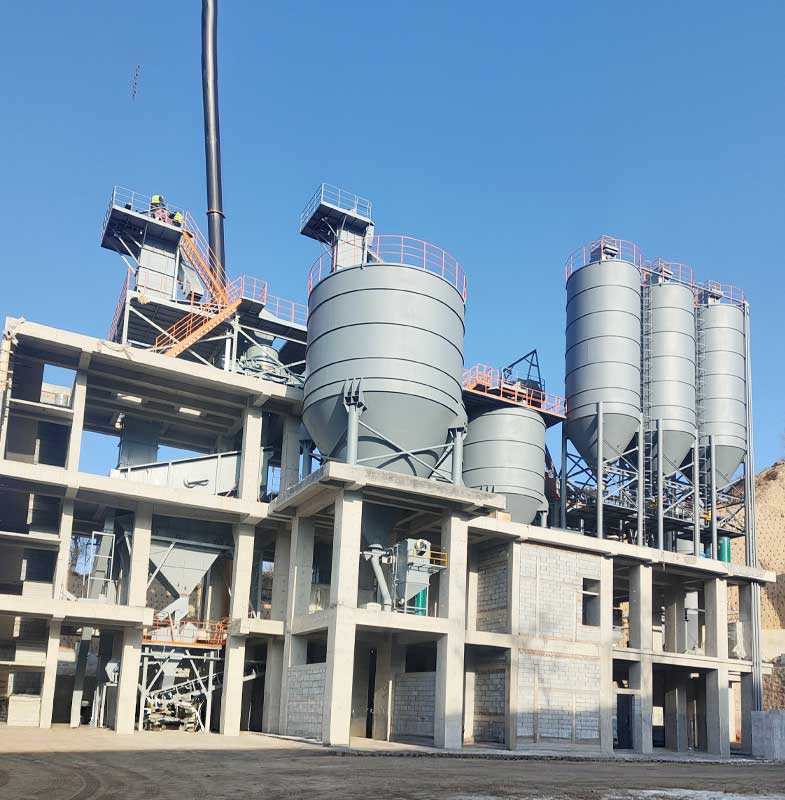
A project review becomes more productive when it starts with your material and production requirements. Provide the rock source or prepared-sand data, representative samples, intended mortar products, approved grading envelopes, and the daily production sequence.
For manufactured sand for dry mortar, include demand for each grade during the busiest period—not just annual tonnage. Add your site drawing, available storage, existing equipment, packaging plans, and any unresolved drying or conditioning requirements.
Our production-line configuration and layout service considers raw materials, process requirements, output, and site conditions together. Ask for a flow diagram, equipment scope, interface schedule, and proposed trial plan so the recommendation can be checked against your actual project.
Conclusion
Manufactured sand for dry mortar should be selected as a controlled ingredient, then supported by a production system that preserves its quality and supplies the grades your schedule consumes.
Start with the mortar formulation, verify the sand, and match the preparation and mixing stages before selecting equipment. Send your raw material data, mortar product range, and site layout to our team. Request an integrated sand and mortar line review to discuss a configuration suited to your production requirements.
FAQ
Can manufactured sand replace natural sand in dry mortar?
It can be considered when the processed material and resulting mortar meet the applicable requirements. Approval should follow representative testing of the intended formulation. Neither natural nor manufactured sand is automatically suitable merely because of its source or name.
What is the best particle size for manufactured sand for dry mortar?
There is no single size range for every product. Specify the complete grading envelope for the intended mortar. The equipment’s stated output range is a starting point for configuration discussions, not a universal recipe specification.
Does a low fines percentage prove the sand is clean?
No. The amount of fine material and its clay characteristics are different measurements. Agree the relevant tests and performance limits. Methylene blue results also need the method and tested fraction identified before values can be meaningfully compared.
Does an integrated plant eliminate the need for sand drying?
No. That depends on feed moisture, the preparation method, and the mortar’s acceptance requirements. Confirm any drying, cooling, and storage provisions in the project scope rather than assuming integration includes them.
Why can enough total sand still leave the mortar line short?
The required grade may be produced too slowly even when overall output is sufficient. Compare qualified supply and consumption for each grade over the same period. Extra material in another bin cannot substitute without an approved formulation change.

