
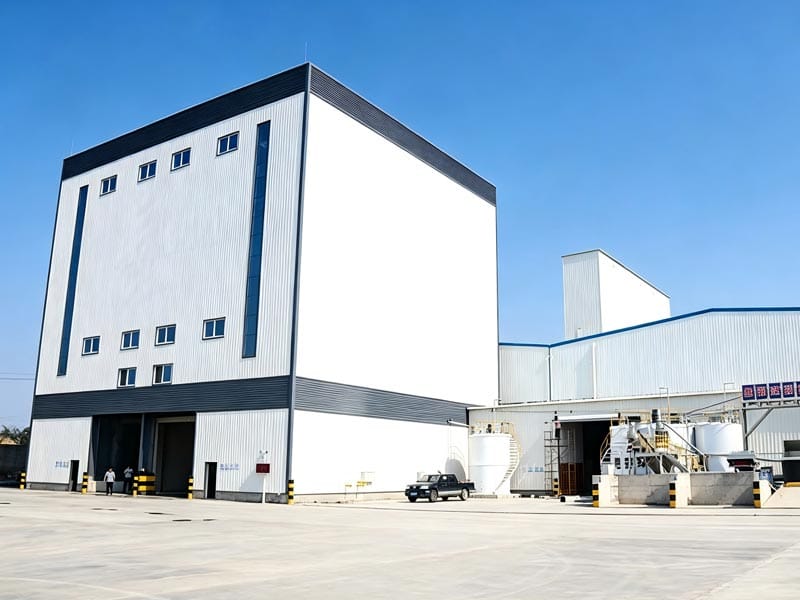
Belt conveyor vs skip hoist is one of the most important layout decisions in a concrete batching plant because the aggregate feeding method affects plant footprint, batch rhythm, maintenance access and the way material reaches the mixer. The choice should not be made from a simple rule that one system is “large” and the other is “small.”
On MixingPlantPro equipment, belt-fed and skip-hoist configurations are available with different silo arrangements and production layouts. That makes the comparison especially useful for buyers who need to balance site constraints with stable concrete production.
This guide explains belt conveyor vs skip hoist selection from the perspective of aggregate flow, cycle timing, space, maintenance and project requirements, while avoiding universal capacity limits that may not apply to a specific configuration.
What Does Belt Conveyor vs Skip Hoist Actually Compare?
Belt conveyor vs skip hoist describes how weighed aggregates travel from the batching section to the elevated receiving point above the mixer. It does not describe the cement silo position, mixer type or complete plant layout by itself.
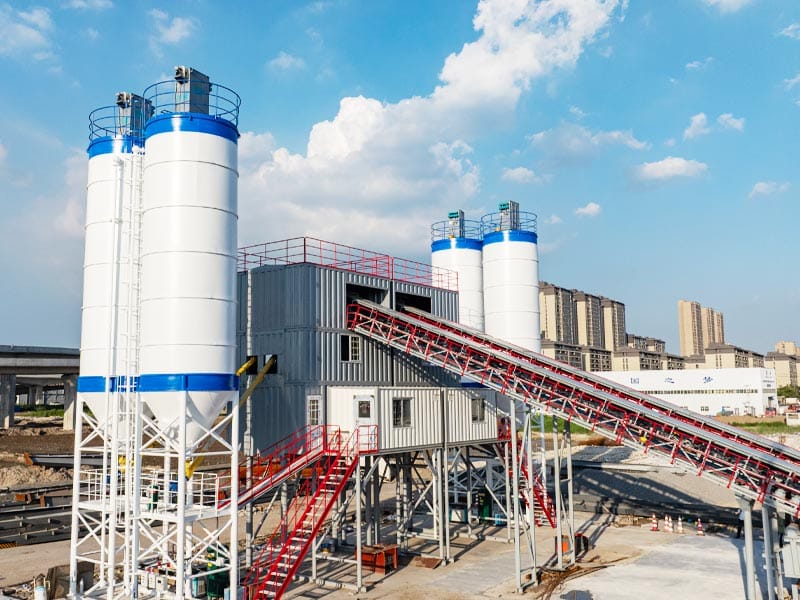
A belt-fed plant uses a flat belt and an inclined belt to move aggregate continuously toward the upper storage or receiving hopper. A skip-hoist plant loads aggregate into a bucket and lifts that bucket along a guided path in repeated cycles.
Nosso central de mistura de concreto com correia montada lateralmente uses continuous flat and inclined belt transfer. Our planta misturadora de concreto de caçamba montada lateralmente uses an intermittent vertical skip-hoist system with synchronized dual wire ropes and multiple limit protections.
The belt conveyor vs skip hoist decision therefore answers one engineering question: how should aggregate move between batching and mixing?
Compare Aggregate Flow Before Comparing Plant Capacity
The main process difference in belt conveyor vs skip hoist selection is whether aggregate transfer is continuous or cyclic.
With a belt conveyor, weighed aggregate can move along the belt while other plant operations continue. Depending on the actual plant layout, this can make it easier to overlap aggregate transfer with mixing or preparation of the next batch.
With a skip hoist, the bucket follows a repeated sequence: load, lift, discharge, return and load again. The useful capacity depends on bucket payload, lifting distance, travel speed, loading time, discharge time and whether other steps can proceed in parallel.
Do not convert these differences into a universal statement that one system always produces more concrete. In the belt conveyor vs skip hoist comparison, the correct method is to build a timed cycle for the proposed plant.
Use a Cycle Diagram to Find the Real Bottleneck
A plant may have a fast mixer but still wait for aggregate. Conversely, a fast aggregate-feeding system does not improve output if truck loading or powder dosing is slower.
For belt conveyor vs skip hoist evaluation, create a cycle diagram showing:
- aggregate batching;
- aggregate transfer;
- powder weighing;
- water and admixture dosing;
- mixer charging;
- mixing;
- discharge;
- receiver or truck readiness.
Consider a hypothetical example. A plant completes mixing in 45 seconds. Aggregate transfer using System A requires 35 seconds and can overlap almost completely with the preceding mixing cycle. System B requires 40 seconds but can only begin after a specific upstream condition is satisfied.
The apparent difference is only five seconds, yet the impact on the complete repeat cycle may be much larger if one transfer step sits on the critical path.
This is why belt conveyor vs skip hoist should be compared using a complete production sequence rather than individual equipment speeds.
How Belt Conveyor Feeding Changes the Site Layout
A belt conveyor needs a physical route between the aggregate batching area and the main mixing structure. That route can be long and inclined, so the plant layout must reserve space for the conveyor structure, supports and maintenance access.
Our side-mounted belt plant arranges powder silos beside the main building and uses flat and inclined belts for continuous aggregate transfer. The configuration is used for commercial concrete production and medium- to long-term infrastructure projects.
In a belt conveyor vs skip hoist site comparison, do not measure only the footprint of the main tower. Include:
- aggregate bins;
- belt route;
- support structures;
- walkways and inspection access;
- loader routes;
- truck circulation;
- powder silo locations.
A belt plant can have a larger physical conveying corridor, but that corridor may also support a smoother aggregate flow for a long-term fixed site.
How Skip Hoist Feeding Changes the Site Layout
A skip hoist moves aggregate upward in a relatively concentrated vertical route. This can make the overall arrangement more compact when the batching section is located close to the mixer.
Our side-mounted bucket plant places the powder silos beside the main building while the aggregate skip lifts material vertically. The product is positioned for constrained construction sites that need to balance footprint, capacity and maintenance access.
Nosso planta misturadora concreto balde aéreo combines skip-hoist aggregate feeding with powder silos arranged above the main building.
This illustrates an important belt conveyor vs skip hoist principle: aggregate feeding method and silo arrangement are separate decisions. A buyer should not assume that every skip-hoist plant has the same tower layout.
Which System Works Better on a Restricted Site?
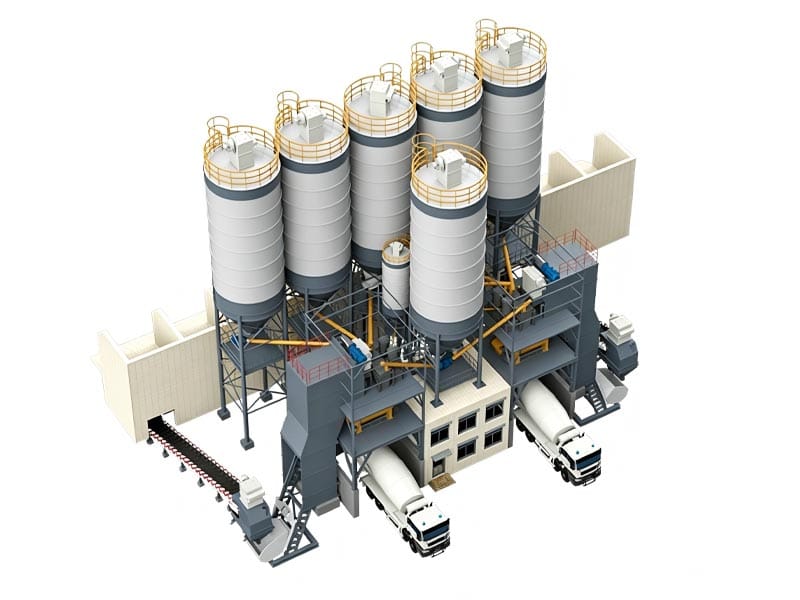
Skip-hoist layouts are often considered when horizontal space is limited because the aggregate path is concentrated near the main building. However, a restricted site should still be reviewed in three dimensions.
For belt conveyor vs skip hoist selection, confirm:
| Site factor | Belt conveyor question | Skip hoist question |
|---|---|---|
| Available length | Is there room for the inclined conveyor route? | Can the batching bins sit close to the lift structure? |
| Available height | What is the highest conveyor and receiving point? | What lift height and structural clearance are required? |
| Maintenance access | Can technicians reach belts, rollers and transfer points? | Can technicians inspect ropes, guides, brakes and limits safely? |
| Traffic | Does the belt structure interfere with loader or truck circulation? | Does the compact arrangement create congestion around the main building? |
A small footprint is only valuable if the resulting site remains operable. Belt conveyor vs skip hoist selection should therefore include traffic and maintenance zones, not just equipment dimensions.
Do Not Assume Skip Hoist Means Low Capacity
Many general industry guides associate skip-hoist plants with smaller capacities and belt conveyors with larger plants. That pattern exists in many product ranges, but it should not be treated as a universal engineering rule.
MixingPlantPro’s side-mounted bucket product range includes models extending well beyond the capacities often associated with compact jobsite plants. This is why the belt conveyor vs skip hoist decision should use the actual proposed model, payload and cycle rather than a generic capacity cutoff.
Ask the supplier to provide the planned aggregate batch quantity and complete lift cycle for the selected configuration. Then compare that sequence with mixer demand.
A skip-hoist system that completes its cycle within the required production rhythm may be suitable. A belt conveyor that cannot supply the receiving hopper fast enough may still become a bottleneck. The feeding label alone does not answer the question.
Buffer Storage Can Change the Production Rhythm
Many batching plants use temporary aggregate storage above the mixer. This allows aggregate weighing and transfer to occur before the mixer is ready to accept the next batch.
In belt conveyor vs skip hoist evaluation, the size and control of this buffer can be as important as the conveying method itself.
If a belt system fills a temporary hopper while the previous batch is mixing, the next mixer charge may already be waiting when discharge finishes. A skip system can also benefit from appropriate temporary storage depending on its configuration.
Ask whether the proposed plant has one-batch or multi-stage buffering, how material is prevented from mixing unintentionally between recipes, and which permissive controls discharge from the buffer to the mixer.
Do not assume that a conveyor described as continuous means the concrete plant itself operates continuously. The mixer still produces discrete batches unless the plant uses a fundamentally different mixing process.
Compare Maintenance by Failure Mode, Not by “Easy” or “Hard”
Maintenance is frequently oversimplified in belt conveyor vs skip hoist comparisons. The two systems have different inspection points rather than one being universally maintenance-free.
A belt system can require inspection of:
- belt tracking;
- rollers and idlers;
- pulleys;
- belt tension;
- cleaners or scrapers;
- transfer chutes;
- drive equipment.
A skip-hoist system can require inspection of:
- wire ropes or lifting components;
- guide rollers;
- braking devices;
- limit switches and position detection;
- bucket condition;
- winch or drive equipment;
- anti-fall protections.
Our side-mounted bucket plant uses synchronized dual wire ropes, multiple limits and dual hydraulic brakes. Those are specific design features to include in the maintenance plan; they should not be interpreted as eliminating the need for lifting-system inspection.
The best belt conveyor vs skip hoist decision is the configuration your maintenance team can inspect safely and consistently.
Safety Requirements Differ Between the Two Feeding Methods
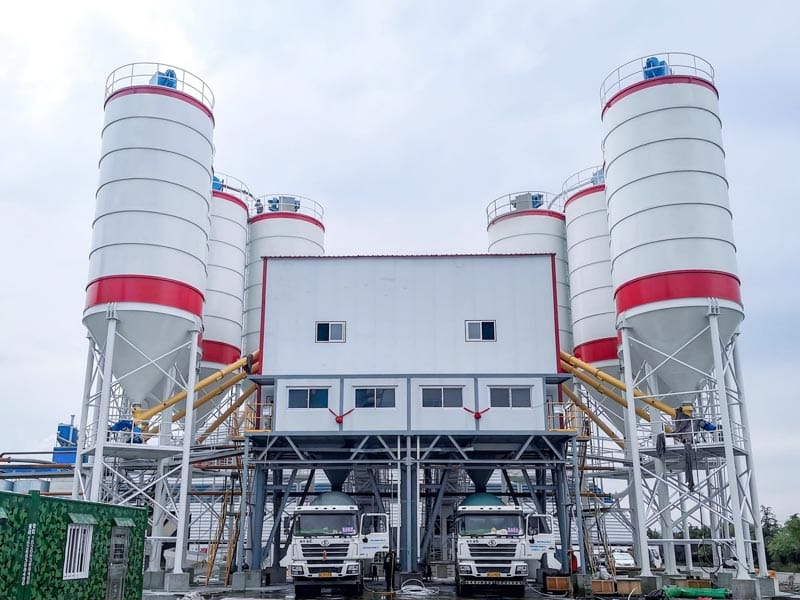
Belt conveyors and lifting systems create different hazards. Conveyor systems have rotating equipment, pinch points and long travel paths. Skip hoists have suspended moving loads, ropes, brakes and vertical travel.
The U.S. Occupational Safety and Health Administration’s conveyor safety requirements address guarding, emergency stopping and other considerations for conveyors used in construction environments.
Skip-hoist lifting systems should be inspected and maintained according to the equipment manufacturer’s instructions and the safety requirements applicable at the site.
For belt conveyor vs skip hoist selection, ask how operators isolate the system, where emergency stops are located, how inspections are performed and how access is prevented during automatic operation.
Safety design should be reviewed before layout approval because retrofitting access platforms or exclusion zones later can be difficult.
Dust Control Changes with the Aggregate Route
Aggregate dust is influenced by transfer points and drop heights. Belt conveyors may have several transfers and a long exposed route. Skip hoists concentrate aggregate movement into loading and discharge points.
In belt conveyor vs skip hoist environmental planning, identify exactly where dry fine aggregate can become airborne.
For belt plants, enclosed conveyors, covered transfer chutes and controlled drop points can reduce dust. For skip-hoist plants, focus on the bucket loading point and discharge area above the mixer.
If water spraying is used as part of aggregate dust control, account for the resulting moisture change. Dust-control water should not silently change the moisture value used in concrete batching.
The plant’s environmental design should therefore connect aggregate conveying with moisture management and housekeeping.
Compare Energy Use from the Real Duty Cycle
It is tempting to declare one feeding method more energy-efficient based on motor power alone. That comparison is incomplete.
For belt conveyor vs skip hoist analysis, calculate energy from the actual duty cycle. A belt may run for extended periods at a relatively stable load. A skip motor may operate intermittently with repeated acceleration and lifting.
Useful input data include:
- motor ratings;
- actual loaded operating time;
- number of batches per hour;
- vertical lift;
- conveyor length;
- idle-running strategy;
- control mode.
Do not use total installed plant power as a direct measure of aggregate-feeding energy. Installed power includes many systems that are unrelated to the belt conveyor vs skip hoist comparison.
What Happens When the Feeding System Stops?
Reliability should include how the plant behaves after a fault, not only how often faults are expected.
If a belt conveyor stops, determine whether the mixer can complete the current batch and whether material remains on the belt or in a transfer chute. If a skip hoist stops mid-cycle, determine how the bucket is secured, how the lifting system is accessed and how production is recovered.
For belt conveyor vs skip hoist procurement, request procedures for safe recovery from common fault conditions. Ask which spare parts are recommended and which inspections are required before restarting.
The recovery method should be clear enough that operators do not improvise around interlocks or safety protections under production pressure.
Use the Same Production Scenario for Both Proposals
The most reliable belt conveyor vs skip hoist comparison uses the same concrete production scenario for both options.
Fornecer:
- peak concrete demand;
- discharged batch size;
- aggregate quantity per batch;
- number of aggregate fractions;
- expected moisture condition;
- mixer cycle requirement;
- site dimensions;
- required operating hours.
Then request a timed cycle and layout for both feeding methods.
Do not compare a belt proposal designed for a high-output commercial plant with a skip proposal sized for a smaller project and conclude that the difference is caused only by the conveyor. The equipment configurations must be normalized before belt conveyor vs skip hoist conclusions are meaningful.
A Practical Belt Conveyor vs Skip Hoist Selection Matrix

| Condição do projeto | What may favor belt conveyor | What may favor skip hoist |
|---|---|---|
| Long-term fixed production | Continuous aggregate flow and flexible fixed-site layout | Possible if cycle and site needs are satisfied |
| Very limited horizontal space | Possible with project-specific routing | Compact vertical material path can be advantageous |
| High peak batch frequency | Opportunity for overlapping transfer and buffering | Requires lift cycle to match mixer demand |
| Maintenance preference | Distributed belt, roller and pulley inspection | Concentrated lifting, rope, brake and limit inspection |
| Complex site traffic | Conveyor route must avoid traffic conflicts | Compact layout may reduce horizontal crossings |
This matrix is intentionally conditional. Belt conveyor vs skip hoist selection should produce a project-specific answer, not a universal winner.
What Should Buyers Send for a Configuration Review?
To choose between belt conveyor vs skip hoist, send the plant supplier more than a requested hourly capacity.
Provide the available site dimensions, terrain, aggregate storage plan, concrete demand profile, expected number of batches per hour and the type of project the plant will support.
Also explain whether the plant is temporary or permanent, whether future expansion is expected, and how loaders and concrete trucks will move through the site.
Nosso soluções de produção personalizadas can use these inputs to compare conveying and layout options. The final decision should be supported by a plant arrangement and production sequence, not only a product category.
Send your project details through our página contato for a configuration review.
Conclusão
Belt conveyor vs skip hoist selection is fundamentally a material-flow decision. Belt conveyors can support continuous aggregate transfer and overlapping production steps, while skip hoists can create a compact vertical route with a different maintenance and control profile.
Neither feeding method should be selected from a generic capacity rule. Compare the actual payload, cycle time, buffer storage, site layout, maintenance access and production schedule of the proposed plant.
When both options are evaluated under the same operating assumptions, the right configuration becomes much easier to identify.
Perguntas frequentes
Which is better: belt conveyor vs skip hoist?
Neither is universally better. Belt conveyor vs skip hoist selection depends on site dimensions, production rhythm, buffer storage, aggregate batch size and maintenance requirements. Compare complete layouts and timed cycles for the specific project.
Does a skip hoist always mean a small batching plant?
No. Although skip hoists are commonly used in compact plants, the practical capacity depends on the actual bucket, lift cycle and plant configuration. MixingPlantPro offers skip-hoist models across a broad range, so selection should use model-specific data.
Why can a belt conveyor support higher production rhythm?
A belt can often transfer aggregate while other batching or mixing steps are occurring, allowing more process overlap. The benefit depends on buffer storage and the complete production cycle, so it should be verified with a timed sequence.
Which system needs more maintenance?
They need different maintenance. Belt systems require belt, roller, pulley and tracking inspection, while skip systems require lifting components, ropes, brakes, guides and limit protections to be checked. Maintenance workload depends on the actual design and duty.
Which feeding method uses less site space?
A skip hoist often creates a more compact horizontal aggregate route, but total site space still depends on silos, aggregate bins, traffic, maintenance access and structural clearances. Review the complete layout before deciding.

