

Dry sand classification is the stage that turns crushed material into controlled sand fractions instead of leaving the production line with one mixed stream of coarse particles, useful fine aggregate and excess powder. For dry mortar and concrete applications, that separation is essential because different products need different grading and fines conditions.
In a manufactured sand line, classification usually combines screening and airflow powder separation. Screening sorts particles by size. Air classification removes or redirects part of the very fine fraction. These two operations solve different problems and should not be treated as one generic “sand separation” step.
Nosso linha de produção de areia fabricada uses a tower process with VSI crushing, circular screening, airflow powder classification, closed-loop return and finished 0–3 mm sand storage. This guide explains how dry sand classification fits that process and how buyers should define useful sand versus excess fines.
What Is Dry Sand Classification?
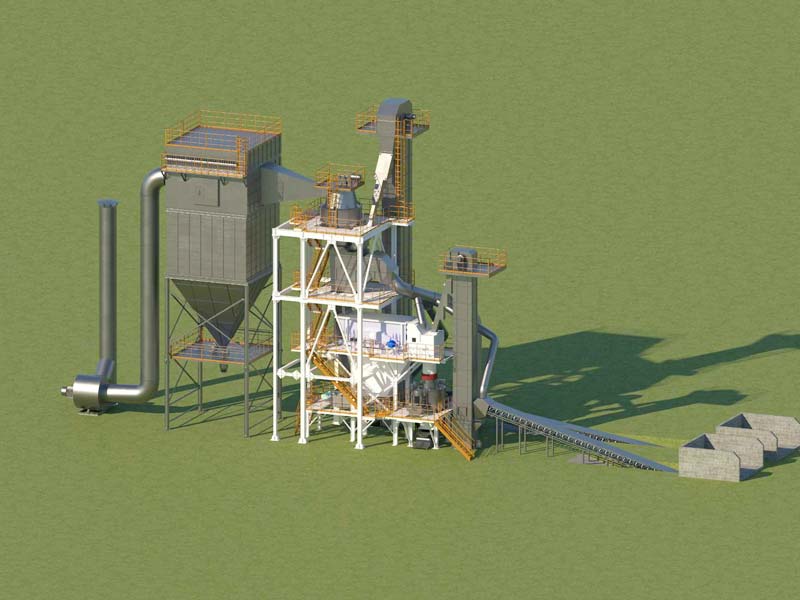
Dry sand classification is the controlled separation of manufactured sand without using a conventional wet washing process as the main classification method. It typically uses mechanical screening for particle-size separation and airflow or similar dry separation for fine-powder control.
The goal is not to remove every fine particle.
The goal is to produce a sand grading that matches the downstream application while controlling the portion of powder that is unnecessary or harmful to that product.
For dry sand classification, the production team should define:
- target finished particle-size range;
- required sieve distribution;
- acceptable fine-powder range;
- number of useful sand fractions;
- downstream mortar or concrete application.
Without these targets, the classifier can only separate material mechanically; it cannot decide which fraction is commercially or technically useful.
Screening and Air Classification Do Different Jobs
One of the most important points in dry sand classification is the difference between particle-size screening and powder classification.
| Process | Main job | Typical control result |
|---|---|---|
| Vibrating screening | Separates material by particle size | Creates coarse, medium or fine fractions and identifies oversize |
| Air classification | Separates very fine particles by aerodynamic behavior | Adjusts powder content in the finished sand |
| Closed-loop return | Sends off-spec coarse material back to crushing | Reduces unqualified coarse discharge |
| Finished storage | Keeps approved sand fractions separate | Supports stable downstream batching |
Dry sand classification works best when each stage has a clear role.
If the sand is too coarse, the first question may be screening or crushing. If powder content is too high, the first question may be airflow classification. Adjusting the wrong stage can create new problems without fixing the original one.
Useful Fine Sand Is Not the Same as Excess Powder
Dry mortar products often need fine aggregate. That means the classifier should not simply remove every small particle.
Useful fine sand contributes to the grading curve and particle packing. Excess powder is the fraction beyond what the approved product needs.
The distinction depends on the application.
For example:
- masonry mortar may tolerate a broader sand distribution;
- tile adhesive may use a much finer controlled sand system;
- self-leveling mortar may need tight fine-aggregate and powder control;
- repair mortar may use different grading depending on placement thickness.
Nosso areia fina para guia de argamassa explains why one size range does not suit every dry mortar product.
Dry sand classification should therefore protect the useful fine fraction while controlling the truly excessive powder.
Start with a Sieve Curve, Not a Visual Impression
A sand sample can look “fine” or “coarse” without telling the engineer how much material lies in each size fraction.
Dry sand classification should be based on measured particle-size distribution.
ASTM C136/C136M is widely used to determine aggregate grading by sieve analysis. The principle is directly useful here: evaluate the full distribution rather than relying on one maximum particle size.
Gravar:
- percentage retained on each selected sieve;
- percentage passing;
- changes between production samples;
- the amount of return material;
- finished-product grading.
This makes it possible to see whether a classification problem affects one fraction or the entire curve.
Very Fine Material Needs Separate Measurement
Mechanical dry sieving does not always describe the finest material completely.
ASTM C117 is used to determine material finer than the 75 μm sieve by washing because this very fine fraction can adhere to larger particles and may not separate fully during dry sieving.
For dry sand classification, this distinction is useful even when the production process itself is dry.
The plant may use an air classifier to control fine powder, while the laboratory can use the appropriate reference test to quantify the fine fraction accurately.
Production classification and laboratory measurement therefore serve different roles.
Powder Content Should Be Defined by the Downstream Product
There is no universal “correct” powder content for every manufactured sand application.
Our manufactured sand production line publicly supports adjustable powder control in its dry classification process.
However, the correct setting should come from the product requirement.
For dry mortar, excess powder can alter:
- demanda de água;
- densidade aparente;
- fluidez;
- additive response;
- embalagem;
- mixing behavior.
For concrete, very fine material can also affect water demand and mixture behavior.
Dry sand classification should therefore be configured around an approved fines target, not simply the lowest achievable powder content.
Stone Powder and Clay Are Not Equivalent
A common mistake is treating all material passing a fine sieve as the same.
Stone powder generated from sound parent rock can behave differently from clay contamination.
Dry sand classification can separate material by size or aerodynamic behavior, but it cannot by itself prove that the fine fraction is clean or chemically suitable.
Buyers should therefore combine classification data with raw-material testing.
Revisão:
- parent rock;
- clay contamination;
- methylene blue or other applicable clay-related tests;
- fines quantity;
- finished mortar or concrete performance.
Nosso manufactured sand raw materials guide explains why source quality and fines quality need to be evaluated together.
Feed Grading Controls Classifier Load
Dry sand classification performance depends on what arrives from the VSI and screen.
If the crushing stage suddenly produces more fines, the air classifier receives a heavier powder load. If the feed becomes coarser, the screening and return circuit may see more oversize.
That means classification cannot be controlled independently from crushing.
Monitor:
- VSI feed grading;
- crusher operating condition;
- screen feed;
- frações selecionadas;
- classifier feed rate;
- finished sand grading.
A stable dry sand classification process starts with a reasonably stable feed.
Closed-Loop Return Changes the Internal Material Balance
Our manufactured sand production line returns unqualified material to the sand maker rather than sending it directly to finished storage.
This creates a closed circuit.
For dry sand classification, the important quantities are:
- fresh feed entering the line;
- material circulating internally;
- qualified finished sand;
- separated powder or other defined fine stream.
Suppose 100 t/h of fresh feed enters a process and 20 t/h circulates back internally. The equipment inside the circuit may handle more than 100 t/h even though external fresh feed remains 100 t/h.
This example is illustrative only. It shows why classification and screen capacity should be sized around internal flow, not just fresh feed.
Screen Efficiency Affects the Quality of Every Downstream Fraction
A dry classifier cannot correct every mistake made by the screen.
If screen media are damaged, blocked or overloaded, particles can enter the wrong stream before airflow classification even begins.
For dry sand classification, inspect:
- screen aperture;
- screen media condition;
- deck loading;
- material moisture;
- screening efficiency;
- oversize return.
If the finished sand contains unwanted coarse particles, changing the air classifier is unlikely to solve the problem.
Moisture Can Make Dry Classification Unstable
Dry classification relies on material remaining sufficiently free-flowing for screening and airflow separation.
Moisture can cause fines to adhere to larger particles, build up on screen surfaces or move differently through the classifier.
For dry sand classification, record feed moisture during commissioning and routine quality control.
Check whether classification changes:
- after rainfall;
- between seasons;
- after stockpile replenishment;
- when feed temperature changes;
- when fine powder begins caking.
If dry classification is required, upstream storage and feed protection become part of the process design.
Airflow Settings Should Not Be Changed Without Sand Data
Increasing or decreasing airflow changes which fine particles remain with the sand and which are separated.
Dry sand classification should therefore use measured results before process adjustments are made.
When airflow changes, record:
- configuração do classificador;
- taxa de alimentação;
- feed moisture;
- finished grading;
- teor de pó;
- separated fine stream quantity.
Do not change airflow, VSI speed and screen configuration at the same time if the goal is to understand which variable corrected the problem.
Too Much Classification Can Remove Useful Material
The objective is not maximum powder removal.
If dry sand classification removes too much fine material, the finished sand can become coarser or less well packed than the mortar formulation requires.
This can increase the amount of filler or binder needed downstream to restore the particle balance.
For a mortar plant, the correct classifier setting should be determined from:
- classificação de areia;
- teor de pó;
- mortar water demand;
- fresh mortar flow;
- finished product testing.
The classifier should support the formulation rather than force the formulation to compensate for an unnecessarily stripped sand.
Different Mortars May Need Different Classified Sand Fractions
A factory producing several dry mortars may need more than one useful sand fraction.
Dry sand classification can support product flexibility when classified fractions are stored separately.
For example:
| Família produto | Possible sand strategy | Plant implication |
|---|---|---|
| Argamassa alvenaria | Broader approved sand blend | Larger-volume main fraction |
| Tile adhesive | Finer controlled fraction | Separate fine-sand storage may be useful |
| Self-leveling mortar | Tighter fine fraction plus powder control | Classification and storage need closer control |
| Repair mortar | Fraction matched to repair thickness | More than one grading may be required |
One total manufactured-sand output figure is therefore not enough to design the downstream mortar plant.
Integrated Sand and Mortar Plants Need Fraction-by-Fraction Balance
Nosso planta integrada de areia manufaturada e argamassa especial links upstream sand preparation with downstream mortar production.
In this configuration, dry sand classification should be balanced around actual mortar demand.
Suppose the sand section produces enough total tonnes per hour, but the tile adhesive line requires more of one narrow fine fraction than the classifier can supply. The mortar plant can still be short of usable sand.
Capacity should therefore be checked by:
- fraction;
- produto;
- hourly demand;
- buffer inventory;
- product-change schedule.
Integration is most useful when the sand process responds directly to the needs of the mortar process.
Separated Powder Can Become a Managed Process Stream
Very fine material removed during dry sand classification should not simply be treated as an undefined waste stream.
The project should decide:
- where separated powder is stored;
- whether it is reused in an approved product;
- whether it is sold or removed;
- how dust is controlled;
- how overfilling is prevented.
If the fine powder is reused in dry mortar, the formulation team should approve that use. Classification equipment alone does not establish that the powder is suitable as filler.
Dust Control Is Part of Dry Classification
Air classification intentionally moves fine particles with air, so dust management is part of the process architecture.
Our manufactured sand line uses full-process negative-pressure dust collection in its published configuration.
For dry sand classification, review:
- classifier enclosure;
- airflow path;
- dust collector;
- filter access;
- powder discharge;
- negative-pressure stability;
- maintenance access.
A classification system cannot remain stable if dust-control airflow changes unpredictably.
Sampling Points Should Be Built into the Process
Operators need representative samples from both feed and finished product.
For dry sand classification, useful sampling locations can include:
- VSI feed;
- screen discharge;
- classifier feed;
- finished sand;
- separated powder;
- return stream.
Sampling only from the finished bin makes troubleshooting slower because the upstream source of a grading change remains unclear.
Sample points should be accessible without requiring unsafe manual contact with moving equipment.
Use Trend Data Instead of One Pass-or-Fail Sample
A single sample can confirm one moment in production. It does not prove process stability.
Dry sand classification should be monitored over time.
Track:
- finished grading;
- teor de pó;
- configuração do classificador;
- feed moisture;
- return load;
- source-rock changes;
- screen maintenance events.
If powder content slowly rises while airflow remains unchanged, the cause may be feed changes or classifier wear rather than an incorrect control setting.
Commission Classification with Representative Raw Material
A dry sand classification system should be commissioned using real or representative feed.
Gravar:
| Commissioning value | Por que isso importa |
|---|---|
| Feed grading | Defines material entering the process |
| Feed moisture | Explains screen and airflow behavior |
| Fresh feed rate | Defines throughput demand |
| Screen fractions | Confirms mechanical separation |
| Classifier setting | Defines fine-powder separation condition |
| Finished grading | Confirms usable sand quality |
| Fine-powder quantity | Shows how much material is being separated |
Repeat the trial under more than one realistic feed condition where the source varies.
What Should Buyers Send for a Dry Sand Classification Review?
A useful inquiry needs the target sand specification and raw-material data.
Fornecer:
- parent rock;
- VSI feed grading;
- normal and worst-case moisture;
- fresh feed rate;
- target finished particle-size range;
- desired grading curve;
- target powder-content range;
- number of useful sand fractions;
- downstream concrete or mortar products;
- site layout.
Nosso soluções de areia fabricadas can then be reviewed around the actual material and product targets.
Send your feed data and target sand grading through our página contato for a project-specific dry sand classification review.
Conclusão
Dry sand classification separates useful manufactured sand from oversize material and excess fine powder through a combination of screening, airflow classification and closed-loop control.
The key is not maximum powder removal. The objective is to produce the grading and fines condition required by the downstream concrete or mortar product.
Define the finished sand first, then balance crushing, screening, airflow classification, return load and storage around that target. When these stages are controlled together, the sand-making line becomes easier to stabilize and better matched to the products that will consume the sand.
Perguntas frequentes
What is dry sand classification?
Dry sand classification separates manufactured sand into controlled particle-size and fine-powder streams without relying on wet washing as the main classification process. It commonly combines screening with airflow separation.
Is fine powder always bad in manufactured sand?
No. Some fine material can contribute to grading and packing. The correct powder content depends on the downstream concrete or mortar product, so the goal is controlled fines rather than complete removal.
What is the difference between screening and air classification?
Screening separates particles mainly by size using screen apertures. Air classification separates very fine particles according to aerodynamic behavior and is used to control powder content.
Why does moisture affect dry sand classification?
Moisture can make fine particles stick to larger grains or screen surfaces and can change airflow separation behavior. Stable dry classification therefore requires control of feed moisture.
What data are needed to select a dry sand classification system?
Provide feed grading, moisture, source rock, feed rate, target finished grading, powder-content requirement, number of useful fractions and the downstream mortar or concrete application.

