

Dry mortar raw materials determine much more than the final product formula. They influence silo count, sand drying, weighing ranges, micro-dosing, screw-conveyor design, mixer loading, dust collection, cleaning requirements and packaging behavior. Two factories making “dry mortar” can therefore need very different production lines even when their target output appears similar.
For equipment buyers, the most useful starting point is not a request for a certain tonnes-per-hour figure. It is a complete material list showing how each raw material is delivered, stored, measured, transferred and consumed.
Của chúng tôi giải pháp sản xuất vữa khô are configured according to raw materials, product formulations, production capacity and site conditions. This guide explains which dry mortar raw materials information should be prepared before a tower, step or workshop production line is finalized.
Why Dry Mortar Raw Materials Should Be Reviewed Before Plant Selection
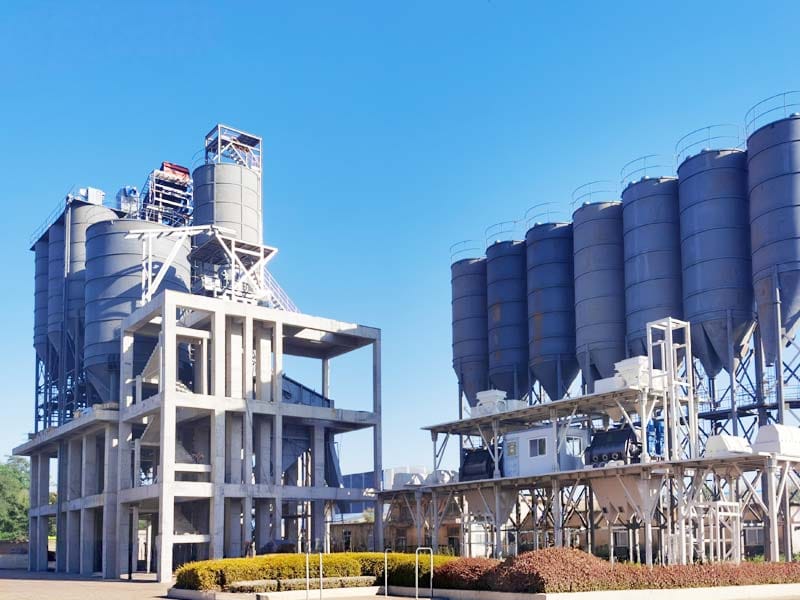
Dry mortar raw materials are the basis of the process design.
A plant making simple masonry mortar may use a limited number of sand and binder streams. A plant producing tile adhesive, self-leveling mortar, waterproof mortar and repair mortar can require several sand fractions, multiple powders, polymer additives, fibers and low-dose functional ingredients.
That difference changes:
- storage-bin count;
- silo count;
- weighing range;
- number of feeders;
- micro-dosing requirements;
- mixer cycle;
- changeover procedure;
- packaging design.
Dry mortar raw materials should therefore be defined before the equipment layout is frozen.
Build a Material Register for Every Product
A useful plant-design package should include a material register rather than a simple ingredient list.
| Material field | Thông tin để cung cấp | Tại sao nó quan trọng |
|---|---|---|
| Material name | Commercial or technical identity | Prevents confusion between similar powders |
| Function | Sand, binder, filler, polymer, fiber or additive | Helps assign storage and dosing method |
| Normal dose | Quantity per batch | Defines normal weighing range |
| Minimum dose | Smallest routine production quantity | Critical for micro-dosing design |
| Bulk density | Loose or specified bulk condition | Supports hopper and storage sizing |
| Moisture sensitivity | Dry, hygroscopic or moisture-variable | Affects storage and handling |
| Delivery form | Bulk tanker, bag, big bag or other | Defines receiving equipment |
When several products share the same line, repeat this exercise for each formulation family.
Sand Is Usually the Largest Dry Mortar Raw Material Stream
Sand often represents the largest material flow in dry mortar production.
For plant design, do not describe sand only as “0–3 mm.” Provide:
- source;
- cát tự nhiên hoặc cát sản xuất;
- full grading curve;
- hàm lượng bột;
- incoming moisture;
- mật độ khối;
- daily consumption;
- required storage time.
ASTM C144-26, the current specification for masonry mortar aggregate, recognizes both natural and manufactured sand but requires suitable grading and control of deleterious materials. That reinforces a key plant-design principle: dry mortar raw materials should be described by measurable properties, not only by material names.
One Sand Fraction May Not Serve Every Mortar Product
Masonry mortar, tile adhesive, self-leveling mortar and repair mortar can require different sand distributions.
If the factory produces several products, dry mortar raw materials planning may need:
- one broad sand fraction;
- several classified sand fractions;
- separate very fine sand;
- independent stone-powder or filler storage.
Của chúng tôi sand grading curve guide explains how sieve data can be converted into screen cuts and storage-bin requirements.
The number of sand bins should follow the product portfolio rather than an arbitrary standard layout.
Incoming Sand Moisture Changes the Process Boundary
Dry mortar requires dry aggregate.
If sand arrives wet, the production system may need:
- sand dryer;
- fuel or heat source;
- dust collection;
- cooling;
- dry sand elevator;
- screening after drying;
- dry storage.
If approved dry graded sand is purchased, those stages may not be needed.
Dry mortar raw materials information should therefore include both normal and worst-case incoming moisture.
Do not size a dryer only from wet-sand tonnes per hour. The actual water-removal duty changes with seasonal moisture.
Manufactured Sand Changes Upstream Equipment Requirements
If the factory makes its own manufactured sand, the dry mortar line becomes part of a larger integrated process.
Của chúng tôi nhà máy sản xuất cát và vữa đặc biệt tích hợp links crushing, screening, powder classification and sand storage with downstream mortar batching.
For dry mortar raw materials, the design package should then also include:
- parent rock;
- VSI feed grading;
- required sand fractions;
- powder-content target;
- fraction demand by mortar product.
Total manufactured-sand output is not enough if one critical fraction cannot meet downstream demand.
Cementitious Binders Need Separate Silo Planning
Dry mortar plants can use several cementitious binders.
Depending on the formulation, these may include cement and other project-specific hydraulic or mineral binders.
For dry mortar raw materials, define:
- number of bulk powders;
- whether they arrive by tanker or bags;
- consumption per batch;
- daily consumption;
- required silo autonomy;
- whether all powders are needed simultaneously.
These data determine silo count, silo capacity, screw conveyors and weighing strategy.
Mineral Fillers Should Not Be Treated Like Sand
Fine mineral fillers can have much lower particle size and different flow behavior from sand.
They may bridge, aerate or create more dust during transfer.
Dry mortar raw materials planning should identify:
- filler particle size;
- mật độ khối;
- moisture sensitivity;
- khả năng chảy;
- normal dose;
- delivery method.
A filler delivered in bulk may justify a dedicated silo, while a low-volume specialty filler may be handled through a bag-dump and smaller hopper.
Polymer Powders Need Dedicated Handling Review
Special mortars often use redispersible polymer powders or other functional polymer additives.
These materials can be used at much lower quantities than sand and cement.
For dry mortar raw materials, polymer information should include:
- normal dose;
- minimum dose;
- bag or bulk packaging;
- mật độ khối;
- humidity sensitivity;
- khả năng chảy;
- storage conditions.
A polymer powder should not automatically be assigned to the same large powder scale used for cement.
Micro-Additives Need Their Own Measuring Range
Cellulose ethers, accelerators, retarders, water repellents, pigments and other additives may be used in very small quantities.
This can make micro-dosing one of the most demanding parts of the line.
For each additive, provide:
- smallest routine dose;
- normal dose;
- maximum dose;
- number of additives used in one recipe;
- whether additives can be weighed in parallel;
- whether manual addition is acceptable.
Của chúng tôi dry mortar weighing accuracy guide explains why minimum production dose matters more than display resolution alone.
Fibers Need a Different Feeding Strategy
Fibers are not free-flowing powders.
Depending on material and length, they can bridge, clump or feed unevenly.
Dry mortar raw materials information for fibers should include:
- fiber material;
- fiber length;
- mật độ khối;
- dose per batch;
- packaging form;
- bridging tendency;
- required dispersion quality.
The feeder and mixing sequence should be selected around the actual fiber rather than assuming a powder screw is suitable.
Gypsum-Based Materials Need Product Separation Planning
A plant producing both gypsum-based and cement-based products needs additional changeover control.
Residual binder can affect the next product’s setting behavior.
For dry mortar raw materials, identify whether gypsum and cement products share:
- silos;
- weigh hoppers;
- băng tải trục vít;
- mixer;
- finished-product bins;
- packaging equipment.
Của chúng tôi dry mortar mixer cleaning guide explains why some binder-family changes require stricter separation and cleaning.
Pigments Can Change Cleaning and Batch-Sequence Requirements
Colored mortars may use relatively small pigment doses but can create visible carryover into the next product.
Dry mortar raw materials planning should therefore include:
- pigment colors;
- dose range;
- number of colored products;
- cleaning sensitivity;
- production sequence.
A plant that mainly produces gray mortar can use a different changeover strategy from a plant producing white and multiple colored products.
Material Flowability Affects Hopper and Conveyor Design
Two powders with similar density can flow very differently.
Dry mortar raw materials should therefore be reviewed for:
- cohesiveness;
- bridging tendency;
- ratholing;
- aeration;
- wall friction;
- storage-time sensitivity.
Của chúng tôi hopper bridging guide explains why outlet size, wall geometry and feeder interface should be designed around the material.
A screw conveyor cannot correct a hopper that does not discharge reliably.
Bulk Density Affects Storage and Mixer Fill
Bulk density converts required mass into occupied volume.
If a product uses low-density fillers or fibers, the mixer can reach a high volumetric fill before reaching the expected batch mass.
For dry mortar raw materials, provide actual or supplier bulk-density data for:
- sand fractions;
- binders;
- fillers;
- polymers;
- fibers.
These data help size hoppers, silos and mixer batch volume more realistically.
Very Fine Powders Increase Dust-Control Demand
Fine dry mortar raw materials can become airborne during:
- mở túi;
- silo filling;
- weighing;
- transfer;
- sạc máy trộn;
- bao bì.
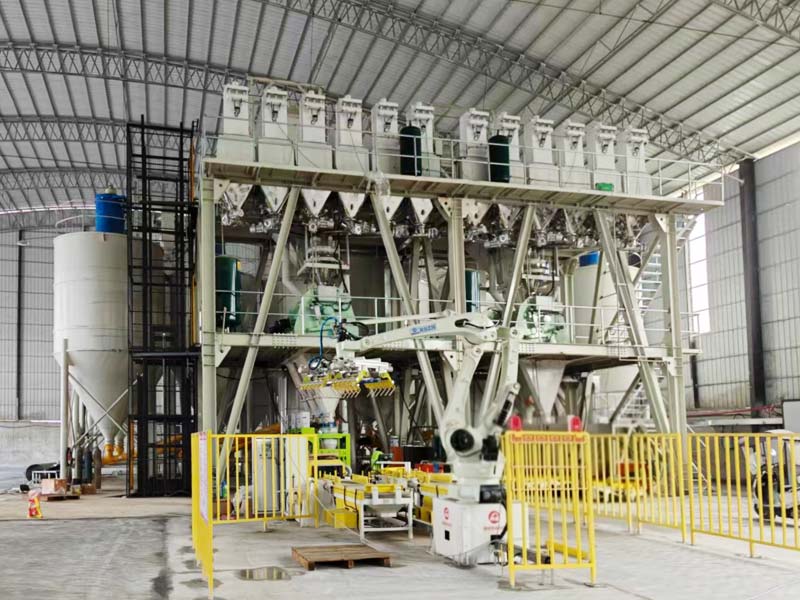
Our tower plant uses enclosed negative-pressure operation and pulse dust collection, while the workshop plant also uses pulse dust collection around its horizontal process.
The UK Health and Safety Executive’s hướng dẫn thông gió khí thải địa phương emphasizes controlling contaminants close to the source.
Dust-control requirements should therefore be mapped material by material and transfer point by transfer point.
Material Temperature Can Matter After Sand Drying
Dry sand leaving a drying process may be hotter than the storage and additive systems are designed to receive.
This can matter when the mortar contains temperature-sensitive polymers or additives.
Dry mortar raw materials planning should define whether sand cooling is required before:
- lưu trữ;
- weighing;
- trộn;
- contact with specialty additives.
The need for cooling should be determined from the actual drying process and product formulation.
Raw Material Variability Affects Automation Strategy
A highly stable purchased material stream may need less operator intervention than a material whose grading, moisture or flow changes frequently.
For dry mortar raw materials, ask which properties vary between deliveries.
Possible monitored variables include:
- sand grading;
- sand moisture;
- mật độ khối;
- powder flowability;
- material lot;
- color;
- supplier source.
These variables can be linked with recipe management, sampling and batch records.
Raw Material Storage Time Should Be Defined
Storage capacity should not be sized only from the largest silo that fits the site.
Some dry mortar raw materials are sensitive to long storage, humidity or compaction.
For each material, define:
- daily consumption;
- delivery interval;
- desired storage autonomy;
- maximum preferred storage time;
- first-in/first-out requirements.
This helps balance storage security against unnecessary long-term inventory.
Packaging Behavior Is Also a Raw-Material Question
The finished mortar’s bulk density and flowability are created by the combination of dry mortar raw materials.
That means packaging performance can change when sand, filler or polymer content changes.
Review:
- finished bulk density;
- powder flow;
- air release during filling;
- bag type;
- target net weight;
- dust generation.
Của chúng tôi mortar bag weight variation guide explains how material behavior can affect the final packing stage.
Different Layouts Suit Different Material Profiles
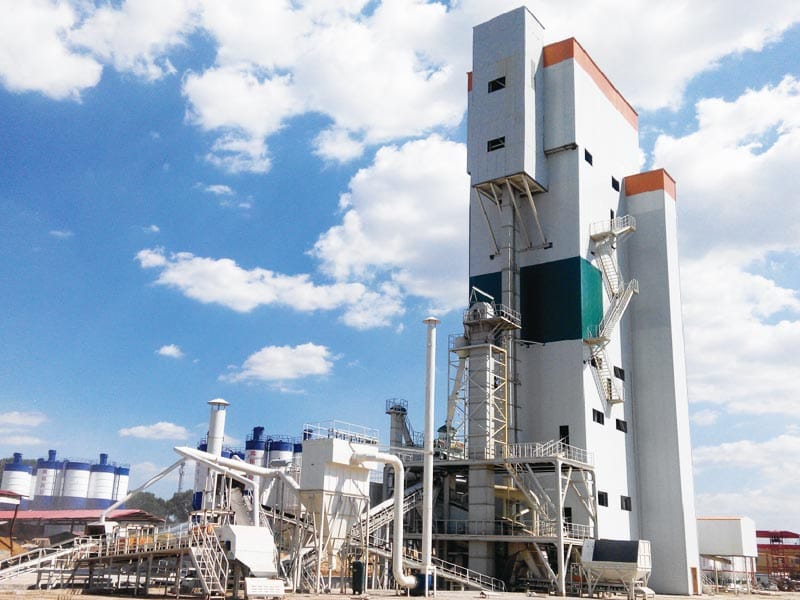
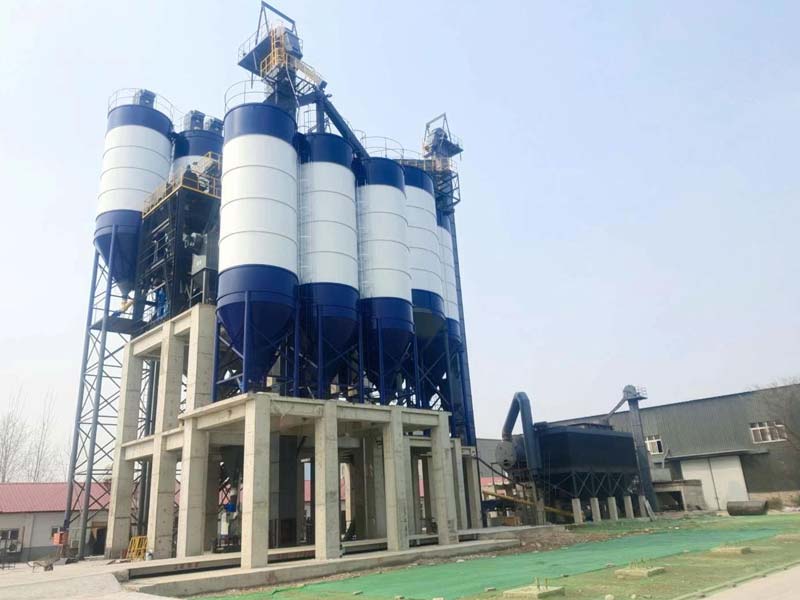
MixingPlantPro currently offers tower, step and workshop dry mortar configurations. The nhà máy kiểu tháp uses vertical gravity flow, while the workshop-type plant uses a horizontal layout connected by screw conveyors.
Dry mortar raw materials help determine which layout is practical.
A product portfolio with many specialty additives and frequent small batches may value direct access to feeders and changeover points. A large repetitive product portfolio may benefit from more vertically integrated material flow.
The layout should follow the process and material profile, not only the output target.
Use Raw Material Data to Size the Weighing Systems
Each scale should be selected around the material quantities it will actually measure.
For dry mortar raw materials, prepare a matrix of:
| Material | Minimum dose | Normal dose | Maximum dose | Preferred weighing system |
|---|---|---|---|---|
| Sand | Project-specific | Project-specific | Project-specific | Bulk aggregate scale |
| Cement/binder | Project-specific | Project-specific | Project-specific | Powder scale |
| Filler | Project-specific | Project-specific | Project-specific | Powder or dedicated scale |
| Polymer/additive | Project-specific | Project-specific | Project-specific | Micro-dosing system where required |
The exact scale architecture should be validated from the real recipes.
Commission the Plant with Representative Raw Materials
Factory logic testing alone cannot prove that all dry mortar raw materials will flow, weigh, mix and package correctly.
Site commissioning should use representative materials where practical.
Verify:
- bin discharge;
- screw-conveyor flow;
- weighing time;
- minimum additive dose;
- fiber feeding;
- mixing sequence;
- tải máy trộn;
- chuyển thành phẩm;
- packaging behavior;
- dust collection.
Then confirm the finished mortar through the applicable product testing program.
What Should Buyers Send Before Plant Design?
A useful plant-design request should include a complete dry mortar raw materials package.
Cung cấp:
- product list;
- recipe ingredient list;
- minimum, normal and maximum dose of each material;
- sand grading and moisture;
- binder and filler bulk density;
- polymer and additive packaging form;
- fiber details;
- material delivery method;
- storage-time requirements;
- dust or humidity concerns;
- lịch trình sản xuất bắt buộc;
- site or workshop dimensions.
These inputs allow storage, weighing, conveying, mixing and packaging to be configured around real dry mortar raw materials rather than a generic plant template.
Send your material list and product portfolio through our trang liên h for a project-specific dry mortar line review.
Kết luận
Dry mortar raw materials are the starting point for production-line design. Sand grading and moisture define aggregate handling. Binders and fillers define silo and powder transfer needs. Polymers, fibers and micro-additives determine low-dose feeding, mixing and cleaning requirements.
The strongest plant design begins with a detailed material register showing physical properties, dose range, delivery form and product usage.
When those data are prepared before equipment selection, the dry mortar line can be sized and arranged around the real formulations instead of forcing the formulations to fit a generic plant.
Câu hỏi thường gặp
What are the main dry mortar raw materials?
Common material groups include sand, cementitious binders, mineral fillers, polymer powders, fibers and low-dose functional additives. The exact materials depend on the mortar product.
Why is sand moisture important for dry mortar plant design?
Dry mortar needs dry aggregate. Wet sand may require drying, cooling, screening and protected storage before it can enter the batching and mixing process.
Why do micro-additives need separate dosing equipment?
Their production quantities can be much smaller than sand or cement. A large bulk-material scale may not provide a practical measuring range for the smallest routine additive dose.
Can all dry mortar raw materials use screw conveyors?
No. Powders, fibers and other materials can have very different flow behavior. Conveyor and feeder selection should follow bulk density, particle form, bridging tendency and required dosing rate.
What raw material data should be sent to the plant supplier?
Provide ingredient names, dose ranges, grading, moisture, bulk density, delivery form, storage requirements and the products that use each material.


