
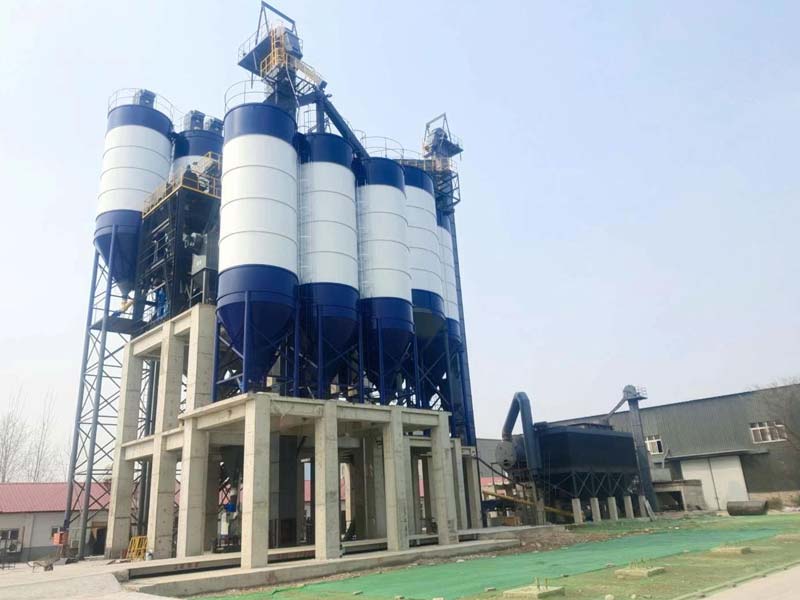
Dry mortar mixer cleaning is not only a housekeeping task. In a multi-product plant, cleaning determines whether residue from the previous batch remains inside the mixer, enters the next formulation, blocks inspection points, or creates a safety problem when technicians access the equipment.
For dry mortar producers, the cleaning plan should distinguish normal production cleaning, product-changeover cleaning and internal maintenance cleaning. These activities have different objectives and different safety requirements. A quick purge between similar products is not the same as opening the mixer for manual cleaning, and neither should be treated as a substitute for proper inspection.
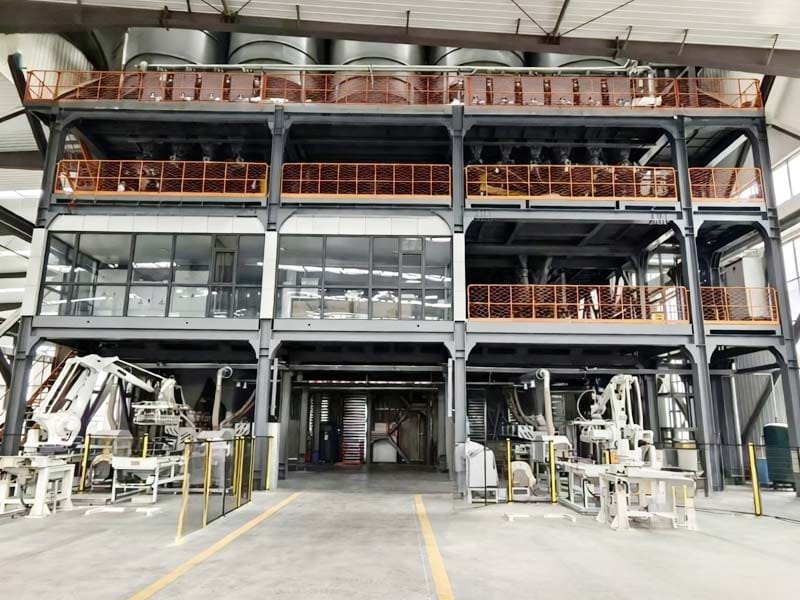
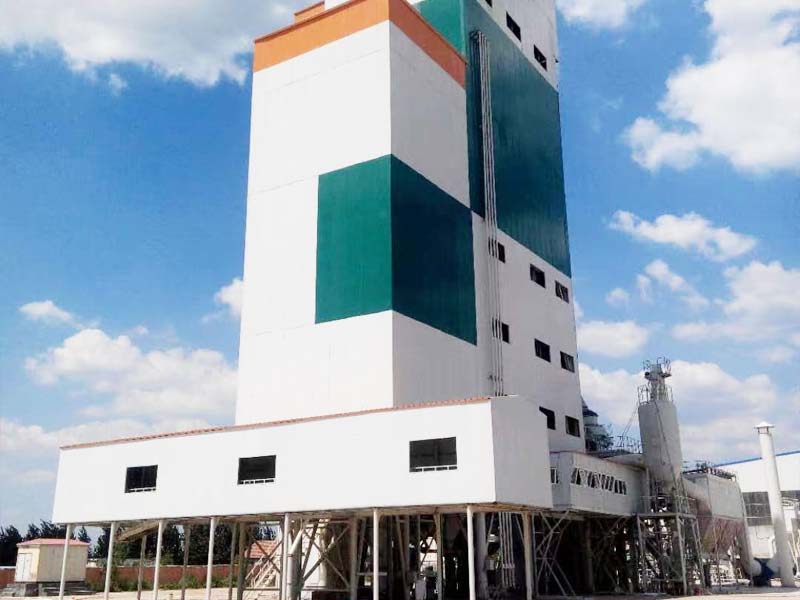
لدينا مصنع خلط الملاط الجاف من نوع الورشة uses a horizontal layout with screw conveyors and emphasizes convenient maintenance access, while our مصنع الملاط الجاف من النوع البرجي uses vertical gravity flow, enclosed dust control and automated production. This guide explains how dry mortar mixer cleaning should be planned around safe access, product separation and real production changeovers.
Why Dry Mortar Mixer Cleaning Matters

Dry mortar mixers handle materials that can behave very differently from one product to another.
A plant may switch between:
- masonry mortar;
- tile adhesive;
- self-leveling mortar;
- waterproof mortar;
- repair mortar;
- gypsum-based products;
- colored or fiber-containing specialty mortars.
Residual powder, sand, polymer, fiber or pigment from one product can change the next product if the quantity is significant relative to the new batch.
Dry mortar mixer cleaning therefore supports both equipment condition and product integrity.
Separate Routine Cleaning from Changeover Cleaning
Not every cleaning task needs the same level of shutdown or dismantling.
| Cleaning type | Main purpose | Typical trigger |
|---|---|---|
| Routine external cleaning | Remove dust and buildup around accessible surfaces | Daily or shift-based housekeeping |
| Production purge | Reduce residue between similar products | Recipe change with compatible product family |
| Changeover cleaning | Prevent carryover into a sensitive next product | Major formula, color, fiber or additive change |
| Internal maintenance cleaning | Remove buildup and inspect mixer condition | Planned maintenance or abnormal residue |
Dry mortar mixer cleaning should be defined by product risk and access level rather than by one universal frequency.
Product Carryover Is the Main Changeover Risk
Carryover occurs when material from the previous product remains inside the mixer or connected equipment and later enters the next batch.
This can come from:
- mixer corners;
- discharge gates;
- shaft or paddle areas;
- inspection-door edges;
- قواديس الوزن؛;
- الناقلات اللولبية؛;
- finished-product buffers.
For dry mortar mixer cleaning, the question is not whether the mixer looks visually clean from the access door. The real question is whether enough residue remains to affect the next product.
Not Every Product Change Requires the Same Cleaning Level
A plant switching between two similar masonry mortar recipes may need a different procedure from a plant switching from white tile adhesive to gray repair mortar containing fibers.
Changeover risk increases when the next product is sensitive to:
- color;
- polymer content;
- fiber contamination;
- setting modifiers;
- gypsum or cement cross-contamination;
- very small additive quantities.
Dry mortar mixer cleaning should therefore be linked to a product-change matrix.
Build a Product Changeover Matrix
A product changeover matrix helps the production team decide what level of cleaning is required between product families.
| Previous product | Next product | Potential concern | Cleaning level |
|---|---|---|---|
| Gray masonry mortar | Similar gray masonry mortar | Low formula sensitivity | Project-defined purge or routine clean |
| Gray mortar | White tile adhesive | Color carryover | Higher cleaning level |
| Fiber repair mortar | Non-fiber mortar | Fiber residue | Targeted internal cleaning may be required |
| Gypsum-based product | Cement-based product | Binder contamination | Strict changeover procedure |
These examples are illustrative. The actual matrix should come from the factory’s formulations and quality requirements.
Use Production Sequence to Reduce Cleaning Demand
Production scheduling can reduce the number of difficult changeovers.
For example, a factory may group similar products together before switching to a more sensitive formulation.
Dry mortar mixer cleaning can become easier when production runs are arranged by:
- color family;
- binder family;
- fiber use;
- polymer level;
- powder fineness;
- cleanliness sensitivity.
This does not eliminate cleaning, but it can reduce unnecessary full cleanouts between compatible products.
Know Where Residue Actually Accumulates
Mixer residue is rarely distributed evenly.
Typical accumulation points can include:
- dead corners;
- behind mixing arms;
- around shaft penetrations;
- under paddles;
- above discharge doors;
- around seals and inspection covers.
Dry mortar mixer cleaning should therefore be based on a physical residue map developed during maintenance inspections.
If the same area repeatedly retains product, the engineering team should review whether geometry, wear or buildup is creating a stagnant zone.
Worn Mixing Components Can Increase Residue
As paddles, liners or scrapers wear, clearances can change and material can remain in areas that were previously swept clean during normal operation.
This means a cleaning problem can also be a maintenance problem.
During dry mortar mixer cleaning, inspect:
- mixing tools;
- liners;
- scrapers;
- السحابات؛;
- discharge-door edges;
- areas of repeated buildup.
Do not compensate permanently for worn components by increasing manual cleaning time.
Discharge Gates Need Special Cleaning Attention
The discharge gate is one of the most common locations for trapped dry mortar.
Residue around the gate can:
- prevent full closure;
- contaminate the next batch;
- increase leakage;
- create hardened buildup;
- change discharge time.
Dry mortar mixer cleaning should include both the visible gate surface and the surrounding sealing area where access is permitted.
If the gate does not return to a repeatable clean position, production teams should investigate wear or mechanical alignment as well as residue.
Purge Material Should Have a Defined Destination
Some plants use a purge material or sacrificial batch to remove residue before producing the next sensitive product.
If this method is used, the factory should define:
- which material is used;
- how much is required;
- where the purge product is discharged;
- whether it can be reused;
- how it is identified;
- how the operator confirms completion.
Dry mortar mixer cleaning should not create an unidentified material stream that later returns to normal production accidentally.
Do Not Assume Purging Replaces Internal Inspection
A purge can reduce loose residue but may not remove compacted material, hardened buildup or fibers trapped behind components.
Dry mortar mixer cleaning still needs periodic physical inspection according to the equipment manual and plant maintenance plan.
If inspection shows buildup after repeated purge cycles, the process should be reviewed.
Internal Cleaning Is a Maintenance Activity
Opening a mixer and manually removing residue is different from routine production housekeeping.
إدارة السلامة والصحة المهنية التحكم في معايير الطاقة الخطرة explicitly includes cleaning and unjamming within servicing and maintenance when workers can be exposed to unexpected startup or release of hazardous energy. citeturn214375search0turn214375search3
Before internal dry mortar mixer cleaning, the site procedure should address all hazardous energy sources that can affect the mixer.
Lock Out More Than the Mixer Motor
Internal cleaning can be hazardous even when the main mixer motor is switched off.
Potential energy sources can include:
- قوة محرك الخلاط؛;
- upstream feeders;
- الناقلات اللولبية؛;
- pneumatic discharge gates;
- hydraulic systems where fitted;
- automatic valves;
- stored mechanical energy;
- material that can fall from above.
Dry mortar mixer cleaning should use the plant’s approved energy-control procedure to isolate all relevant sources.
OSHA requires energy-control procedures to include shutdown, isolation, lockout/tagout application and verification of isolation effectiveness. citeturn214375search5
Verify Isolation Before Accessing the Mixer
Turning the selector switch to “manual” or “maintenance” does not by itself prove the mixer is isolated.
The approved procedure should include verification that hazardous energy has actually been controlled before a worker enters or reaches into the mixer.
For dry mortar mixer cleaning, verification may include:
- checking electrical isolation;
- verifying pneumatic pressure is released or secured;
- confirming upstream feed equipment cannot start;
- confirming discharge components are secured;
- testing the control circuit according to procedure.
The exact method depends on the installed equipment and facility safety program.
Access Doors Should Support Cleaning Without Creating New Hazards
Mixer access design affects both cleaning time and safety.
For dry mortar mixer cleaning, review:
- door size;
- door location;
- platform access;
- guarding;
- lighting;
- working posture;
- ability to remove residue from hidden areas.
A small inspection door may be enough for visual checks but not for major maintenance.
The plant layout should distinguish routine inspection access from full internal maintenance access.
Workshop Layouts Can Simplify Physical Access
Our workshop-type dry mortar plant arranges core equipment on the same or similar workshop floor and connects stages by screw conveyors. The public product page emphasizes convenient installation and maintenance access. citeturn871953search0
For dry mortar mixer cleaning, that horizontal layout can make some feeders, screw conveyors and service points easier to reach.
However, the workshop still needs:
- clear space around access doors;
- room to remove screws or mixer parts;
- safe platforms where needed;
- dust-control duct access;
- cleaning-waste handling space.
Tower Layouts Need Planned Elevated Access
A tower-type plant moves material vertically through batching, mixing, storage and packaging. citeturn871953search1
For dry mortar mixer cleaning, this means service access may be at elevated levels.
مراجعة:
- stairs and platforms;
- guardrails;
- mixer access-door clearance;
- lifting points;
- cleaning tool access;
- material-removal route.
Vertical gravity flow can reduce mechanical transfers, but it does not eliminate the need for safe maintenance access around the mixer.
Cleaning Dust Must Be Controlled
Manual brushing, scraping or vacuuming can release fine mortar dust.
Dry mortar mixer cleaning should therefore be integrated with the facility’s dust-control and personal-protection procedures.
Avoid uncontrolled compressed-air blowdown unless the facility procedure specifically allows it and the exposure risk has been addressed.
Where practical, use methods that capture residue instead of redistributing it through the workshop.
Use Suitable Industrial Vacuum or Collection Methods
Fine powder removed during cleaning should have a controlled collection route.
The plant should determine:
- what collection equipment is permitted;
- where recovered material goes;
- whether the residue is reusable;
- how cross-contamination is prevented;
- how dust exposure is controlled.
Dry mortar mixer cleaning should not turn the surrounding floor into a secondary source of contamination.
Water Cleaning Is Not Automatically Appropriate
Dry mortar plants are designed to handle dry materials.
Introducing water into the mixer can create caking, corrosion or difficult residue depending on the product and mixer design.
For dry mortar mixer cleaning, do not use water unless the manufacturer and plant procedure specifically permit it.
Dry mechanical cleaning or approved vacuum methods may be more appropriate for many dry mortar systems.
Gypsum and Cement Products Need Special Separation
A plant producing both gypsum-based and cement-based products should pay particular attention to cross-contamination.
Residual binder from one product family can affect the setting behavior of another.
Dry mortar mixer cleaning between these product families should be based on validated changeover criteria, not only visual cleanliness.
Where the risk is high, the plant may need:
- dedicated product campaigns;
- stricter purge rules;
- targeted internal cleaning;
- separate storage or transfer equipment.
Fiber Products Can Leave Hidden Residue
Fibers can remain trapped around mixing arms, gates or internal edges after the bulk powder has discharged.
If the next product does not contain fiber, even a small visible carryover may be unacceptable for appearance or application reasons.
Dry mortar mixer cleaning after fiber-containing products should include specific inspection points where fibers tend to accumulate.
Colored Products Need a Different Cleaning Standard
Pigments can leave visible residue even at relatively low quantities.
For factories making white, gray or colored products, the cleaning sequence should usually move from lower-risk colors toward more sensitive products only when the approved changeover procedure allows it.
Dry mortar mixer cleaning criteria for color-sensitive products should be linked to finished-product appearance testing.
Cleaning Frequency Should Follow Product Risk and Condition
A fixed daily cleaning rule may be too frequent for one product and insufficient for another.
Dry mortar mixer cleaning frequency can depend on:
- product family;
- number of recipe changes;
- fiber or pigment use;
- polymer content;
- residue observed during inspection;
- mixer wear condition;
- storage time between production runs.
Use a base procedure plus condition-based inspection rather than relying on one universal interval.
Keep Cleaning Records for Sensitive Products
Cleaning records help trace whether a quality issue followed a specific product change.
| Record field | لماذا يهم |
|---|---|
| Previous product | Identifies potential carryover material |
| Next product | Defines contamination sensitivity |
| Cleaning method | Shows whether purge or internal clean was used |
| Inspection result | Confirms visible residue condition |
| Operator | Provides traceability |
| Release approval | Confirms production can restart |
Dry mortar mixer cleaning records are especially useful for specialty mortars with tight color, fiber or additive requirements.
Inspect Downstream Equipment Too
Cleaning the mixer alone may not prevent contamination if residue remains in downstream transfer equipment.
Check:
- finished-product screw conveyors;
- buffer hoppers;
- packaging feeders;
- bulk-loading chutes;
- sampling points.
Dry mortar mixer cleaning should be part of a complete changeover plan from the last ingredient feeder through the finished-product route.
Inspect Upstream Feeders for Residue
Micro-additive feeders, powder weigh hoppers and screw conveyors can also hold residue.
If a polymer, pigment or fiber remains upstream, the next batch can become contaminated even when the mixer is clean.
The product-change matrix should therefore identify which upstream points require cleaning for each changeover.
Do Not Restart Until the Work Area Is Restored
After internal cleaning, the mixer should not return to production immediately.
OSHA’s lockout/tagout standard requires the work area to be inspected, nonessential items removed, and employees safely positioned before energy is restored. citeturn214375search0
For dry mortar mixer cleaning, the restart check should include:
- all tools removed;
- cleaning residue removed;
- access doors closed;
- guards restored;
- discharge gate checked;
- upstream and downstream equipment ready;
- affected employees notified according to site procedure.
Use a Controlled First Batch After Major Cleaning
After a major product change or internal clean, the first production batch deserves additional attention.
Depending on the quality plan, the plant may:
- inspect the first discharge;
- take a sample;
- verify color or fiber absence;
- check packaging behavior;
- hold the batch pending quality approval.
The exact release method should reflect the product risk.
Design Cleaning Access Before Buying the Plant
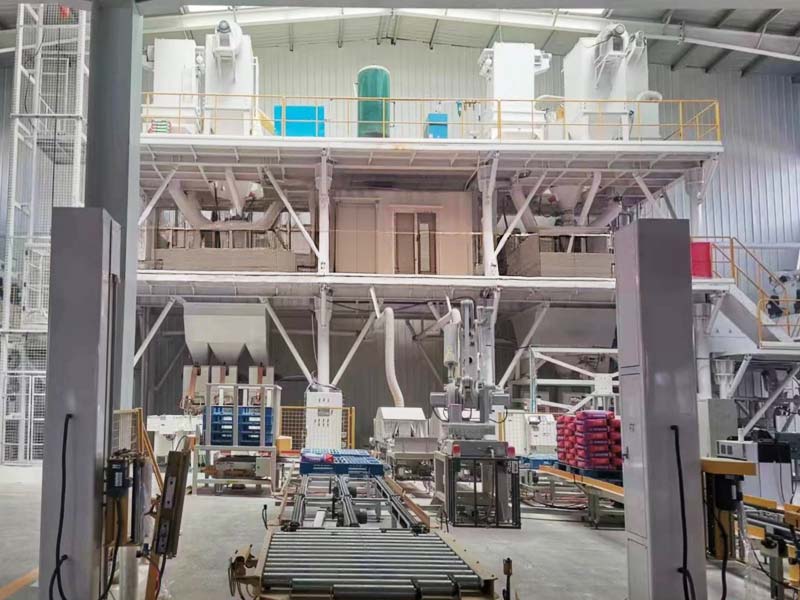
Cleaning efficiency is partly determined during equipment selection.
Ask the supplier:
- Where are the mixer access doors?
- Which residue points require inspection?
- Can the discharge gate be reached safely?
- Can wear parts be removed without dismantling unrelated equipment?
- What energy sources need isolation?
- What cleaning methods does the mixer manual permit?
- How much space is required around the mixer?
لدينا dry mortar plant layout guide explains why cleaning, maintenance and changeover access should be included in the plant arrangement from the beginning.
What Should Buyers Send for a Cleaning and Changeover Review?
A useful dry mortar mixer cleaning review should include the real product portfolio.
يقدم:
- product families;
- color changes;
- gypsum and cement product mix;
- fiber-containing products;
- polymer-rich products;
- number of changeovers per shift;
- حجم الدفعة العادي؛;
- required cleaning time window;
- site or workshop dimensions;
- quality-control release requirements.
لدينا dry mortar solutions can then be reviewed around both production capacity and practical changeover requirements. citeturn871953search3
Send your product range and production schedule through our صفحة الاتصال for a project-specific dry mortar line review.
خاتمة
Dry mortar mixer cleaning should be planned as part of production, quality control and maintenance. Routine housekeeping, purge cleaning, sensitive product changeover and internal maintenance cleaning all serve different purposes.
The strongest cleaning plan maps residue points, groups products by contamination risk, uses safe access and hazardous-energy control, and extends the changeover procedure beyond the mixer to upstream and downstream equipment.
When cleaning requirements are considered during plant selection and scheduling, the factory can reduce cross-contamination, shorten changeovers and maintain safer access without relying on emergency manual cleaning.
الأسئلة الشائعة
How often should a dry mortar mixer be cleaned?
There is no universal interval. Cleaning frequency should reflect product type, changeover frequency, fiber or pigment use, residue condition and the mixer manufacturer’s maintenance instructions.
Can purge material replace internal mixer cleaning?
Not always. Purging can reduce loose residue but may not remove compacted material, fibers or buildup in hidden areas. Periodic internal inspection is still necessary according to the maintenance plan.
Does mixer cleaning require lockout/tagout?
If cleaning exposes workers to unexpected startup, stored energy or moving parts, the applicable hazardous-energy control procedure should be used. Internal cleaning generally requires a formal isolation process.
Can water be used to clean a dry mortar mixer?
Only if the mixer manufacturer and plant procedure specifically permit it. Water can cause caking, corrosion or additional residue in dry mortar equipment, so dry cleaning methods are often preferred.
What should be cleaned during a product changeover?
Depending on contamination risk, cleaning may include the mixer, micro-additive feeders, weighing hoppers, screw conveyors, buffer hoppers and packaging feeders. The required scope should be defined by a product-change matrix.


