

Thermal insulation mortar production places unusual demands on a dry mortar plant because some of the materials used for insulation are much lighter, more fragile or less free-flowing than conventional sand and cement. A line designed around dense mineral materials can behave very differently when it starts handling low-bulk-density lightweight aggregate, expanded particles, fibers or fine insulating fillers.
For equipment buyers, the first design question should therefore be material behavior, not only tonnes per hour. Storage volume, feeder type, weighing range, conveying speed, mixer fill level and packaging performance can all change when lightweight materials are introduced.
لدينا مصنع خلط الملاط الجاف من النوع البرجي supports special mortar production including thermal insulation mortar, while MixingPlantPro also provides step-type and workshop-type dry mortar configurations through its dry mortar solutions. This guide explains which material-handling questions should be answered before a thermal insulation mortar production line is finalized.
What Makes Thermal Insulation Mortar Production Different?
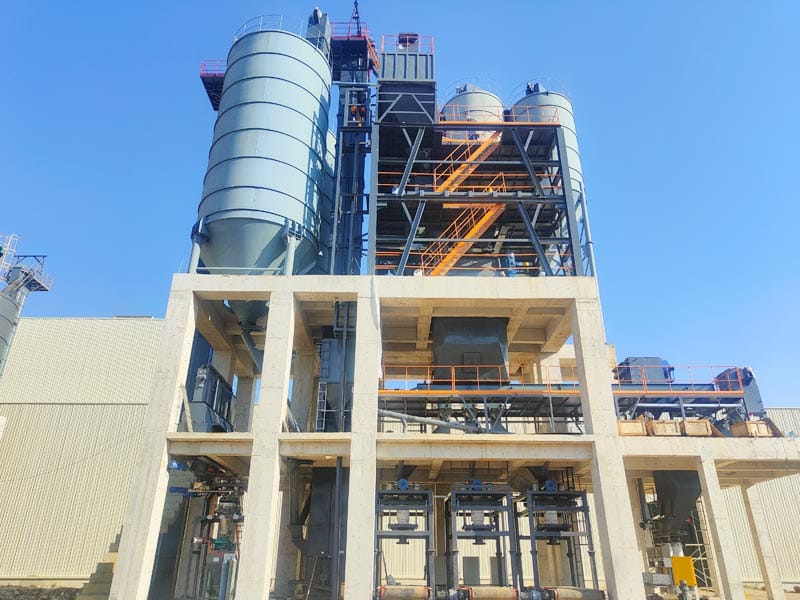
Thermal insulation mortar typically relies on a formulation that reduces density and thermal conductivity compared with conventional cement-sand mortar.
Depending on the product system, this can involve:
- lightweight mineral aggregate;
- expanded or porous particles;
- fine mineral fillers;
- cementitious binders;
- polymers;
- fibers;
- air-entraining or rheology-modifying additives.
These ingredients do not all behave like dense dry sand.
Thermal insulation mortar production therefore needs equipment selected around the physical behavior of the actual formulation.
Start with Bulk Density, Not Only Mass Flow
Low-density material occupies more volume for the same mass.
That changes storage, feeder and mixer design.
Consider a simplified example. If one aggregate has a bulk density of 1,500 kg/m³ and another lightweight aggregate has a bulk density of 150 kg/m³, then 150 kg of the first material occupies about 0.10 m³ while 150 kg of the second occupies about 1.0 m³.
The arithmetic is illustrative only, but the engineering implication is important.
For thermal insulation mortar production, provide the actual bulk density of every lightweight material so the plant can size:
- storage bins;
- weigh hoppers;
- feeders;
- transfer equipment;
- mixer working volume.
Volumetric Mixer Loading Can Limit Batch Size
A mixer may reach its practical fill volume before the batch reaches the expected mass.
This can happen when thermal insulation mortar uses a large proportion of low-density lightweight aggregate.
For thermal insulation mortar production, do not calculate batch size only from tonnes.
Check:
- bulk density of each ingredient;
- total loose volume before mixing;
- expected compaction during mixing;
- mixer working volume;
- minimum and maximum batch size.
A line designed for dense dry mortar can be volumetrically overloaded by a much lighter product.
Lightweight Aggregate Can Be Fragile
Some insulating aggregates can break down when exposed to excessive mechanical impact.
This can change:
- particle-size distribution;
- bulk density;
- water demand;
- finished mortar consistency.
For thermal insulation mortar production, review every transfer point for potential breakage.
Ask:
- How high is the material drop?
- Does the screw conveyor shear fragile particles?
- Does a bucket elevator create impact damage?
- Does the mixer overwork the lightweight aggregate?
The correct conveying method should preserve the approved material as much as practical.
Do Not Assume Screw Conveyors Suit Every Lightweight Material
Screw conveyors are widely used in dry mortar plants for powders and some granular materials.
However, low-density or fragile lightweight aggregate may behave differently from cement or sand.
Potential issues include:
- particle breakage;
- bridging at the inlet;
- poor screw filling;
- air entrainment;
- unstable feed rate.
Thermal insulation mortar production should therefore validate screw conveying with the real material before the system is finalized.
Gravity Flow Can Reduce Mechanical Handling
A tower-type dry mortar plant uses vertical gravity flow through storage, batching, mixing and packaging.
For thermal insulation mortar production, this can reduce the number of mechanical transfer stages for some materials.
However, gravity transfer still needs careful design because lightweight particles can:
- segregate;
- bridge;
- fluidize;
- generate dust;
- be damaged by long drops.
The tower layout is useful when the product and raw-material profile suit vertical integration, but the chute geometry and drop heights still need to be reviewed.
Storage Bins Need More Volume Than Dense-Material Design Suggests
Low bulk density means large storage volume.
If the lightweight aggregate is one of the main dry mortar raw materials, the storage system should be sized from:
- daily consumption by volume;
- delivery frequency;
- material bulk density;
- usable bin volume;
- required buffer time.
Thermal insulation mortar production can become constrained by storage volume even when the mass throughput appears modest.
Bin Geometry Should Match Flowability
Some lightweight materials flow freely. Others can bridge or form stable arches.
For thermal insulation mortar production, provide information on:
- particle size;
- particle shape;
- bulk density;
- angle of repose;
- حساسية الرطوبة؛;
- bridging tendency.
لدينا hopper bridging guide explains why outlet size, wall angle and feeder interface need to match the actual material.
Fine Insulating Fillers Can Create Dust Problems
Some thermal insulation mortar formulations use very fine mineral or lightweight powders.
These materials can become airborne during:
- bag opening;
- silo filling;
- weighing;
- transfer;
- شحن الخلاط؛;
- packaging.
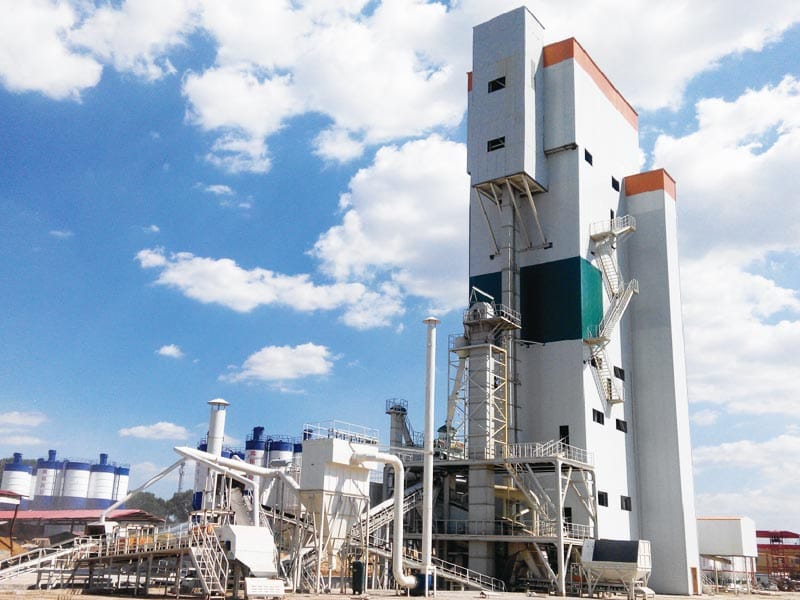
MixingPlantPro’s tower-type plant uses enclosed negative-pressure production and pulse dust collection in its published configuration.
Dust control should be designed around the finest and lightest raw materials, not only the main sand stream.
Lightweight Aggregate Can Be Easily Carried by Airflow
Very light particles can move with ventilation or dust-extraction airflow.
This creates a special challenge.
Too little dust extraction can increase airborne powder. Too much extraction close to a lightweight-material transfer point can remove useful product.
For thermal insulation mortar production, dust-control commissioning should verify both:
- workplace dust control;
- material loss into the collection system.
The extraction system should capture dust without becoming an unintended classifier.
Weighing Systems Need to Work at Low Bulk Density
A weigh hopper selected by mass may still be too small by volume for a lightweight ingredient.
For thermal insulation mortar production, define:
- minimum dose;
- جرعة عادية؛;
- maximum dose;
- bulk density;
- required hopper volume;
- feeding time.
A large-volume low-mass ingredient may require a physically larger hopper than its weight alone suggests.
Minimum Dose Still Matters for Lightweight Additives
Some thermal insulation mortar formulas combine lightweight aggregate with relatively small doses of polymer, cellulose ether, air-entraining additives or other modifiers.
The plant therefore needs two different measuring capabilities:
- large-volume low-density material handling;
- small-mass micro-additive dosing.
لدينا dry mortar weighing accuracy guide explains why the smallest routine dose should be checked independently from the main bulk scale.
Fibers Need Separate Feeding Review
Fibers are often used to improve crack control or application behavior in specialty mortars.
For thermal insulation mortar production, fibers can create:
- bridging;
- clumping;
- poor feeder repeatability;
- dispersion problems.
يقدم:
- fiber material;
- fiber length;
- bulk density;
- dose;
- packaging form;
- feeding method.
Do not assume the same screw used for fine powder can meter fibers reliably.
Mixing Sequence Can Protect Fragile Aggregate
The order of ingredient addition can affect both dispersion and particle damage.
A thermal insulation mortar production sequence may need to balance:
- dispersion of cement and fillers;
- micro-additive distribution;
- fiber separation;
- protection of lightweight aggregate.
In some formulations, adding fragile lightweight particles later in the cycle may reduce unnecessary mechanical stress.
The actual sequence should be validated experimentally for the approved formulation and mixer.
Mixing Time Should Be Validated by Uniformity and Particle Integrity
Longer mixing is not automatically better.
Insufficient mixing can leave additives unevenly distributed. Excessive mixing can damage fragile particles or fibers.
For thermal insulation mortar production, commissioning should compare:
- وقت الخلط؛;
- batch uniformity;
- lightweight aggregate condition;
- bulk density;
- finished mortar performance.
The optimum time is product-specific.
Segregation Can Occur After the Mixer
A well-mixed product can segregate during discharge or transfer if materials have very different density and particle size.
This risk is especially important in thermal insulation mortar production.
مراجعة:
- mixer discharge height;
- finished-product screw conveyors;
- bucket elevators;
- buffer hoppers;
- packaging feeders;
- long free-fall distances.
Post-mixer handling should preserve the uniformity achieved inside the mixer.
Bulk Density Variation Can Affect Packaging
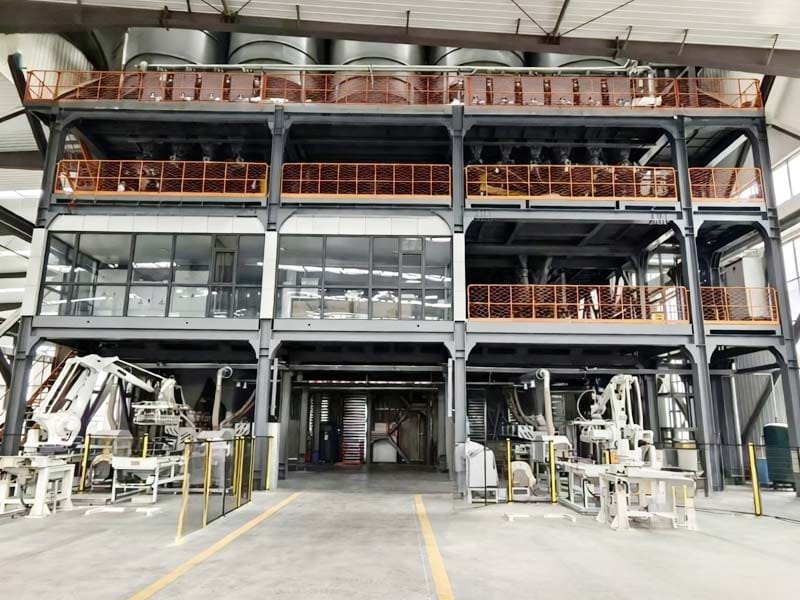
Finished thermal insulation mortar can have a much lower bulk density than conventional mortar.
This can change:
- bag volume;
- filling speed;
- air release;
- packer cutoff;
- finished bag dimensions.
For thermal insulation mortar production, packaging equipment should be tested using the actual finished product.
A packer configured for dense masonry mortar may behave differently with a lightweight formulation.
Bag Size Should Be Checked by Volume as Well as Weight
A 20 kg bag of lightweight mortar can occupy much more volume than a 20 kg bag of dense mortar.
That affects:
- bag dimensions;
- filling spout design;
- sealing;
- pallet pattern;
- warehouse space;
- transport volume.
Thermal insulation mortar production should therefore confirm bag volume during packaging trials.
Raw Material Moisture Still Needs Control
Although lightweight materials can behave differently from sand, dry mortar production still requires controlled moisture.
Moisture can cause:
- caking;
- bridging;
- unstable weighing;
- reduced storage stability;
- poor additive performance.
If the insulation aggregate is hygroscopic or stored in humid conditions, protected storage becomes especially important.
Product Changeovers Need Residue Control
A thermal insulation mortar line may also produce tile adhesive, plaster, repair mortar or other specialty products.
Low-density particles and fibers can remain in:
- mixer corners;
- discharge gates;
- الناقلات اللولبية؛;
- buffer hoppers;
- packers.
لدينا dry mortar mixer cleaning guide explains how changeover cleaning should be based on contamination risk rather than one universal procedure.
Thermal Insulation Mortar May Need More Storage Volume Than Throughput Suggests
A line with moderate mass output can still require substantial storage space because lightweight raw materials and finished product occupy more volume.
For thermal insulation mortar production, calculate:
- raw-material cubic meters per hour;
- finished-product cubic meters per hour;
- buffer hopper volume;
- warehouse volume;
- bag storage volume.
This prevents the project from underestimating space because it looked only at tonnes per hour.
Tower and Step Layouts Should Be Compared by Material Behavior
MixingPlantPro offers both tower-type and step-type dry mortar plants within its dry mortar solutions.
For thermal insulation mortar production, the comparison should focus on:
- number of mechanical transfers;
- drop heights;
- الوصول إلى الصيانة؛;
- lightweight-material storage location;
- micro-dosing layout;
- finished-product transfer.
A tower plant can reduce some conveying stages through gravity flow, while a step layout can offer a different balance of height, access and material transfer.
The actual choice should follow the raw-material profile and site constraints.
Do Not Reuse Generic Capacity Numbers Without Product Validation
Thermal insulation mortar can be volumetrically different from standard dry mortar.
That means a line rated for a certain mass throughput on conventional mortar may not automatically achieve the same production pattern with low-density insulation mortar.
For thermal insulation mortar production, validate capacity from:
- ingredient feeding time;
- weighing time;
- mixer fill volume;
- وقت الخلط؛;
- post-mixer transfer;
- packaging speed.
The slowest stage determines practical output.
Commission the Line with Representative Lightweight Materials
Factory no-load testing cannot prove that fragile lightweight aggregate will flow, weigh and mix correctly.
Site commissioning should use representative materials.
Verify:
| Commissioning item | ماذا تتحقق |
|---|---|
| Storage discharge | Bridging, ratholing and stable flow |
| Conveying | Breakage, feed stability and dust loss |
| Weighing | Mass accuracy and sufficient hopper volume |
| Micro-dosing | Minimum additive repeatability |
| خلط | Uniformity without excessive particle damage |
| التعبئة والتغليف | Bag volume, filling speed and weight stability |
Repeat the trial long enough to observe material buildup and changeover behavior.
What Should Buyers Send for a Thermal Insulation Mortar Line Review?
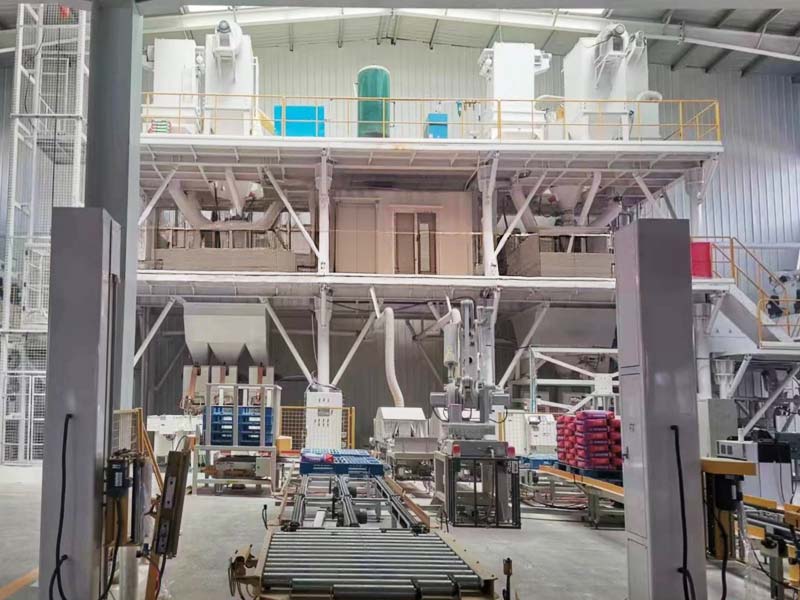
A useful equipment review needs the actual formulation and material properties.
يقدم:
- thermal insulation mortar product type;
- lightweight aggregate type;
- particle-size distribution;
- bulk density;
- حساسية الرطوبة؛;
- fragility or breakage concerns;
- fiber information;
- polymer and additive list;
- minimum and maximum dose;
- حجم الدفعة العادي؛;
- target production schedule;
- bag size and packaging method;
- site height and layout.
Our dry mortar solutions can then be reviewed around the real material behavior instead of using a generic line configuration.
Send your product requirements and raw-material information through our صفحة الاتصال for a project-specific line review.
خاتمة
Thermal insulation mortar production requires more than standard dry powder handling. Low-density and fragile materials can change storage volume, weighing, conveying, mixer fill, dust control and packaging.
The strongest plant design begins with actual bulk density, particle size, flowability, fragility, additive dose and product packaging requirements.
When those material properties are used to select storage, feeding, mixing and packaging equipment, the line can protect lightweight ingredients while maintaining repeatable production and practical changeovers.
الأسئلة الشائعة
Why is bulk density important in thermal insulation mortar production?
Low-density materials occupy more volume for the same mass. This affects storage bins, weigh hoppers, mixer fill and packaging volume.
Can lightweight aggregate be transported by screw conveyor?
Sometimes, but it should be validated. Fragile or very light materials can break, bridge or feed unevenly in a screw conveyor depending on their physical properties.
Why can lightweight aggregate reduce practical mixer capacity?
The mixer can reach its allowable working volume before the batch reaches the expected mass. Capacity should therefore be checked by volume as well as tonnes.
Does thermal insulation mortar need special packaging equipment?
It may. Lower finished bulk density can increase bag volume and change filling speed, air release and bag dimensions, so packaging should be tested with the real product.
What data should be provided before selecting a thermal insulation mortar plant?
Provide lightweight aggregate type, grading, bulk density, moisture, fragility, fiber and additive information, batch size, output target and packaging requirements.

