
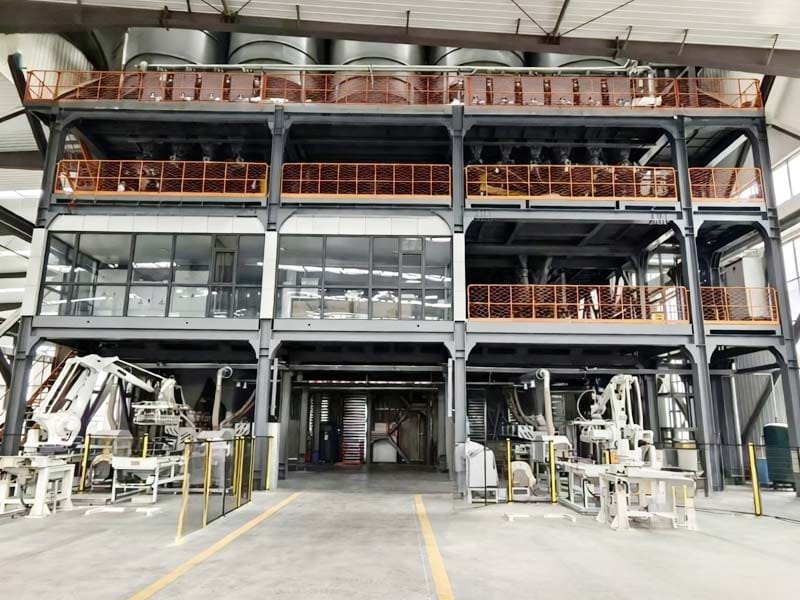
Waterproof mortar production requires more than a mixer with enough nominal capacity. The line has to reproduce a dry formulation that may contain graded sand, cementitious binders, mineral fillers, redispersible polymer powder, water-repellent additives, fibers and other low-dose ingredients. If these materials are not stored, weighed, dispersed and packed consistently, the finished mortar may vary from batch to batch even when the laboratory formula itself has not changed.
For equipment buyers, the key question is therefore not simply “Can this plant make waterproof mortar?” It is “Can the complete line handle the ingredient range, small-dose materials, mixing sequence, cleaning requirements and packaging conditions required by my approved waterproof mortar formulations?”
Μας εργοστάσιο ανάμειξης ξηρού κονιάματος τύπου εργαστηρίου is designed for special mortar production inside an industrial workshop, while our ξηρά διαλύματα also include tower and step configurations for different production scales and site conditions. This guide explains how waterproof mortar production requirements should be translated into equipment decisions.
What Is Waterproof Mortar Production?

Waterproof mortar production is the controlled manufacture of a dry mortar designed to resist water penetration or support waterproofing performance after it is mixed with water and applied according to the product instructions.
There is no single universal waterproof mortar formula. Depending on the intended product, the dry blend may include:
- cementitious binders;
- graded fine aggregate;
- mineral fillers;
- polymer powder;
- hydrophobic additives;
- cellulose ether or rheology modifiers;
- fibers;
- setting or water-retention additives.
The production line should reproduce the approved formulation accurately. It should not be expected to “create waterproof performance” by itself.
Waterproof mortar production therefore begins with a defined product specification and laboratory formula, then uses the plant to reproduce that formula consistently at production scale.
Start with the Waterproof Mortar Product Family
Before selecting the plant, define which waterproof mortar products will share the line.
| Ερώτηση προϊόντος | Γιατί έχει σημασία | Επιπτώσεις παραγωγής |
|---|---|---|
| How many product grades will be made? | Each grade may use different ingredients. | Changes storage, recipe control and changeover frequency. |
| Πόσα κλάσματα άμμου απαιτούνται? | Grading influences workability and packing. | Determines aggregate bins and weighing arrangement. |
| What is the smallest additive dose? | Low-dose ingredients need suitable measuring systems. | May require dedicated micro-dosing. |
| Are polymers or fibers used? | These materials can have different feeding behavior. | May need separate storage, dosing and cleaning. |
| How is the product packed? | Bag size and powder flow affect packaging. | Determines packer and finished-product buffer. |
This product-first approach prevents a common waterproof mortar production mistake: choosing a line from tonnes per hour first and trying to fit the formulations into the equipment later.
Sand Grading Must Match the Intended Mortar
Fine aggregate is a major part of many waterproof mortar formulations, so its grading needs to be controlled.
A sand that is too coarse can change finishing and layer behavior. A sand with excessive fines can alter water demand and powder balance. The correct grading depends on the approved product design.
For waterproof mortar production, buyers should provide the complete sand sieve analysis rather than only a maximum particle size.
If the factory makes several products, the line may need separate sand fractions that can be blended in different proportions.
Μας ενσωματωμένο βιομηχανοποιημένο εργοστάσιο άμμου και ειδικού κονιάματος can connect sand preparation with downstream special mortar production where the project needs tighter upstream control of manufactured sand grading.
Manufactured Sand Can Be Used Only After Product Validation
Manufactured sand can be suitable for waterproof mortar production when the grading, fines, cleanliness and parent-rock characteristics match the product requirements.
However, “manufactured sand” is not one standardized material. Different rocks and crushing systems can produce different particle shapes, fines contents and absorption behavior.
Before integrating manufactured sand into a waterproof mortar line, verify:
- particle-size distribution;
- fine-powder fraction;
- clay or deleterious contamination;
- particle shape;
- χύδην πυκνότητα;
- moisture condition;
- repeatability of the sand process.
The mortar laboratory should approve the sand before the equipment supplier treats it as a production input.
Dry Sand Moisture Is a Process Requirement
Dry mortar production depends on dry raw materials. If sand enters the line with excessive moisture, it can cake, bridge, stick to conveyors and reduce storage stability.
For waterproof mortar production, define the maximum acceptable sand moisture condition before the material enters storage and batching.
If drying is required, size the drying system from the actual moisture load.
For example, 20 tonnes per hour of sand at a higher incoming moisture contains more water to remove than the same tonnage at a lower moisture condition. The dryer therefore needs to be evaluated from both throughput and water-evaporation duty.
Do not assume that one dryer rating automatically applies across all seasonal feed conditions.
Bulk Materials and Micro-Ingredients Need Different Weighing Strategies
Waterproof mortar production often combines large quantities of sand and cementitious materials with much smaller amounts of additives.
These materials should not automatically share one measuring range.
A scale designed to weigh hundreds of kilograms may be unsuitable for a product requiring a very small polymer, fiber or hydrophobic additive dose.
For each recipe, list:
- minimum dose;
- normal dose;
- maximum dose;
- feeding method;
- weighing method;
- transfer route to the mixer.
Μας dry mortar weighing accuracy guide explains why the lowest real production dose should be included during validation.
Micro-Additive Feeding Can Limit the Batch Cycle
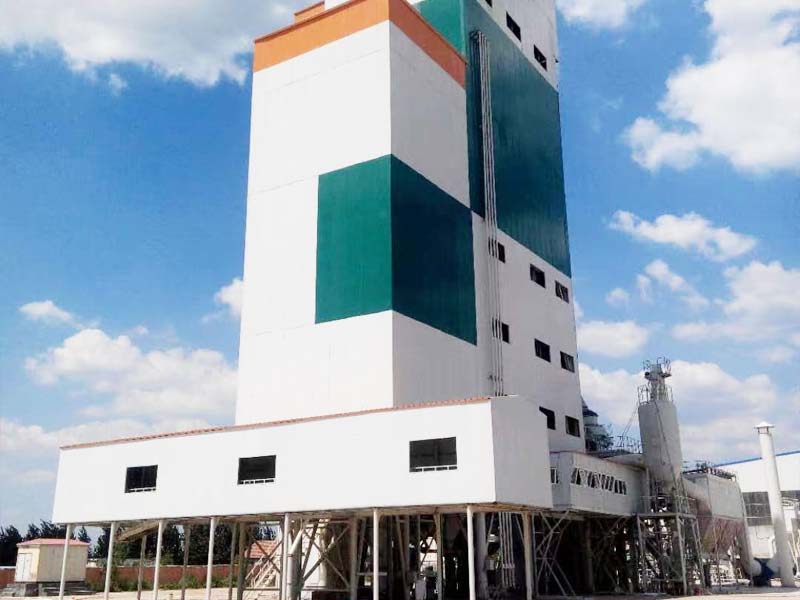
Small-dose materials can take longer to feed accurately than major ingredients.
If waterproof mortar production uses several polymers, water repellents or rheology modifiers, the micro-dosing stage may become part of the critical production path.
Check whether low-dose materials can be weighed in parallel with major ingredients or whether they are handled sequentially.
Also check:
- συμπεριφορά αποκοπής τροφοδότη·;
- material residue;
- bridging inside small hoppers;
- dust extraction at charging points;
- ingredient identification;
- batch traceability.
A fast mixer does not increase line output if the mixer spends most of its time waiting for micro-ingredients.
Fibers Need a Controlled Feeding Method
Some waterproof mortar products include fibers. Fibers can be more difficult to meter and disperse than free-flowing powders.
For waterproof mortar production, the equipment team should confirm:
- fiber type;
- fiber length;
- χύδην πυκνότητα;
- normal dose;
- whether the material tends to bridge;
- how it enters the mixer;
- how the feeder is cleaned.
Do not assume a powder screw feeder will automatically handle every fiber product correctly.
If fibers are added manually for specialty batches, the operating procedure should still record the quantity and confirm that the correct material entered the correct batch.
Mixing Sequence Can Matter for Polymer-Modified Mortars
Waterproof mortar production should use a defined charging sequence.
Fine additives can form local concentrations if they are introduced poorly. Fibers may clump. Polymer powder can require adequate distribution through the dry blend.
The laboratory and production team should therefore establish the sequence used during scale-up.
A representative sequence may include major sand and binder addition first, followed by selected fillers and low-dose ingredients, but the correct order depends on the formulation and mixer.
Do not copy a generic sequence into every recipe. Validate the actual product.
Mixing Time Must Be Proven with the Actual Formula
Waterproof mortar production cannot use one universal mixing time for every product.
Mixing duration depends on:
- mixer design;
- fill level;
- ingredient number;
- powder fineness;
- fiber content;
- polymer content;
- charging sequence.
During commissioning, produce representative batches and sample the dry blend according to an agreed test plan.
Establish the minimum mixing time that repeatedly gives acceptable product uniformity. Then optimize the cycle without sacrificing the validated result.
Small Batches May Need Separate Validation
A line may produce both high-volume waterproof mortar and smaller customized products.
If the mixer operates at a much lower fill level, material movement inside the chamber can change.
Waterproof mortar production should therefore validate:
- smallest routine batch;
- normal batch;
- largest production batch.
Do not assume a mixer that performs well at full load will provide identical results at one-third load.
This is especially important for special mortar lines where customer-specific formulas may be produced in smaller campaigns.
Workshop Layouts Can Suit Multi-Product Special Mortar Production
Our workshop-type dry mortar plant uses a horizontally distributed arrangement connected by screw conveyors and is intended for small-batch and special mortar production.
For waterproof mortar production, this type of layout can be attractive when:
- the factory already has a suitable industrial building;
- multiple products share one line;
- frequent access to feeders and screws is important;
- horizontal expansion is planned;
- smaller production campaigns are common.
The final decision still depends on building height, floor loading, raw-material storage and packaging requirements.
Μας workshop dry mortar plant guide explains how to evaluate an existing building before installing the line.
Step-Type Plants Need Project-Specific Capacity Review
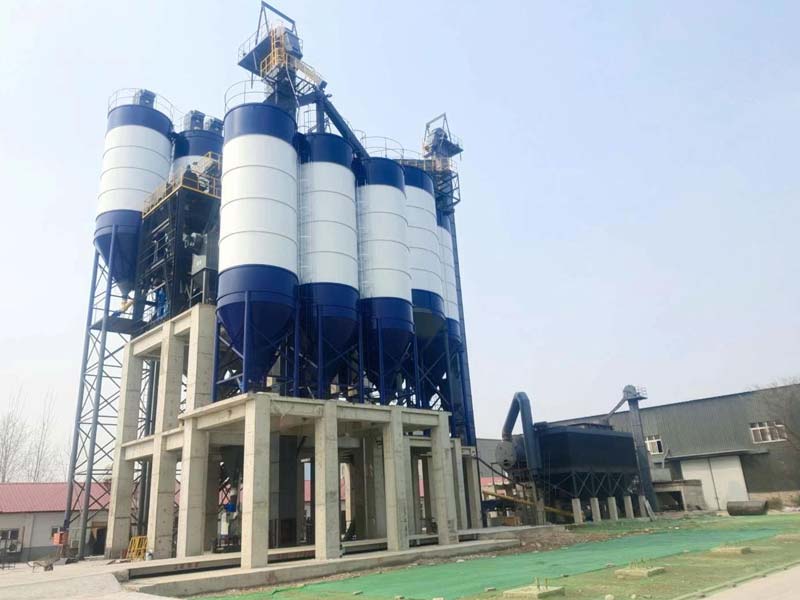
A step-type dry mortar plant combines elevated stages with mechanical conveying and can provide a balance between vertical integration and layout flexibility.
For waterproof mortar production, the relevant questions are:
- how many transfers are required;
- which materials move by gravity;
- which materials use screw or other conveying;
- how much intermediate storage is available;
- whether the product sequence creates residue risks;
- how the packaging section is connected.
The final step-type configuration should be reviewed from the actual product and site requirements.
Capacity should be calculated from the proposed process flow rather than relying on a generic layout label.
Prevent Segregation After Mixing
A dry blend can be uniform when it leaves the mixer and then segregate during downstream transfer.
Waterproof mortar production may combine sand, filler and fine additives with very different particle sizes and densities.
After mixing, review:
- ύψος πτώσης;
- screw conveyor speed;
- αριθμός πόντων μεταφοράς·;
- γεωμετρία χοάνης τελικού προϊόντος.;
- storage time before packing;
- μέθοδος τροφοδοσίας συσκευαστή.
The production line should preserve the mixture created by the mixer until the mortar enters the sealed bag or bulk dispatch system.
Cleaning Matters When Formulations Share the Same Line
Residue from the previous product can affect the next waterproof mortar batch.
For example, one grade may contain fibers while the next does not. One may use a different pigment, polymer level or binder system.
Waterproof mortar production should identify residue locations in:
- χοάνες ζύγισης;
- μικροπροσθετικοί τροφοδότες;
- βιδωτοί μεταφορείς;
- επιφάνειες μίξερ;
- κάδοι τελικού προϊόντος;
- packing equipment.
Then establish cleaning or purge procedures between products.
Changeover time should also be included in daily production-capacity calculations.
Dust Control Should Cover the Complete Fine-Powder Route
Waterproof mortar production handles many fine powders that can become airborne during bag opening, feeding, weighing, mixing and packaging.
Το Στέλεχος Υγείας και Ασφάλειας του Ηνωμένου Βασιλείου τοπική καθοδήγηση εξαερισμού recommends capturing contaminants close to the source and commissioning extraction systems under realistic working conditions.
Our workshop dry mortar plant includes pulse dust collection as part of the production system.
For the project layout, identify every significant dust point and confirm:
- capture location;
- duct route;
- πρόσβαση φίλτρου;
- collected-material handling;
- maintenance clearance.
One general dust collector specification does not prove that every source on the line is effectively controlled.
Packaging Needs to Match Product Flow and Plant Output
The final dry blend can flow differently depending on sand grading, polymer content and fine-powder level.
Waterproof mortar production should therefore test packaging with the actual product.
Κριτική:
- bag size;
- bag type;
- χύδην πυκνότητα;
- χρόνος πλήρωσης;
- packer cutoff;
- dust extraction;
- finished bag weight;
- downstream pallet handling.
A mixer capable of a high output does not determine sustainable line capacity if the packer cannot match it.
Μας mortar bag weight variation guide explains how filling behavior, scales and product flow should be checked separately.
Batch Records Support Waterproof Mortar Quality Control
Waterproof performance is verified through product testing, but production records help explain why a product changed.
For each batch, useful records can include:
| Record | Γιατί έχει σημασία |
|---|---|
| Recipe and revision | Confirms which formulation was intended. |
| Target and actual ingredient quantities | Shows whether the batch was produced as specified. |
| Manual additions | Keeps fibers or specialty ingredients traceable. |
| Mixing time | Links process duration to product tests. |
| Batch time | Connects production to raw-material lots and packaging. |
| Alarm or override history | Shows abnormal production events. |
When laboratory results move outside the normal range, these records help determine whether the cause may be raw materials, formulation or production execution.
Finished-Product Testing Must Define Acceptance
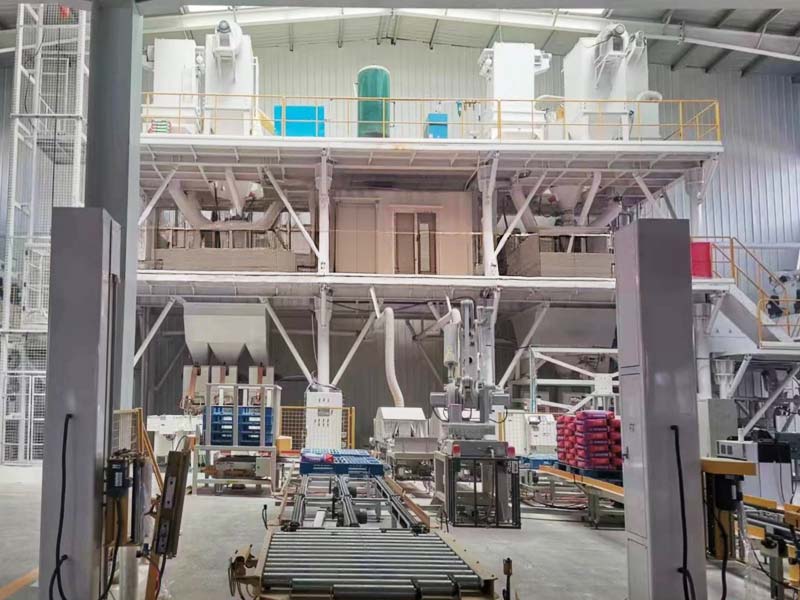
The production line should be accepted based on both equipment function and finished-product performance.
The applicable waterproofing or mortar tests depend on the product type and target market.
Possible product-level properties can include:
- fresh consistency;
- water retention;
- setting behavior;
- compressive or flexural strength;
- bond strength;
- water penetration or absorption;
- product-specific waterproofing performance.
The exact acceptance standard should come from the customer’s product specification and regulatory market.
Do not use one generic waterproof test to approve every waterproof mortar product.
Commission the Line with the Most Demanding Planned Product
A good commissioning plan uses representative materials and at least one technically demanding formula.
For waterproof mortar production, verify:
- sand storage and weighing;
- binder and filler dosing;
- minimum additive doses;
- fiber feeding where applicable;
- mixing sequence;
- ομοιομορφία ανάμειξης;
- finished-product transfer;
- λειτουργία ελέγχου σκόνης·;
- packaging;
- παρτίδα-δημιουργία ρεκόρ.;
- εργαστηριακά αποτελέσματα τελικού προϊόντος.
Repeat the production trial. One successful batch does not prove the line can reproduce the product consistently.
What Should Buyers Send for Waterproof Mortar Production Design?
A useful equipment inquiry should include the product and material requirements.
Παρέχω:
- waterproof mortar product types;
- main binders;
- sand grading and sand source;
- filler types;
- polymer and additive categories;
- smallest additive dose;
- fiber information where applicable;
- κανονικό μέγεθος παρτίδας.;
- required product changes per shift;
- bag size and packing method;
- required production schedule;
- site or workshop dimensions.
These inputs allow the plant to be configured around the actual waterproof mortar production process rather than a generic dry mortar line.
Send your formulation range and site information through our σελίδα επικοινωνίας for a project-specific production line review.
Συμπέρασμα
Waterproof mortar production is a precision dry-mixing process that depends on controlled sand grading, bulk-material weighing, micro-additive dosing, validated mixing and careful post-mixer handling.
The right plant should match the actual product portfolio, ingredient range, batch size, changeover frequency and packaging method. Workshop, step or tower layouts can all be appropriate under different project conditions.
Define the product first, then configure the equipment around the formula. That approach gives the production team a much better chance of reproducing the waterproof mortar consistently at scale.
ΣΥΧΝΈΣ ΕΡΩΤΉΣΕΙΣ
What equipment is needed for waterproof mortar production?
A typical waterproof mortar production line can include sand and powder storage, weighing systems, micro-additive dosing, dry mixing, dust collection, finished-product transfer and packaging. The exact equipment depends on the approved formulation.
Can manufactured sand be used in waterproof mortar?
Yes, when the manufactured sand grading, fines, cleanliness and other relevant properties have been validated for the product. The mortar laboratory should approve the sand before production-scale use.
Why are micro-additives important in waterproof mortar production?
Polymers, water repellents, rheology modifiers and similar ingredients may be used at low doses but can strongly influence product performance. Their weighing and feeding systems therefore need validation at the real production dose.
Which dry mortar plant layout is best for waterproof mortar?
There is no universal best layout. Workshop plants can suit flexible special-mortar production, while step or tower arrangements can suit other site and capacity requirements. The decision should follow the actual product range and process flow.
How should a waterproof mortar production line be commissioned?
Use representative materials and production formulas, verify weighing, micro-dosing, mixing, transfer, dust control and packaging, then test traceable finished-product samples according to the applicable product specification.


