
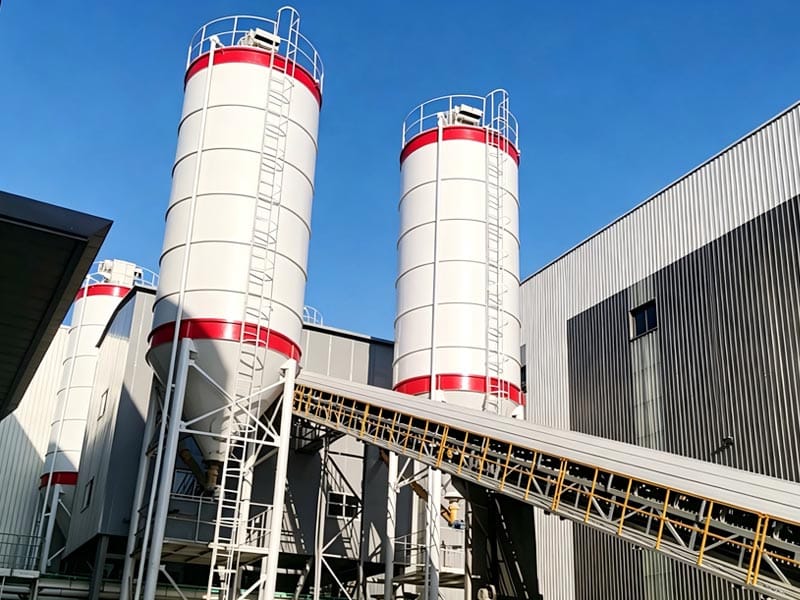
Precast concrete panels place different demands on a batching plant than a general ready-mix operation. The plant has to deliver concrete in the right batch size, at the right consistency, and at the right time for mold filling, reinforcement congestion, architectural finishes and the casting schedule used inside the factory.
For equipment buyers, this means the batching plant should be selected around panel production rather than only an hourly capacity figure. A plant can have enough theoretical output and still create delays if it cannot handle small completion batches, moisture changes, recipe switching, transport-bucket timing or quality-control records.
Onze stortinstallatie voor geprefabriceerd beton uses planetary mixing, multiple discharge doors, moisture and temperature monitoring, and production-line software interfaces. This guide explains how those functions relate to the real requirements of precast concrete panels.
Why Precast Concrete Panels Need a Dedicated Batching Strategy
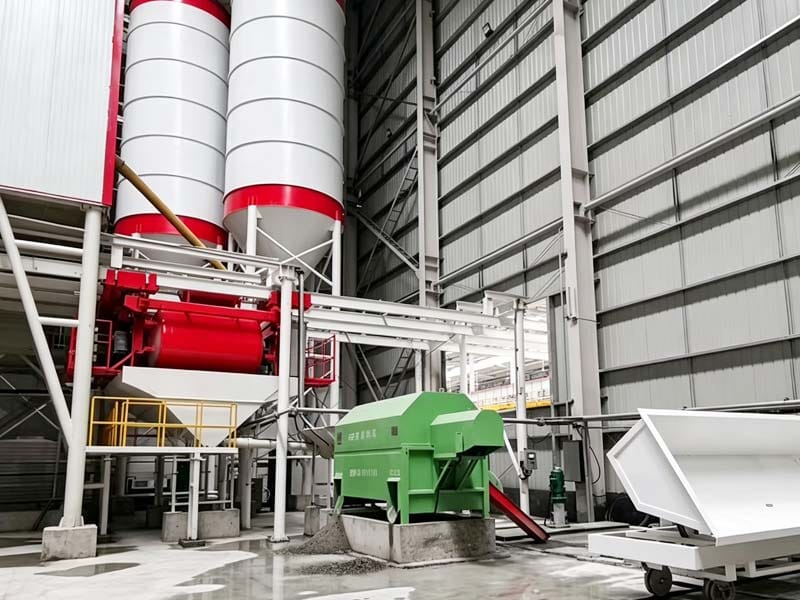
Precast concrete panels are manufactured products, not simply concrete placed into a mold. Their geometry, surface finish, reinforcement layout, lifting inserts, embedded items and production sequence can all influence how the concrete must be batched and delivered.
ACI guidance for precast concrete wall panels emphasizes controlled batching and mixing facilities, accurate material proportioning, aggregate moisture determination and equipment capable of producing uniformly mixed concrete. The broader production principle is clear: the batching plant has to support repeatable panel fabrication, not just generate volume.
For precast concrete panels, the batching strategy should therefore define:
- panel types;
- normal pour volume;
- smallest completion batch;
- concrete families;
- casting frequency;
- surface and architectural requirements;
- transport route from mixer to mold.
These inputs should be established before mixer size and plant layout are finalized.
Start with the Panel Production Schedule
The batching plant should follow the casting line, not the other way around.
List the products planned for each shift and identify when concrete is actually needed.
| Production input | Waarom het ertoe doet | Batching implication |
|---|---|---|
| Panel type | Different molds may use different concrete | Controls recipe switching and batch size |
| Concrete volume per panel | Defines normal delivery quantity | Influences mixer and transport-bucket sizing |
| Panels per hour | Defines casting rhythm | Controls required cycle frequency |
| Peak simultaneous demand | Several stations may call for concrete together | Controls transport and scheduling logic |
| Completion pour | Final volume may be smaller than full batch | Requires low-batch validation |
For precast concrete panels, the highest hourly total is often less important than the timing of individual casting requests.
Continuous Casting Demand Can Control Plant Capacity
Some panel production sequences require concrete to arrive continuously or with tightly controlled interruption.
If a mold needs several deliveries in sequence, a delay between batches can interrupt placing and finishing.
The batching plant therefore needs enough capacity to support the required casting rhythm over the full pour period.
Consider a hypothetical example. A panel mold needs 6 m³ of concrete delivered in four 1.5 m³ batches. If the complete batch-and-delivery cycle takes six minutes, the pour lasts around 24 minutes before any additional waiting is considered.
If the production team expects the same panel to be filled in 15 minutes, the plant, transport system or both need to be reviewed.
This example is illustrative only. It shows why precast concrete panels should be evaluated from the complete production cycle rather than nominal mixer output.
Small Completion Batches Need Separate Validation
Precast factories rarely operate only at full mixer load.
A panel may require one final partial batch to complete the mold. Architectural panels may also use smaller facing mixes or special concrete volumes.
For precast concrete panels, validate:
- minimum routine batch;
- normal batch;
- maximum batch;
- mixing uniformity at each condition;
- weighing performance at small ingredient quantities.
A mixer that performs well at full capacity may not produce identical mixing action at a much lower fill level.
Onze precast batching plant casting-line guide explains why minimum batch size should be considered during plant selection.
Planetary Mixing Can Suit Panel Production
Our precast batching plant uses a vertical-shaft planetary mixer. This type of mixer is commonly used in precast applications because the mixing tools move through overlapping paths across the pan.
For precast concrete panels, the important question is not simply mixer type but whether the mixer can repeatedly handle the actual product range.
Check performance with:
- normal wet-cast concrete;
- zelfconsoliderend beton;
- stiffer mixtures;
- fiber-containing concrete where applicable;
- small completion batches.
Onze planetary vs twin-shaft mixer guide explains how the two architectures differ for precast production.
Batch-to-Batch Consistency Is Critical for Panel Quality
Precast concrete panels are often produced repeatedly from the same mold or product family. Visible and dimensional consistency matter.
If one batch has different water content, admixture dose or mixing history from the next, the production team may see changes in:
- workability;
- mold filling;
- surface appearance;
- finishing behavior;
- setting rate;
- demolding schedule.
For precast concrete panels, the plant should record enough production data to distinguish batch variation from other factory causes.
Onze precast concrete consistency guide covers moisture, weighing, mixing and transport as one process-control chain.
Aggregate Moisture Needs Active Control
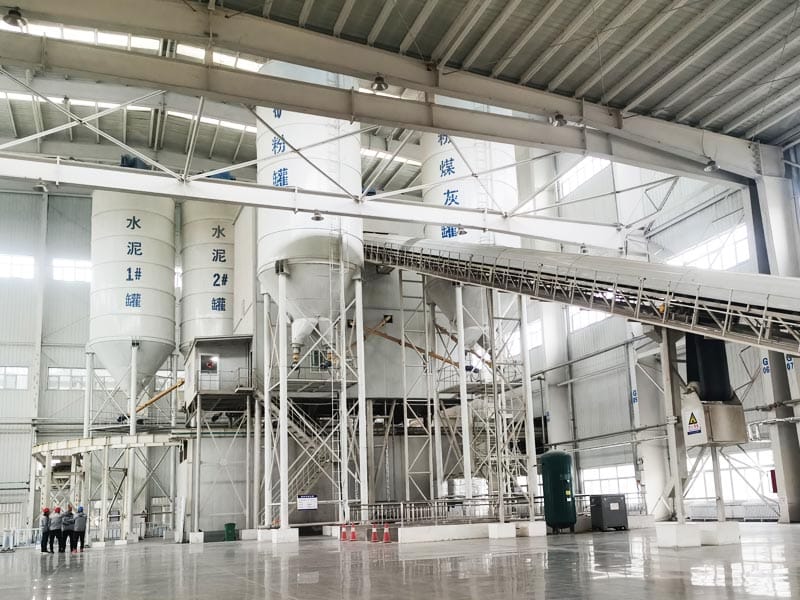
Fine aggregate moisture can change during the production day, especially when stockpiles are exposed to weather or recently replenished.
That changes both the wet sand quantity and the amount of separate water the plant should add.
For precast concrete panels, uncontrolled moisture can create visible differences between batches even though the recipe on the screen has not changed.
The batching plant should therefore support:
- representative moisture measurement;
- wet aggregate correction;
- batch-water correction;
- reference moisture verification;
- recording of the values used.
Moisture sensors should support the quality-control system, not replace periodic reference testing.
Aggregate Grading Should Stay Stable Across Panel Production
Changes in aggregate grading can alter concrete workability and packing.
For precast concrete panels, stable aggregate supply helps the plant avoid repeated recipe adjustment.
Recensie:
- stockpile separation;
- segregation during handling;
- bin contamination;
- moisture variation;
- supplier source changes.
If one aggregate source changes, the quality team should determine whether the approved mixture needs revalidation.
A batching plant cannot compensate indefinitely for uncontrolled raw-material variation.
Admixture Dosing Needs to Match the Real Production Range
Precast concrete panels may use water reducers, accelerators, retarders, air-entraining admixtures, viscosity modifiers or other products depending on the mix design.
Some doses can be relatively small compared with aggregate and cement.
The batching system should therefore be checked at:
- minimum routine dose;
- normal dose;
- maximum planned dose;
- multiple-admixture combinations.
For quality-sensitive panel production, record which admixture product was used and the actual delivered quantity where the control system supports it.
SCC Panel Production Needs Especially Stable Water and Admixture Control
Self-consolidating concrete is widely used in precast production because it can flow through reinforcement and around embedded items with limited vibration.
However, SCC can be sensitive to moisture, water and admixture variation.
For precast concrete panels using SCC, review:
- sand moisture;
- water correction;
- mengdosering;
- mixing sequence;
- mengtijd;
- transport waiting time;
- fresh-property testing.
A stable SCC process depends on the complete production chain.
Architectural Panels May Need More Than One Concrete Mix
Some architectural precast concrete panels use a facing mix and a separate backup mix.
This creates additional batching requirements because the plant may need to change recipes, pigments, aggregates or concrete appearance within the same production period.
For these panels, review:
- facing-mix volume;
- backup-mix volume;
- recipe sequence;
- cleaning between visually sensitive batches;
- pigment or specialty aggregate handling;
- traceability of each mix.
The plant should not assume one large standard batch is the most efficient approach when the panel design uses multiple concrete layers.
Color Consistency Requires Material and Process Consistency
Architectural panel appearance can be sensitive to changes in cement, aggregate, pigment, water and finishing conditions.
The batching plant cannot control every visual factor, but it should minimize avoidable production variation.
For precast concrete panels with architectural surfaces, keep records of:
- material lots where required;
- receptrevisie;
- actual batch quantities;
- moisture correction;
- mixing sequence;
- mengduur;
- concrete temperature.
If panel color changes, these records provide evidence for whether the batching process changed.
Concrete Temperature Can Affect Panel Production Rhythm
Concrete temperature influences fresh behavior and setting rate.
In a precast factory, this can affect the timing of finishing, curing and demolding.
Our precast batching plant includes material moisture and temperature monitoring within its published production configuration.
For precast concrete panels, temperature should be recorded together with the batch and compared with the approved production procedure.
If heated water, chilled water or another temperature-control method is required, the batching plant should incorporate the relevant storage and dosing equipment during project design.
The Plant Must Match Concrete Transport to the Mold
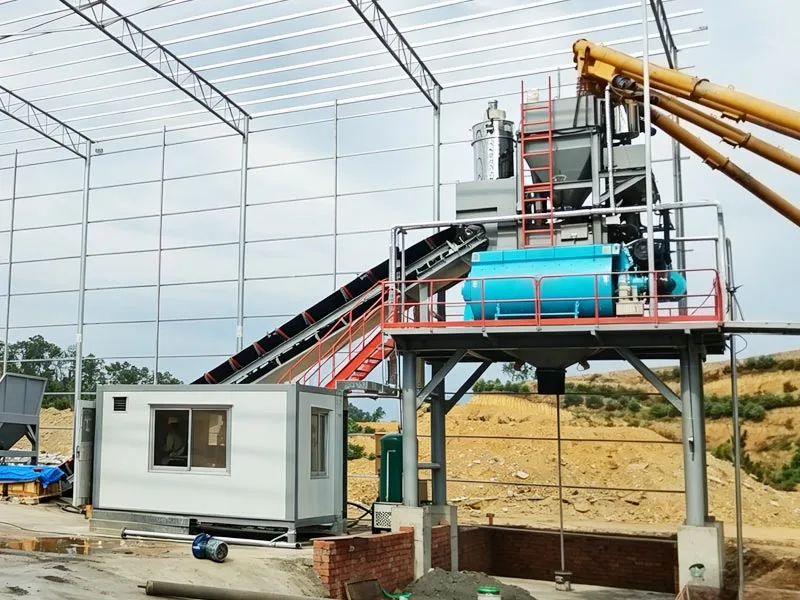
Concrete production is not complete when the mixer discharges.
Precast concrete panels may receive concrete through buckets, distributors, transfer hoppers or other factory-specific systems.
The batching plant should match:
- transport-bucket volume;
- mixer batch size;
- travel distance;
- waiting time;
- casting-station demand;
- return cycle.
Onze prefab beton transportgids explains how a slow delivery loop can limit plant output even when the mixer itself has enough capacity.
Multiple Discharge Doors Can Support Different Production Routes
Our precast batching plant uses multiple discharge doors.
This can help a factory serve more than one concrete transport route or casting zone.
For precast concrete panels, define:
- which door serves each transport route;
- how the receiving bucket is identified;
- how the control system confirms that the receiver is ready;
- what happens when one route is unavailable.
Multiple discharge doors increase routing flexibility, but they do not create multiple independent mixers.
Batch Traceability Should Reach the Panel or Production Lot
A useful batch record should connect concrete production with the actual precast product.
For precast concrete panels, record fields can include:
| Batch record | Panel production link |
|---|---|
| Batch ID | Mold, casting station or production lot |
| Recipe revision | Panel type |
| Actual material quantities | Quality-control record |
| Moisture values | Concrete consistency review |
| Mixing time | Production sequence |
| Alarm or override | Corrective-action record |
Onze slimme concrete batching plant guide explains how batch records and production destinations can be connected.
Production-Line Software Interfaces Need to Be Defined Early
Our precast batching plant supports production-line software interfaces, but the actual integration requirements depend on the factory.
For precast concrete panels, decide whether the batching plant needs to exchange:
- recipe requests;
- batch quantity;
- casting-station ID;
- production-order number;
- batch completion status;
- quality data;
- alarm information.
Define these interfaces before commissioning so the plant and production-line software use the same data structure.
Panel Factories Need Maintenance Without Disrupting the Casting Schedule
Precast production can be tightly scheduled around molds and curing cycles.
A batching plant shutdown can therefore stop several downstream operations.
For precast concrete panels, plan maintenance access to:
- mixer wear parts;
- planetary arms and scrapers;
- discharge doors;
- weighing systems;
- moisture sensors;
- conveyors and transfer equipment.
Routine maintenance should be scheduled around factory production rather than treated as an isolated plant task.
Commissioning Should Use Real Panel Production Conditions
A new batching plant should be tested with representative materials and production sequences.
For precast concrete panels, commissioning should include:
- normale batchgrootte;
- small completion batch;
- representative concrete types;
- aggregate moisture correction;
- mengdosering;
- mixing sequence;
- discharge to the actual transport system;
- delivery to a real casting station;
- batch-record generation.
Do not stop the acceptance test at the mixer.
The batching system should prove that it can supply concrete to the panel production line under realistic timing and quality-control conditions.
What Should Buyers Send for a Precast Panel Plant Review?
A useful equipment review needs the panel-production plan.
Verstrekken:
- panel types;
- panel dimensions;
- concrete volume per panel;
- concrete families;
- smallest and largest batch;
- panels per shift;
- peak casting demand;
- transport method;
- number of casting stations;
- factory layout;
- software-integration requirements;
- future product range.
Onze prefab betonoplossingen can then be reviewed around the actual casting schedule and factory layout.
Send your panel production plan and factory drawing through our contactpagina for a project-specific batching plant review.
Conclusie
Precast concrete panels require a batching plant that can support repeatable concrete quality and the actual casting rhythm of the factory.
Batch size, aggregate moisture, admixture control, mixer performance, transport timing, discharge routing and production traceability all matter.
The strongest equipment selection starts with the panel schedule and follows the concrete all the way from raw materials to the mold. When the plant is sized and controlled around real production conditions, the entire precast line becomes easier to schedule, test and manage.
FAQ
What batching plant is suitable for precast concrete panels?
A precast-focused batching plant should support accurate batching, repeatable mixing, moisture control, suitable batch sizes, efficient discharge and integration with the factory transport and casting schedule. The exact configuration depends on the panel products.
Why are small batches important for precast panels?
Panels often need completion batches or smaller specialty mixes. The plant should be validated at the smallest routine batch rather than assuming full-load performance applies to every production condition.
Can SCC be used for precast concrete panels?
Yes, where the approved product design uses SCC. The plant should provide stable moisture correction, water and admixture dosing, mixing control and transport timing because SCC can be sensitive to production variation.
Why are multiple discharge doors useful in a precast plant?
Multiple discharge doors can serve different transport buckets or casting zones. The control system still needs to confirm the correct destination and receiver readiness before discharge.
What information should I provide before selecting a precast batching plant?
Provide panel types, concrete volume per panel, concrete mixes, minimum and maximum batch sizes, casting schedule, transport method, factory layout and software-interface requirements.


