Depozitarea nisipului de mortar uscat este o legătură critică între prepararea nisipului și lotul de mortar. Odată ce nisipul a fost uscat, cernut și clasificat în fracții utile, planta trebuie să mențină acele fracții uscate, separate și care curg liber până când sunt cântărite în următorul lot.
Pentru cumpărătorii de echipamente, depozitarea nu trebuie selectată doar în funcție de tone totale. o fracțiune de nisip fin poate curge foarte diferit de o fracțiune mai grosieră, iar un coș care arată suficient de mare pe hârtie poate pierde capacitatea utilizabilă atunci când punțile materiale, ratholes sau rămâne stagnant de-a lungul pereților.
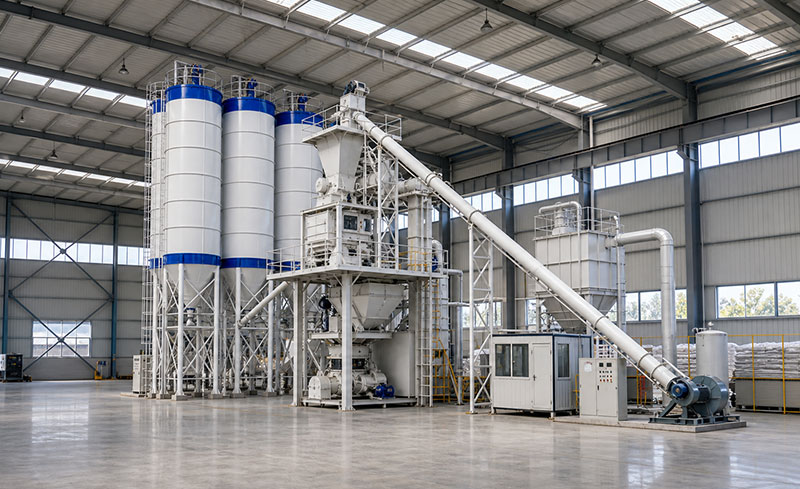
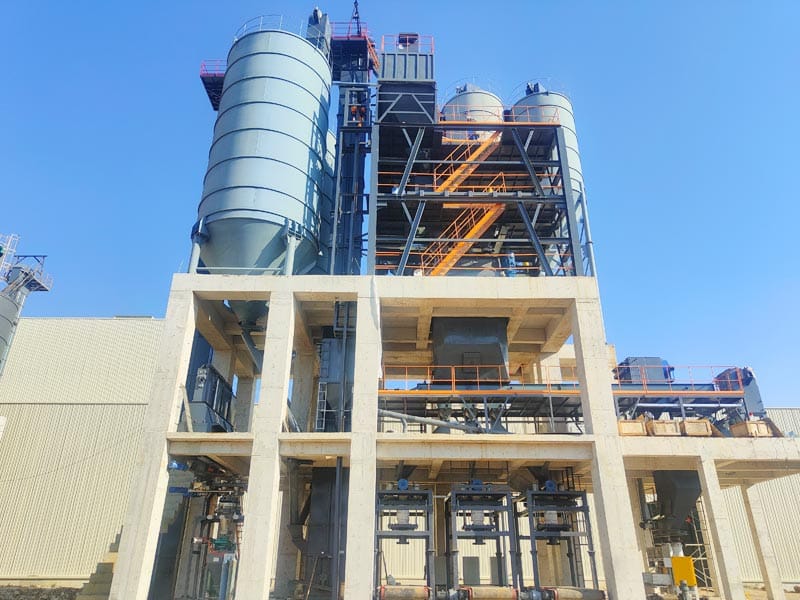
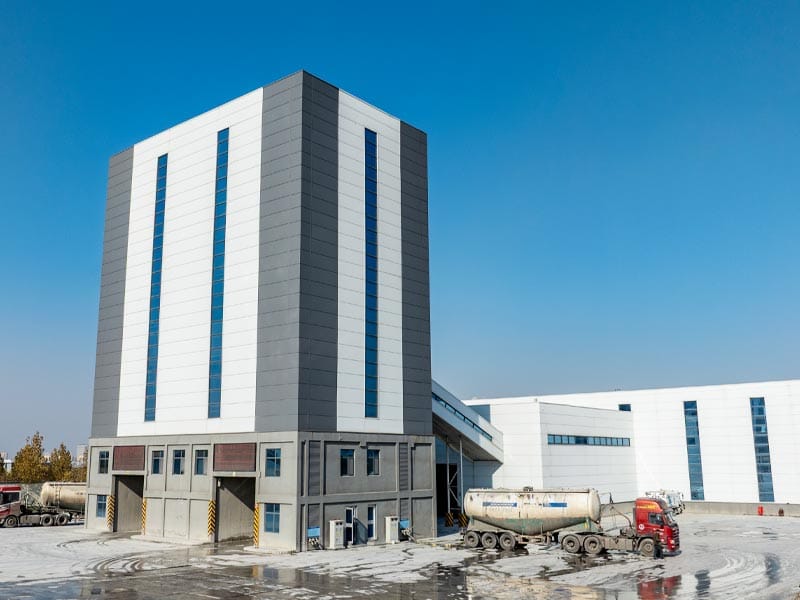
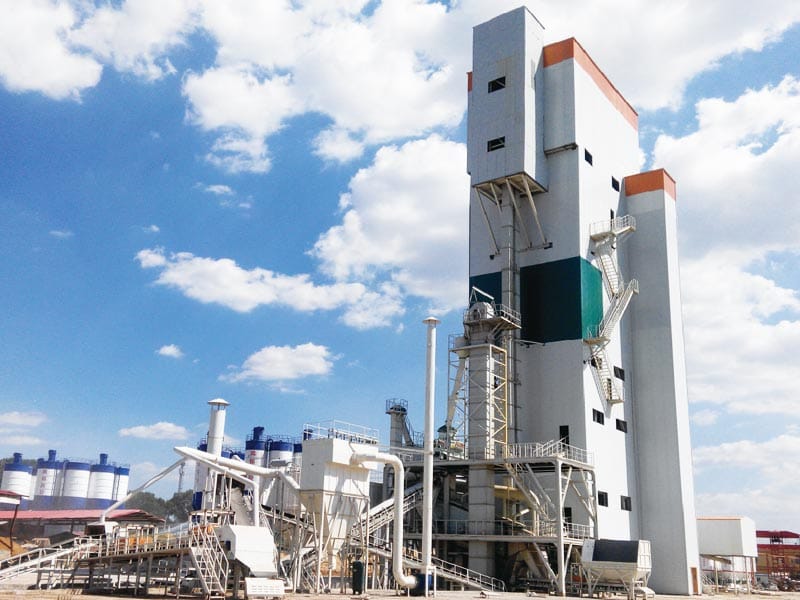
Nostru instalație de amestecare a mortarului uscat de tip turn utilizează stocarea superioară și fluxul gravitațional, în timp ce step-tip planta mortar uscat combină montarea verticală cu transportul orizontal. Acest ghid explică modul în care ar trebui planificată depozitarea nisipului de mortar uscat în jurul gradării, densității în vrac, fluxului de material, reaprovizionării și cererii de mortar în aval.
De ce contează depozitarea uscată a nisipului de mortar
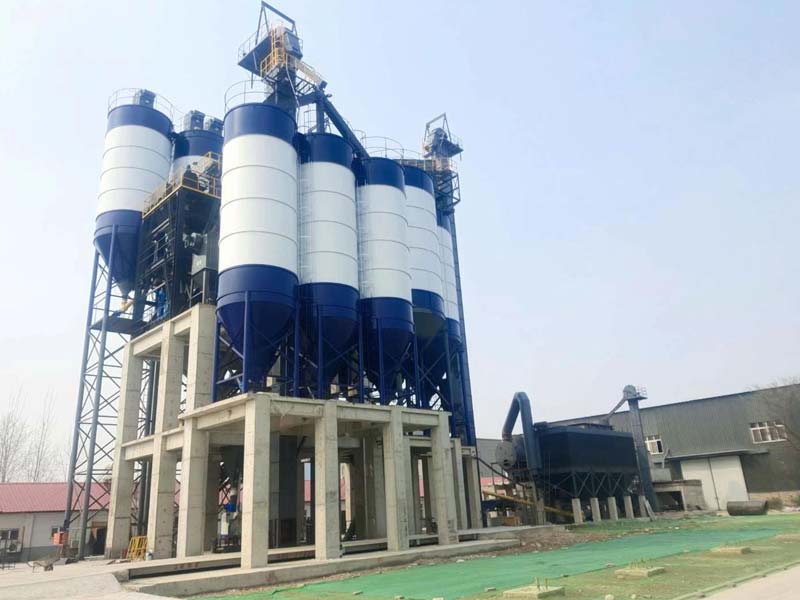
Nisipul uscat este unul dintre cele mai mari fluxuri de materiale din majoritatea fabricilor de mortar.
Sistemul său de stocare trebuie să efectueze mai multe lucrări simultan:
- protejați nisipul de umiditate;
- păstrați fracțiile clasificate separate;
- oferiți suficientă capacitate tampon;
- alimentați echipamentele de cântărire în mod constant;
- evitați crearea de punți și ratholing;
- sprijiniți modificările produsului;
- permiteți inspecția și curățarea în siguranță.
Depozitarea nisipului mortar uscat este, prin urmare, parte a procesului de producție, nu doar un loc pentru a păstra inventarul.
Începeți cu numărul de fracții de nisip
Prima întrebare de proiectare este de câte fracții separate de nisip are nevoie portofoliul de produse.
O instalație care produce numai mortar de zidărie convențional poate folosi o fracțiune de nisip mai largă.
O instalație care produce adeziv pentru plăci, mortar autonivelant și mortar de reparații poate avea nevoie de mai multe fracții clasificate.
Pentru depozitarea nisipului mortar uscat, definiți:
- fiecare fracție de nisip;
- intervalul de dimensiuni ale particulelor;
- curba de clasificare;
- consumul zilnic;
- produse care utilizează fracția respectivă;
- timpul necesar al tamponului.
Nostru ghid curbă de gradare nisip explică modul în care datele sitei pot fi traduse în fracții utile de stocare.
Nu măriți fiecare coș de nisip la fel
Fracții diferite sunt consumate la rate diferite.
Dacă o fracție fină este utilizată numai în mortarul de specialitate, în timp ce o fracție medie este utilizată în majoritatea produselor, este posibil ca coșurile de dimensiuni egale să nu aibă sens.
| Fracția nisipului | Întrebare tipică de design | Implicație de stocare |
|---|---|---|
| Fracția largă principală | Folosit în majoritatea loturilor? | Poate avea nevoie de cel mai mare tampon |
| Fracție fină | Folosit în adezivul pentru plăci sau produse de specialitate? | Depozitarea mai mică, dar protejată poate fi suficientă |
| Fracție mai grosieră | Folosit în zidărie sau produse de reparații? | Dimensiunea din cererea reală de rețetă |
| Nisip special | Produs cu volum redus sau premium? | Poate justifica un coș mic dedicat |
Depozitarea nisipului de mortar uscat ar trebui să fie dimensionată mai degrabă după modelul de consum decât după simetria vizuală.
Densitatea în vrac transformă tone în volum necesar
Capacitatea de stocare este de obicei discutată în tone, dar pubele și silozurile sunt volume fizice.
Pentru a converti unul în celălalt, designul are nevoie de o densitate în vrac reprezentativă.
Pentru depozitarea nisipului mortar uscat, furnizați:
- loose bulk density;
- compacted bulk density where relevant;
- notare;
- moisture condition;
- expected variation by source.
If the actual bulk density is lower than assumed, the bin can reach its volume limit before the expected mass is stored.
Usable Capacity Is Not the Same as Geometric Capacity
A storage vessel may have a certain geometric volume, but not all of that volume is always usable in production.
Material can remain in stagnant zones or fail to discharge completely.
ASTM D6773 notes that bulk-solids storage problems can include arching, ratholing, flooding, segregation, caking and usable capacity that is significantly lower than nominal design capacity.
That principle is directly relevant to dry mortar sand storage.
Debitul de masă și fluxul de pâlnie se comportă diferit
In mass flow, most or all stored material moves when the outlet discharges.
In funnel flow, material mainly moves through a central flow channel while material near the walls remains relatively stagnant.
For dry mortar sand storage, this distinction can affect:
- first-in/first-out behavior;
- residence time;
- segregation;
- aglomerare;
- usable capacity.
Neither flow pattern should be assumed from hopper angle alone. Material-wall friction and bulk-solid properties also matter.
Fine Sand Can Bridge More Easily Than Expected
Fine dry sand can become cohesive, especially when it contains very fine powder or residual moisture.
Bridging occurs when a stable arch forms above the outlet and stops flow.
For dry mortar sand storage, bridge risk can increase with:
- small outlet size;
- high fine-powder content;
- umiditate;
- timp lung de depozitare;
- rough hopper walls;
- compaction.
Nostru ghid de punte pentru buncăr explains why recurring flow stoppage should be investigated as a material-and-geometry problem.
Ratholing Can Hide Inventory Inside the Bin
Ratholing occurs when material flows through a narrow channel above the outlet while stable material remains around it.
The operator may believe the bin is nearly empty because flow stops, even though significant material remains inside.
This creates several problems:
- reduced usable capacity;
- old material remaining in storage;
- unexpected refill timing;
- product contamination during changeover.
Dry mortar sand storage should therefore be designed for reliable discharge, not only maximum nominal volume.
Flow Testing Can Clarify Difficult Materials
ASTM D6773 measures properties such as unconfined yield strength, internal friction, bulk density and wall friction for bulk solids.
The standard notes that these measurements are commonly used to design bins and hoppers to prevent arching and ratholing.
For difficult dry mortar sand storage applications, bulk-solids flow testing can help determine:
- dimensiunea prizei;
- hopper slope;
- wall-surface selection;
- flow-aid requirements.
This is more reliable than choosing hopper geometry only from previous experience with a different sand.
Moisture Can Change Flow Behavior Quickly
Sand that flows freely when dry can become cohesive after absorbing moisture.
For dry mortar sand storage, monitor:
- dryer outlet moisture;
- cooling condition;
- storage humidity;
- rain or water ingress;
- condensation;
- seasonal changes.
Even a small process change can alter how the same grading behaves inside a hopper.
Dried Sand Should Stay Dry After the Dryer
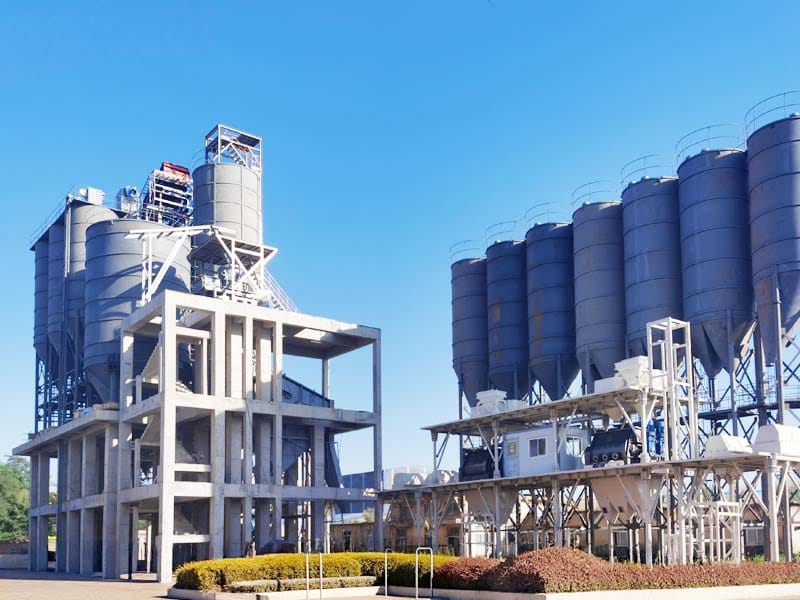
Drying solves only the first moisture problem.
After drying, sand still needs protected:
- elevators;
- screens;
- conveyors;
- bins;
- inspection openings.
Dry mortar sand storage should prevent rewetting after the energy has already been spent to dry the material.
Hot Sand May Need Cooling Before Long-Term Storage
Freshly dried sand can remain hot.
If hot material enters a cooler vessel, temperature gradients can influence condensation and storage conditions.
For dry mortar sand storage, review:
- dryer outlet temperature;
- cooling stage;
- bin temperature;
- ambient humidity;
- storage duration.
The acceptable condition should be established from the actual raw materials and mortar formulation.
Segregation Can Occur During Filling
A well-graded sand can segregate when dropped into a tall storage bin.
Larger particles may travel differently from finer particles during filling.
Potential consequences include:
- grading variation from one discharge period to another;
- different bulk density;
- different water demand downstream;
- unstable mortar consistency.
Dry mortar sand storage should therefore consider the filling point, drop height and internal flow pattern.
Long Free-Fall Distances Can Increase Segregation
A tall silo creates more vertical drop.
For classified sand, excessive drop can cause:
- particle separation;
- impact;
- dust generation;
- wear on internal surfaces.
Chute design and filling arrangement should reduce unnecessary free fall where practical.
Keep Classified Fractions Physically Separate
Screening has little value if the fractions remix during storage.
Inspectați:
- divider walls;
- chutes;
- bin overflow paths;
- conveyor discharge points;
- maintenance openings.
Dry mortar sand storage should preserve the grading control created upstream.
Replenishment Rate Must Exceed Consumption During Peak Production
A storage bin is a buffer between upstream sand preparation and downstream mortar production.
If the mortar plant consumes one sand fraction faster than it can be replenished, the bin will eventually empty even when total sand production is high.
For each fraction, compare:
- production rate;
- consumption rate;
- capacitate de stocare utilizabilă;
- replenishment cycle;
- peak production duration.
Dry mortar sand storage should be balanced fraction by fraction.
Integrated Sand and Mortar Lines Need Fraction-Level Buffering
Nostru instalație integrată de nisip și mortar special connects sand preparation directly with mortar batching.
In this type of plant, dry mortar sand storage becomes the buffer between two production systems.
If the sand-making section produces a surplus of one fraction but too little of another, total tonnes per hour can still look acceptable while the mortar plant waits.
Storage should therefore absorb short-term imbalance between fraction production and fraction consumption.
Tower Plants Use Gravity to Simplify Internal Flow
The current MixingPlantPro tower-type plant uses a vertically integrated process where dried sand is screened and graded, lifted to upper storage, then moves by gravity through batching, mixing, finished-product storage and packaging.
For dry mortar sand storage, tower layout can reduce some repeated mechanical transfer stages after the sand reaches upper storage.
The design still needs to address:
- bin flow;
- segregation;
- maintenance access;
- level measurement;
- dust control.
Step-Type Plants Use a Mixed Vertical and Horizontal Route
The current MixingPlantPro step-type line uses a semi-vertical and semi-horizontal layout, with materials distributed to platform storage through elevators and screw conveyors before staged gravity flow to mixing.
For dry mortar sand storage, this layout can provide a different balance between:
- plant height;
- storage location;
- horizontal conveying;
- maintenance access;
- future expansion.
The appropriate layout depends on site conditions and product mix.
Workshop Plants Rely More on Horizontal Screw Transfer
The workshop-type line stores materials in separate bins and uses screw conveyors to feed sand, powder and additives into metering hoppers.
For dry mortar sand storage, this can make storage and feeders easier to distribute across an existing factory floor.
However, more horizontal transfer means additional feeder and conveyor interfaces that should be checked for flow stability and residue.
Level Measurement Should Reflect Real Material Behavior
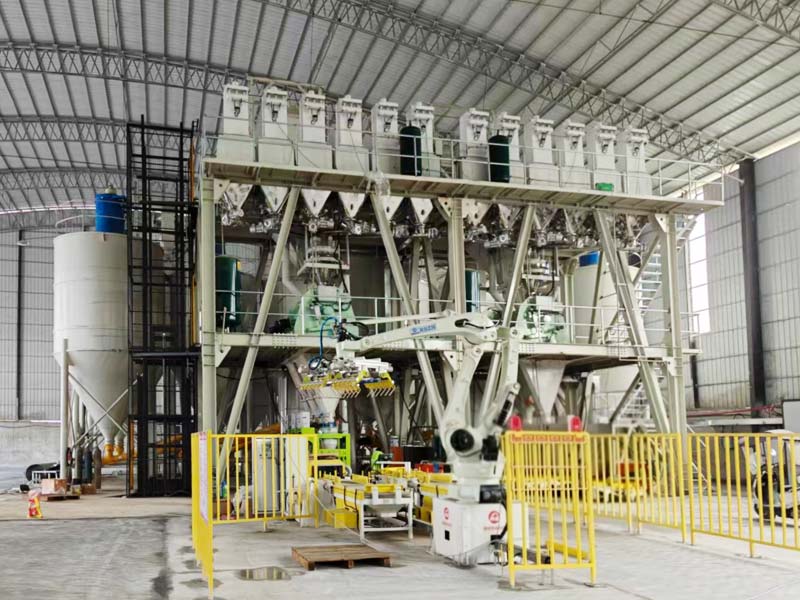
A level indicator should help the operator understand usable inventory.
But level measurement can be misleading when:
- the material surface is uneven;
- ratholing occurs;
- dust interferes with the sensor;
- material hangs on walls.
Dry mortar sand storage should combine level measurement with production consumption data and periodic physical verification.
High-Level Protection Prevents Overfilling
Overfilling a sand bin can create:
- spillage;
- blocked vents;
- structural overload;
- cross-contamination between adjacent bins.
The fill-control system should therefore have a defined high-level response.
Operators should also know what happens if the normal level sensor fails.
Low-Level Alarms Can Protect Batching Stability
If a bin is almost empty, discharge can become unstable.
Possible symptoms include:
- feeder starvation;
- longer weighing time;
- batch timeout;
- unexpected fraction shortage.
Dry mortar sand storage should use low-level information to trigger replenishment before the material flow becomes unreliable.
Flow Aids Should Solve a Defined Problem
Possible flow aids include vibration, aeration or mechanical devices depending on the material and hopper design.
They should not be added blindly.
For dry mortar sand storage, first determine whether the problem is:
- punte;
- ratholing;
- wall buildup;
- feeder starvation;
- moisture-induced cohesion.
The wrong flow aid can make segregation or compaction worse.
Feeder Design Is Part of the Storage System
The hopper outlet and feeder operate together.
A well-designed bin can still perform poorly if the feeder withdraws material unevenly.
For dry mortar sand storage, review:
- screw conveyor inlet;
- belt feeder where used;
- deschiderea porții;
- withdrawal width;
- feed-rate control.
The feeder should support the intended flow pattern rather than creating a narrow active channel.
Storage Time Can Change Flowability
Bulk solids can become more cohesive after sitting under load.
ASTM D6773 specifically includes testing of bulk solids after storage at rest because time consolidation can influence flow behavior.
For dry mortar sand storage, this matters when:
- a plant stops over weekends;
- one fraction is used infrequently;
- seasonal production pauses occur;
- bins remain full for long periods.
A material that discharges well immediately after filling may behave differently after several days at rest.
Cleaning and Changeover Need Emptying Strategy
A multi-product mortar plant may need to empty or isolate one sand fraction before a product change.
Dry mortar sand storage should therefore include:
- drain-down strategy;
- cleanout access;
- residual-material handling;
- inspection openings;
- safe access.
Nostru ghid de curățare a mixerului de mortar uscat explains why changeover planning should extend beyond the mixer.
Dust Control Is Needed at Fill and Discharge Points
Even dry sand can generate airborne fines during transfer.
Dust-control points can include:
- elevator discharge;
- bin filling;
- priza buncărului;
- weighing hopper;
- transfer chutes.
The current MixingPlantPro dry mortar systems use enclosed dust-control arrangements and pulse dust collection in their published process descriptions.
Dry mortar sand storage should therefore be designed together with ventilation and dust collection.
Inspection Access Should Be Included in the Layout
Operators need access to:
- level sensors;
- hopper outlets;
- flow aids;
- feeder drives;
- inspection ports;
- cleanout points.
A large bin with poor access can become difficult to maintain.
Access requirements should be defined during plant layout, not after a flow problem occurs.
Commission Storage with the Actual Sand Fractions
Empty-bin testing cannot prove material-flow performance.
Commissioning should use representative dry sand.
Verifica:
| Commissioning item | Ce să observi |
|---|---|
| Filling | Segregation, dust and level sensing |
| Storage | Compaction and time-at-rest effects |
| Discharge | Bridging, ratholing and stable flow |
| Feeding | Repeatable rate to the weigh hopper |
| Emptying | Residual material and cleanout condition |
Repeat the test with the fine and coarse fractions that are expected to behave differently.
What Should Buyers Send for Sand Storage Design?

A useful dry mortar sand storage review needs both material and production data.
Furniza:
- number of sand fractions;
- grading curve for each fraction;
- densitate în vrac;
- moisture range;
- consumul zilnic;
- peak hourly consumption;
- replenishment method;
- autonomia de stocare dorită;
- site height and footprint;
- product change schedule.
MixingPlantPro’s soluții uscate de mortar can then be configured around the real raw materials, formulations and site conditions rather than a generic storage arrangement.
Send your sand grading, consumption and site layout through our contact pagină for a project-specific plant review.
Concluzie
Dry mortar sand storage should preserve the value created by upstream drying and classification. The system needs enough usable capacity, reliable discharge, moisture protection and physical separation between sand fractions.
Bin volume alone is not enough. Bulk density, flowability, wall friction, outlet geometry, residence time, feeder design and downstream demand all influence real storage performance.
When storage is sized fraction by fraction and commissioned with representative sand, the mortar plant can maintain more stable batching and avoid turning a simple buffer system into a production bottleneck.
FAQ
How should dry mortar sand storage capacity be calculated?
Use the consumption rate of each sand fraction, required buffer time, replenishment rate, bulk density and usable—not only geometric—bin volume.
What causes dry sand to bridge inside a hopper?
Fine powder, residual moisture, small outlets, wall friction, compaction and long storage can all contribute to bridging. The material and hopper geometry should be evaluated together.
Is a silo better than a bin for dry mortar sand storage?
Not universally. The choice depends on sand fraction, bulk density, flowability, storage volume, plant height, replenishment method and maintenance access.
Why can classified sand segregate during storage?
Different particle sizes can move differently during long free fall, filling and discharge. Chute design, drop height and hopper flow pattern can influence segregation.
What information should I provide for dry mortar sand storage design?
Provide sand fractions, grading curves, bulk density, moisture, consumption rates, replenishment method, required buffer time and site layout.