
Dry mortar dosing overshoot occurs when the final measured quantity of sand, powder or additive exceeds the recipe target after the feeder has already been told to stop. The problem is especially important for small additives because a small absolute excess can become a large percentage of the intended dose.
For plant teams, overshoot should not immediately be treated as a scale-calibration problem. The weighing system can be accurate while the feeder, screw conveyor, valve, material-in-flight compensation or hopper condition causes the final quantity to rise beyond target.
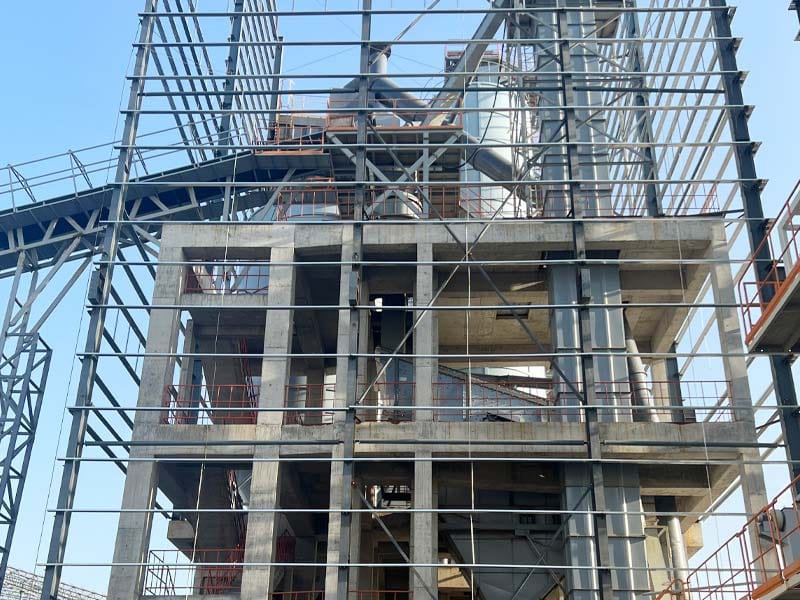
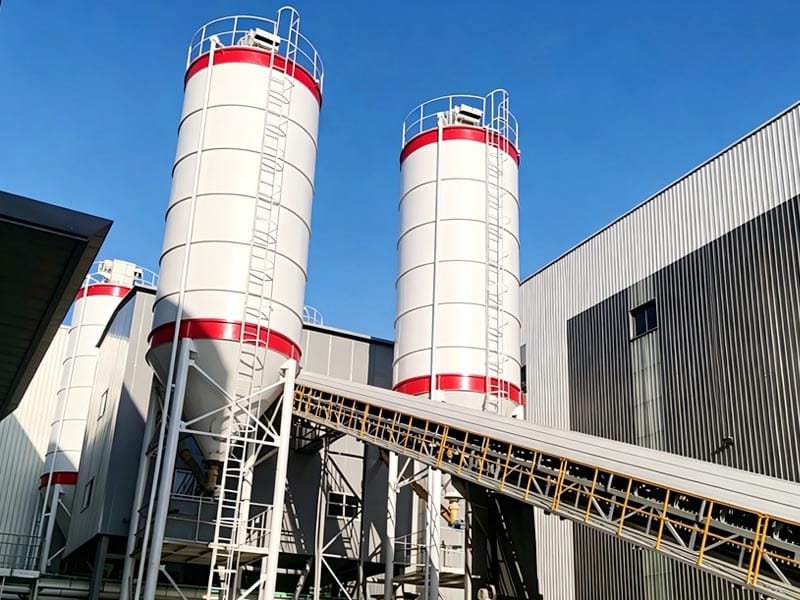
Наш ступенчатый смесительный завод сухих растворов и цеховая установка по смешиванию сухих растворов use separate metering of sand, powders and additives with automated batching and recorded production data. This guide explains how dry mortar dosing overshoot can be diagnosed from batch records before control parameters are changed.
What Is Dry Mortar Dosing Overshoot?
Dry mortar dosing overshoot is the amount by which the final measured dose exceeds the requested target.
If a recipe requests 10.00 kg of an additive and the final settled weight is 10.25 kg, the overshoot is 0.25 kg.
The cause may be:
- feeder cutoff occurring too late;
- material continuing to fall after cutoff;
- screw conveyor coast-down;
- powder aeration;
- unstable weighing signal;
- residual material entering the scale;
- incorrect compensation values.
Dry mortar dosing overshoot should therefore be analyzed as a complete feeding-and-weighing problem.
Start with Target, Cutoff and Final Weight
The most useful batch record contains more than only target and final quantity.
For each material, record:
| Record value | Почему это важно |
|---|---|
| Target weight | Defines the intended recipe quantity |
| Coarse-feed cutoff | Shows when fast feeding stopped |
| Fine-feed cutoff | Shows when final feeding stopped |
| Weight at cutoff | Shows how early the feeder stopped |
| Final settled weight | Shows actual completed dose |
| Dosing time | Shows changes in material flow rate |
These values make dry mortar dosing overshoot much easier to diagnose than one final error number.
Material in Flight Is a Common Cause
When a screw, valve or feeder stops, some material is already moving between the feeder outlet and the weigh hopper.
That material continues to fall after the stop command.
This is commonly called material in flight.
Dry mortar dosing overshoot caused by material in flight depends on:
- скорость подачи;
- высота падения;
- material bulk density;
- powder aeration;
- feeder response time.
The control system can compensate by stopping before the target and allowing the remaining material to complete the dose.
Material-in-Flight Compensation Must Match the Actual Product
One compensation value may not work for every powder.
Cement, filler, polymer powder and fine additives can flow at different rates.
For dry mortar dosing overshoot, compare the final error by material.
If one product consistently overshoots while other materials on the same scale remain stable, the scale itself is less likely to be the main cause.
Coarse and Fine Feeding Should Be Evaluated Separately
Many dosing systems use a high-rate coarse feed followed by a lower-rate fine feed.
The coarse stage provides speed. The fine stage provides control near the target.
If coarse feed continues too close to target, dry mortar dosing overshoot can increase.
If fine feed begins too early, the batch may be accurate but unnecessarily slow.
Обзор:
- coarse-to-fine transition point;
- fine-feed rate;
- final cutoff point;
- settled final error;
- total dosing time.
Small Additives Magnify Overshoot
A fixed amount of excess material has a larger relative effect when the target is small.
| Цель | Overshoot | Relative error |
|---|---|---|
| 100 kg | 0.2 kg | 0.2% |
| 10 kg | 0.2 kg | 2% |
| 2 kg | 0.2 kg | 10% |
This arithmetic is illustrative only.
It shows why dry mortar dosing overshoot should always be reviewed against the actual target quantity.
Scale Resolution Matters More at the Low End
A scale used for large powder batches may not be ideal for very small additive quantities.
For low-dose materials, review:
- scale capacity;
- display increment;
- load-cell range;
- signal stability;
- minimum routine production dose.
Dry mortar dosing overshoot can become difficult to distinguish from normal measurement resolution when the target is too small for the installed scale.
Zero Drift Can Look Like Overshoot
If the scale does not return to a repeatable empty zero before the next batch, the final result can appear high.
К числу возможных причин относятся
- material remaining inside the weigh hopper;
- flexible connection interference;
- powder buildup;
- load-cell drift;
- механический контакт;
- vibration.
For dry mortar dosing overshoot, record the as-found zero before the next cycle starts.
Hopper Residue Can Shift the Next Batch
A weigh hopper can discharge most material while retaining a small amount around:
- corners;
- outlet gate;
- flexible sleeve;
- wall buildup.
If the next batch begins without properly accounting for that residue, apparent dry mortar dosing overshoot can occur.
Repeated positive zero drift is a useful warning sign.
Mechanical Interference Can Bias the Weight Signal
The weigh hopper should transfer load only through its intended load cells.
Осмотреть:
- гибкие связи;
- кабели;
- dust-extraction hoses;
- adjacent steelwork;
- механические остановки;
- наращивание материала.
A flexible sleeve packed with hardened powder can become effectively rigid and change the indicated weight.
Screw Conveyor Coast-Down Can Increase Final Weight
A screw conveyor does not always stop moving material at the instant the motor receives a stop command.
Rotational inertia and material remaining inside the screw can continue feeding.
Dry mortar dosing overshoot caused by screw coast-down can change with:
- screw speed;
- screw length;
- material fill level;
- powder density;
- drive deceleration.
This is why cutoff tuning should use the real installed feeder.
Faster Screw Speed Is Not Always Better
Increasing screw speed shortens filling time, but it can increase material in flight and make the final cutoff harder to control.
For dry mortar dosing overshoot, compare:
- average dosing time;
- average final error;
- variation between batches.
The best operating point balances throughput and repeatability.
Powder Aeration Can Change Feed Rate
Powder that has recently been pneumatically transferred or disturbed can contain more entrained air.
This can change its apparent bulk density and flow behavior.
If dry mortar dosing overshoot increases after a silo refill, check whether:
- powder is more aerated;
- feed rate has increased;
- material settles differently;
- the previous compensation value is still appropriate.
Hopper Level Can Affect Feeder Output
The same screw speed does not always produce the same mass flow under every hopper condition.
Changes in head pressure and material packing can affect screw filling.
For dry mortar dosing overshoot, compare batches at:
- high hopper level;
- normal level;
- low level.
If overshoot follows hopper level, control tuning alone may not be the full solution.
Refilling Can Change Powder Behavior
Research on gravimetric powder feeding shows that hopper refilling can disturb feeder behavior because the powder bed and local density at the feeder inlet change during refill events.
Although continuous loss-in-weight feeding differs from batch dosing, the principle is useful: changing powder consolidation can change feed rate.
Dry mortar dosing overshoot should therefore be compared with storage-bin replenishment events.
Bridging Can Cause Both Underfeed and Sudden Overshoot
A cohesive powder may bridge above the feeder.
At first, the scale fills slowly.
If the bridge suddenly collapses, a surge of material can enter the feeder and create overshoot.
Проверка:
- hopper outlet;
- wall buildup;
- влажность материала;
- flow aids;
- screw inlet.
Наш hopper bridging guide explains why flow problems should be fixed before aggressive control tuning.
Different Materials Need Different Tuning
Dry mortar plants often dose:
- sand;
- cement;
- mineral filler;
- polymer powder;
- cellulose ether;
- pigments;
- other additives.
These materials have different bulk density and flowability.
Dry mortar dosing overshoot should therefore be trended by material name, not only by scale ID.
Do Not Use One Compensation Value for Every Recipe
If the same ingredient is dosed at very different quantities across recipes, the ideal cutoff compensation may change.
A fixed 0.5 kg pre-act value can behave differently at a 5 kg target than at a 100 kg target.
For dry mortar dosing overshoot, consider whether compensation should depend on:
- материал;
- target range;
- feeder stage;
- actual measured flow rate.
Batch Records Can Reveal Systematic Bias
A useful trend table can include:
| Batch | Цель | Final | Error | Dosing time |
|---|---|---|---|---|
| 1 | 10.00 | 10.22 | +0.22 | 18 s |
| 2 | 10.00 | 10.20 | +0.20 | 18 s |
| 3 | 10.00 | 10.24 | +0.24 | 17 s |
This pattern suggests a consistent positive bias rather than random measurement noise.
Dry mortar dosing overshoot that repeats in the same direction often points toward cutoff or compensation settings.
Random Error Suggests a Different Problem
If the final error alternates widely between positive and negative values, investigate:
- unstable material flow;
- scale vibration;
- mechanical interference;
- bridging;
- changing hopper level;
- sensor noise.
A simple pre-act adjustment may not correct a highly variable process.
Signed Error Is More Useful Than Absolute Error Alone
Absolute error shows how far the result is from target.
Signed error shows whether the system is normally heavy or light.
For dry mortar dosing overshoot, keep the sign:
- positive = over target;
- negative = under target.
If ten batches all show positive error, that tells a different story from ten batches with the same average absolute error but mixed positive and negative results.
Mean Error and Spread Should Be Reviewed Together
A dosing system can have low average bias but poor repeatability.
For example, errors of -0.5, +0.5, -0.5 and +0.5 average near zero but are still unstable.
For dry mortar dosing overshoot analysis, review:
- mean signed error;
- maximum error;
- minimum error;
- standard deviation where useful;
- dosing time variation.
Dosing Time Is a Powerful Diagnostic Variable
If dry mortar dosing overshoot increases while dosing time decreases, material may be flowing faster than before.
If overshoot rises while dosing time also rises, the cause may be less straightforward and can include unstable flow or control hunting.
Trend dosing time with final error.
Recipe Changes Can Reveal Scale-Range Problems
If a scale performs well for large targets but poorly for small targets, the weighing range may be too broad for the low-dose material.
For dry mortar dosing overshoot, compare performance by target band:
- minimum dose;
- low dose;
- normal dose;
- high dose.
This can show whether a dedicated micro-dosing system is justified.
Micro-Dosing May Need Separate Equipment
Specialty mortars can use additives at quantities much smaller than sand or cement.
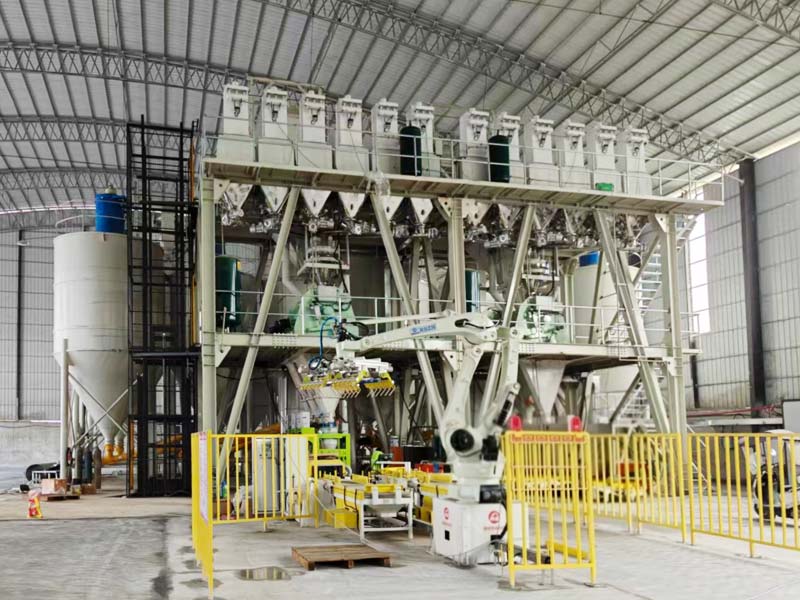
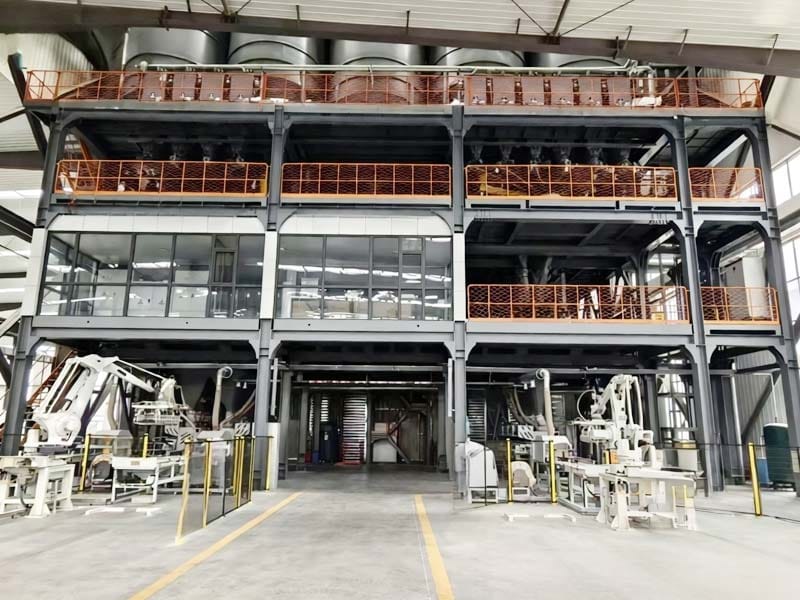
The workshop-type dry mortar plant is intended for multi-variety and small-batch specialty production, with separate screw feeding of sand, powder and additives into metering hoppers. citeturn962007search1
For very small additive targets, dry mortar dosing overshoot can be reduced by using a feeder and scale designed specifically for the smaller operating range rather than forcing all ingredients onto one large system.
Manual Addition Still Needs Verification
Some low-volume ingredients may be added manually.
This avoids automatic feeder overshoot but introduces different risks:
- wrong material;
- wrong quantity;
- missed addition;
- duplicate addition.
Manual dosing should therefore use controlled weighing and batch confirmation.
Dust Extraction Can Disturb Small Weighing Hoppers
Fine additive weighing is sensitive to small forces.
If dust extraction creates pressure or tension on a weigh hopper through a rigid connection, the displayed weight can shift.
For dry mortar dosing overshoot, check whether:
- the reading changes when dust extraction starts;
- flexible connections move freely;
- negative pressure is excessive;
- filters are blocked.
Vibration Can Affect the Final Settled Reading
Nearby mixers, elevators and screw conveyors can create vibration.
The scale may appear to cross the target before the signal settles.
For dry mortar dosing overshoot, compare:
- instant cutoff reading;
- settled reading;
- nearby equipment operating state.
Signal filtering should not be used to hide a mechanical vibration problem.
Do Not Recalibrate the Scale to Correct a Feeder Problem
If reference weights prove the scale is accurate, but automatic batches are consistently high, changing scale calibration to make production “look correct” creates a false measurement relationship.
Instead, investigate:
- pre-act;
- coarse/fine transition;
- feeder coast-down;
- material in flight;
- flow-rate changes.
Наш dry mortar weighing accuracy guide explains why measurement accuracy and dosing control should be verified separately.
Check Overshoot After Maintenance
Replacing or adjusting a screw, motor, valve or VFD can change feed behavior.
Dry mortar dosing overshoot should be rechecked after:
- screw replacement;
- gearbox replacement;
- VFD parameter changes;
- hopper modification;
- scale maintenance;
- material change.
Use an Overshoot Diagnostic Table
| Observed pattern | Likely area to check first |
|---|---|
| Stable positive error | Cutoff or material-in-flight compensation |
| Large random positive/negative error | Flow instability, vibration or scale interference |
| Overshoot increases at high hopper level | Feeder inlet pressure and screw filling |
| Overshoot after silo refill | Powder aeration or density change |
| Only smallest targets overshoot | Scale/feeder operating range |
| Final weight rises after feeder stops | Material in flight or screw coast-down |
This table provides a starting point, not a final diagnosis.
Step-Type Layouts Add Transfer Interfaces
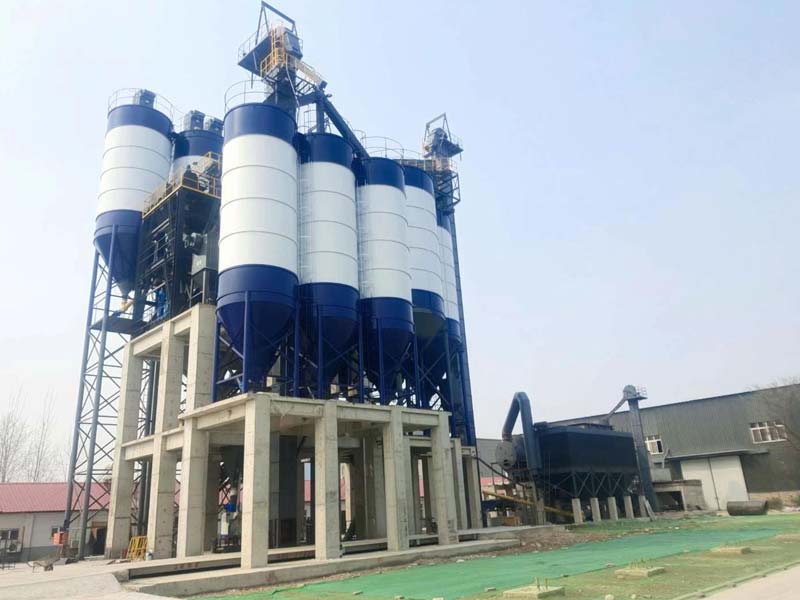
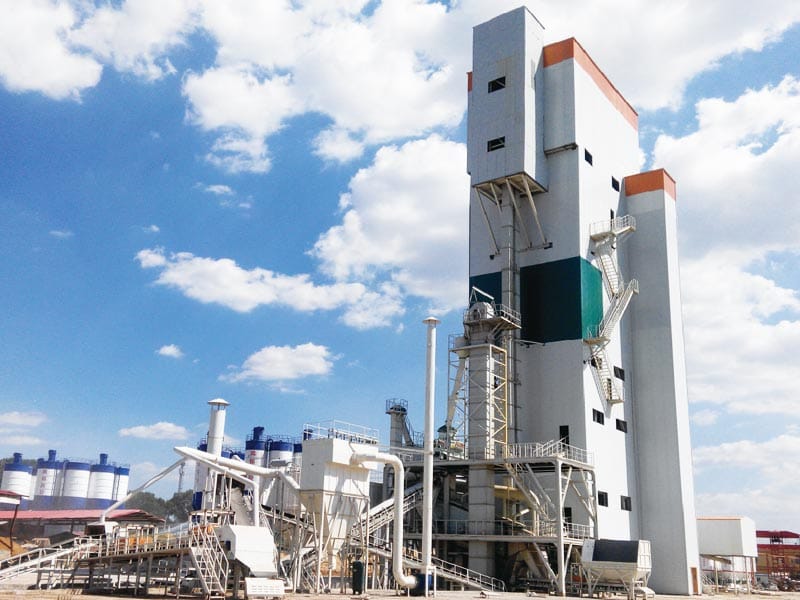
The current step-type dry mortar process uses separate metering, then elevators and screw conveyors to move materials to storage bins on different platforms before staged gravity flow and mixing. citeturn962007search6
For dry mortar dosing overshoot, the weighing stage should be analyzed independently from those later transfer stages.
Also, because public capacity fields for step-type configurations have shown inconsistency across site versions, equipment selection should use the final project proposal rather than a generic website capacity figure.
Workshop Layouts Can Make Dosing Equipment Easier to Inspect
The workshop-type line places core equipment on the workshop floor and uses screw conveyors to feed sand, powder and additives into metering hoppers. citeturn962007search1
This can make it easier to inspect:
- screw feeders;
- weigh hoppers;
- гибкие связи;
- micro-dosing points.
Dry mortar dosing overshoot still needs data-based tuning regardless of layout.
Commissioning Should Include Repeated Low-Dose Batches
A single successful test is not enough.
Commissioning should verify:
- minimum routine target;
- normal target;
- multiple repeated batches;
- different hopper levels;
- actual production materials;
- пакетно-записывающий вывод.
The most demanding small-dose ingredient should be included in the test.
What Should Buyers Send for a Dosing Overshoot Review?
A useful dry mortar dosing overshoot review needs production records.
Обеспечить:
- material name;
- target dose;
- final dose;
- batch-by-batch error;
- dosing time;
- coarse/fine cutoff settings;
- hopper level;
- feeder type;
- scale capacity;
- recent maintenance or material changes.
Наш растворы сухого раствора can then be reviewed around the actual dosing range and production requirements.
Send your mortar line configuration and production records through our страница контактов для технического обзора.
Заключение
Dry mortar dosing overshoot is often caused by the interaction between material flow, feeder response and weighing control rather than by the scale alone.
Batch records can reveal whether the error is a stable positive bias, random variation, target-range problem, hopper-level effect or material-flow change. Target, cutoff weight, final weight and dosing time are especially useful together.
The strongest troubleshooting process verifies the scale first, then studies feeder behavior and material flow before changing compensation values. That prevents calibration from being used to hide a mechanical or process-control problem.
ЧАСТО ЗАДАВАЕМЫЕ ВОПРОСЫ
What causes dry mortar dosing overshoot?
Common causes include material in flight, screw conveyor coast-down, coarse-feed cutoff that occurs too late, powder aeration, changing hopper level, bridging and unstable scale signals.
Why does the final weight rise after the feeder stops?
Material already moving between the feeder and weigh hopper continues to fall after cutoff. Screw inertia can also continue feeding briefly.
Can scale calibration fix dosing overshoot?
Only if the scale is actually inaccurate. If reference-load verification is correct, overshoot should be addressed through feeder control, cutoff compensation and material-flow checks.
Why is dosing overshoot worse for small additives?
The same absolute excess represents a larger percentage of a small target, and the scale or feeder may be operating near the lower end of its practical range.
What records help diagnose dry mortar dosing overshoot?
Record target weight, cutoff weight, final settled weight, signed error, dosing time, hopper level, feeder settings and recent maintenance or material changes.