
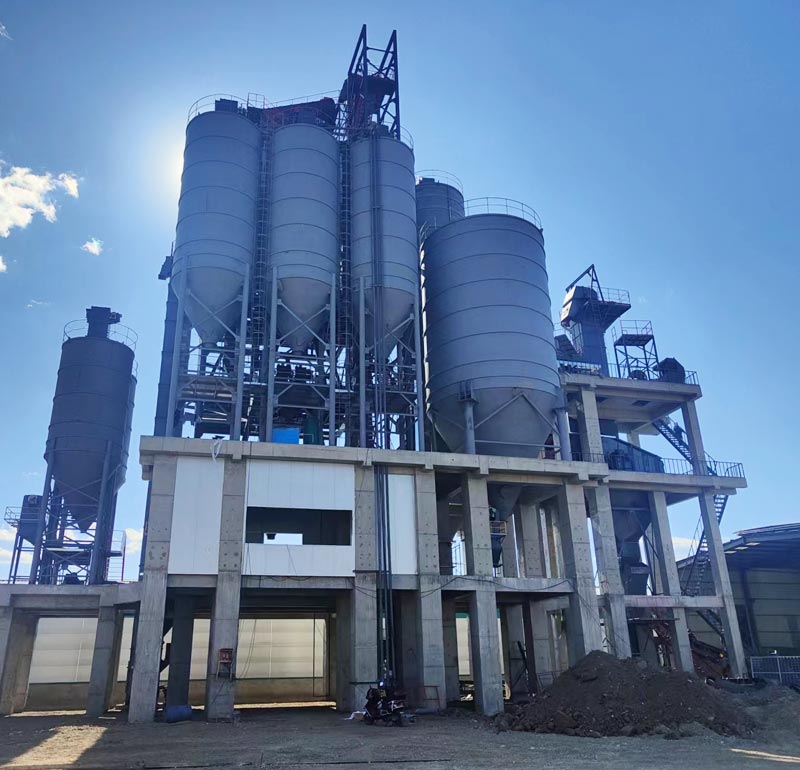
Dry mortar plant maintenance should protect the product leaving the packaging line, not merely keep the mixer turning. A plant can restart after cleaning while old powder remains in a conveyor, a weighing hopper no longer moves freely, or the next recipe enters the wrong finished-product bin.
Náš step-type dry mortar mixing plant combines layered platforms, gravity transfer and screw conveying. Those connections matter when planning inspections, cleaning and product changes.
This guide connects dry mortar plant maintenance to equipment selection: which access points to request, what to check along the material route, and how to distinguish a completed service task from a line ready for its next product.
Obsah
What Should Dry Mortar Plant Maintenance Protect?

A useful plan covers three separate outcomes: safe equipment, reliable material movement and an acceptable finished blend. Treat each as something to verify rather than assuming that one successful restart proves everything.
Dry mortar plant maintenance includes storage outlets, feeders, weighing assemblies, the mixer, finished-powder transfer, dust extraction and packaging. Include upstream drying or screening equipment only where it forms part of the actual installation.
Define responsibility at each interface. When a packaging machine comes from another supplier, its cleaning and release checks still belong in the plant-wide plan. A clean mixer feeding an uncleared packing hopper is not a completed product changeover. For a multi-product factory, specify who hands each cleared section back to production and who authorizes the finished material for packaging or dispatch.
Match Service Access to the Plant Layout
Compare dry mortar plant maintenance requirements on an equipment drawing, not through a general claim of easy servicing. Mark where a technician stands, which cover opens and how a replacement component leaves the structure.
Step-type layouts
The step arrangement combines vertical drops with horizontal screw conveyors across several platforms. Review each transfer point separately. Ask whether a conveyor section can be removed without dismantling an adjacent pipe, platform or structural member.
Workshop layouts
Náš dielňa typu suché malty miešanie rastlín places its core equipment on the workshop floor with screw-conveyor connections. Include withdrawal space beside those conveyors and working space around the mixer, metering hoppers and packaging interface.
Tower layouts
Náš miešačka suchej malty vežového typu uses a vertical gravity-flow arrangement. Evaluate access at each level, including routes for tools and replacement parts. Fewer horizontal transfers do not remove the need to inspect elevated storage, gates and discharge points.
Build a Schedule Around Duty and Product Changes
Use the following dry mortar plant maintenance schedule as a planning framework, not a model-specific service instruction. Actual intervals depend on the equipment manual, material characteristics, operating hours and inspection findings.
| Timing | Planning focus | Record or release requirement |
|---|---|---|
| Before production | Previous faults, guarded access, material routes and extraction status. | Authorized startup condition and unresolved issues. |
| During normal operation | Read available operating indicators and observe externally from designated safe positions. | Material, recipe, load and symptom; no intrusive inspection. |
| At a product change | Residual powder, shared transfer routes, packaging identity and next-recipe selection. | Cleaning record and defined first-product checks. |
| During planned shutdown | Manual-specified wear inspection, lubrication, seals, drives and measuring-system checks. | Findings, parts fitted, settings and verification results. |
| After repair or extended idle time | Affected safety functions, mechanical operation and material performance. | Documented release before normal production resumes. |
Assign an owner and an action to each dry mortar plant maintenance task. “Check conveyor” is incomplete unless the team knows what condition requires attention and who decides whether production may continue. HSE’s usmernenie k kontrole zariadenia supports risk-based checks that reflect deterioration and operating conditions.
Plan Isolation Before Opening the Equipment
Dry mortar plant maintenance involves more than disconnecting the mixer motor. The work boundary may include upstream feeding, stored pneumatic energy, gravity-fed material and remote startup commands.
HSE’s bezpečné vedenie údržby emphasizes competent personnel, secure isolation and control of stored energy. A stopped control screen or emergency-stop button is not a substitute for the required isolation procedure.
Ask the designer to identify isolation points and safe access arrangements for each planned task. Do not reach into conveyors, remove guards around moving equipment or enter beneath material that could discharge.
Prefer inspection and cleaning arrangements that avoid vessel entry. Where entry into a confined space cannot be avoided, it needs a separately assessed safe system of work and emergency arrangements, as explained in HSE’s confined-space guidance. Apply the equipment instructions and local requirements to the actual installation.
Choose Cleaning Methods for a Dry-Powder Line
Dry mortar plant maintenance should not copy the washdown routine of a wet-concrete mixer. Agree permitted cleaning methods for the materials and equipment, including how the line will be confirmed suitable before powder production resumes.
HSE’s guidance on vacuuming industrial dust warns that brushing or blowing deposits can put dust back into the air. Select suitable dust-controlled collection equipment through the site risk assessment; an ordinary household vacuum should not be assumed suitable.
Do not introduce water or cleaning chemicals into product-contact equipment without an approved procedure covering compatibility, electrical protection, residue removal and drying. Cleaning agents should not become an uncontrolled ingredient.
In your dry mortar plant maintenance record, identify what was removed and where it went. Keep collected powder, sweepings and maintenance debris separate from released material. Reuse requires an approved material-specific decision, not an assumption that everything collected originally belonged in mortar.
Inspect Mixer Wear and Discharge Together
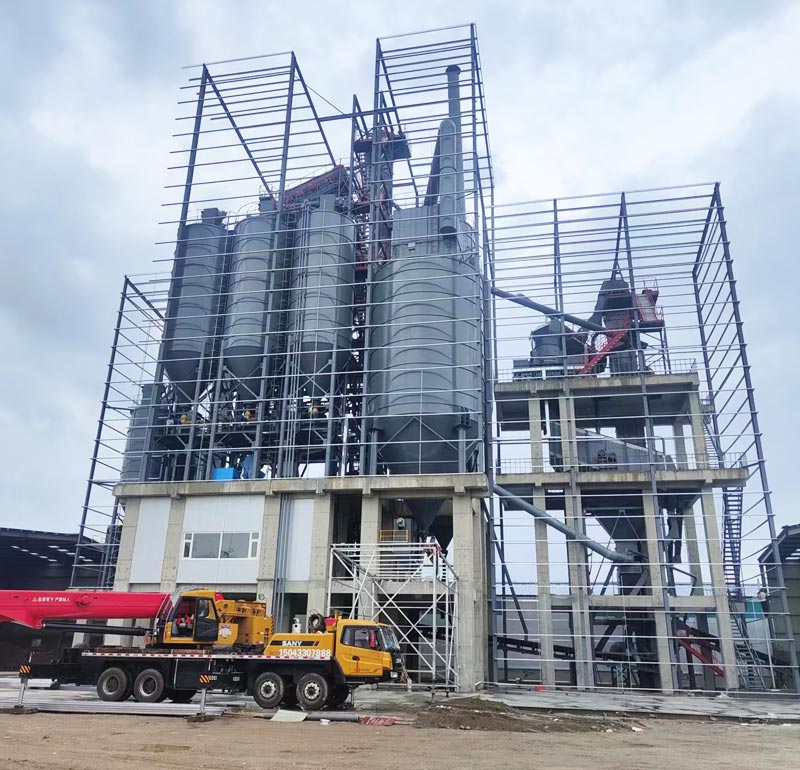
The step-type product description identifies a twin-shaft mixer. The workshop product description does not establish the same mixer construction, so confirm the proposed machine rather than transferring one inspection checklist across every layout.
For dry mortar plant maintenance, request model-specific inspection points for mixing elements, installed liners, shaft seals, discharge closures and their actuators. Use the manufacturer’s limits for wear, clearances, lubrication and adjustment; this guide does not prescribe universal values.
During an authorized shutdown, document retained powder and the condition of accessible product-contact surfaces. Compare findings with the previous recipe and operating period. Look for repeated locations rather than treating each deposit as an isolated cleaning task. Use labeled photographs and an agreed inspection form so the next inspection covers the same locations. A general photograph of an open mixer is less useful than a record identifying the discharge edge, seal area or mixing element being assessed.
After work, check both mechanical operation and material discharge under an approved test procedure. A drive running normally does not establish that the next blend is uniform or that the chamber empties as required.
Follow Feeders, Weighing Hoppers and Transfer Points
Dry mortar plant maintenance must follow the powder beyond the mixing chamber. The workshop process uses screw conveyors to feed separate metering hoppers and move finished material toward packaging. Each connection belongs in the inspection map.
Ask which covers provide access, how flexible connections are protected during servicing and how the engineer verifies that a weighing hopper is free from unintended contact. Where screws or elevators are installed, identify the correct drive, bearing and seal instructions for each unit.
After work affecting measurement or feeding, define checks at the intended ingredient quantities. NIST’s metrological traceability policy explains why traceability alone does not establish fitness for purpose: measurement uncertainty must suit the decision.
Keep instrument verification separate from a dosing trial. For dry mortar plant maintenance, the relevant question is whether the serviced assembly can measure, feed and discharge within the agreed operating requirements—not simply whether its display returns to zero.
Maintain Dust Extraction as a Working System
Our workshop and step-type configurations describe pulse dust collection. Effective dry mortar plant maintenance should address the installed extraction network, not only the filter elements.
Establish a baseline for the commissioned system. HSE’s miestne vedenie na uvedenie do prevádzky výfukového vetrania calls for defined operating conditions, performance benchmarks and test methods. These provide a reference when assessing later changes.
Have the responsible specialist define checks for capture points, ducts, filters, pulse-cleaning components and collection-hopper discharge. Compare available airflow or pressure readings under comparable conditions. A gauge value needs a defined meaning and action limit; it is not an independent proof of adequate dust control.
The HSE guidance for extraction-system users also emphasizes user instructions, records and timely repair.
Map the fate of collected dust. Where several products share extraction equipment, agree whether collected material is discarded, separately held or returned through a validated route. Do not automatically return mixed dust to the next batch. Dust control and product identity are different requirements.
Validate Product Changes Beyond the Recipe Screen
Dry mortar plant maintenance becomes a product-quality issue whenever formulations share equipment. Changing the selected recipe does not physically remove material from a mixer outlet, conveyor, finished-product hopper or packing spout.
Create a changeover matrix with the product technologist. Consider changes in binder system, color, aggregate grading and functional additives. Decide which transitions can follow a documented routine and which need additional cleaning, testing or dedicated equipment.
A residue calculation that changes the inspection question
Consider a hypothetical transfer route retaining 6 kg of the previous product. If all of it enters the next 1,000 kg of new blend, the old-product fraction is 6 ÷ 1,006 × 100, or approximately 0.60% of the combined mass.
If that residue instead enters only the first 100 kg of new blend, the affected portion contains 6 ÷ 106 × 100, or approximately 5.66% old product. These are illustrative mass balances, not equipment performance or acceptable contamination limits.
The implication for dry mortar plant maintenance is practical: a whole-batch average can conceal an uneven release of residue. Agree sampling locations and timing, including the initial discharge where relevant. The product technologist must set acceptance criteria; the calculation cannot establish compatibility or predict finished-mortar performance.
Use suitable trials to validate the chosen cleaning and release method. Neither a clean-looking chamber nor a fixed number of flushing batches proves that every downstream route is ready.
Include the Finished-Powder and Packaging Route
Do not stop dry mortar plant maintenance at the mixer outlet. The published step-type flow includes a finished-product bin followed by packaging or bulk delivery. Review whichever delivery route the project actually includes.
Specify access around transfer gates, intermediate storage and the installed filling equipment. Ask how retained powder is removed, how bag-weight checks are performed and how the packing area remains connected to effective extraction.
At a product change, verify the receiving bin, product identification and packaging materials as well as the equipment condition. Keep startup material on hold until the agreed release decision. A mechanically correct package can still contain the wrong product or carry the wrong label.
Release the Line in Defined Stages
A completed dry mortar plant maintenance task should end with documented decisions, not just a signature beside “machine running.” Use a release structure like this, adapted to the work performed.
| Release stage | Evidence to agree | What remains unproven |
|---|---|---|
| Mechanical completion | Work checked; tools, temporary items and loose material accounted for. | Safe operation and product suitability. |
| Safe functional restart | Guards, relevant protective functions and authorized operating checks verified. | Correct material quantities and finished-blend properties. |
| Material trial | Feeding, weighing, discharge and packaging evaluated for the affected functions. | Release of material without the required product checks. |
| Product release | Samples, identity and agreed quality results reviewed by the responsible person. | Suitability for untested recipes or operating conditions. |
Scale the test scope to the intervention. Replacing an external lamp and disturbing a weighing support need different verification. Keep the reason for that decision with the work record.
Use Repeated Faults to Improve the Equipment Specification
Keep dry mortar plant maintenance records by asset and symptom. Record the product, operating condition, intervention, replaced part and result of the subsequent checks. Repeatedly writing “cleaned blockage” hides the information needed to investigate recurrence.
Before selecting a replacement line, review the locations that demand repeated access. Ask whether the proposed arrangement changes the transfer route, inspection opening or component-removal method. Require an engineering explanation rather than assuming a larger motor fixes every interruption.
Náš riešenia na výrobu suchej malty include different plant configurations. Compare them against the actual maintenance tasks and product schedule, not only the nominal production requirement.
Specify Maintenance Deliverables Before Ordering
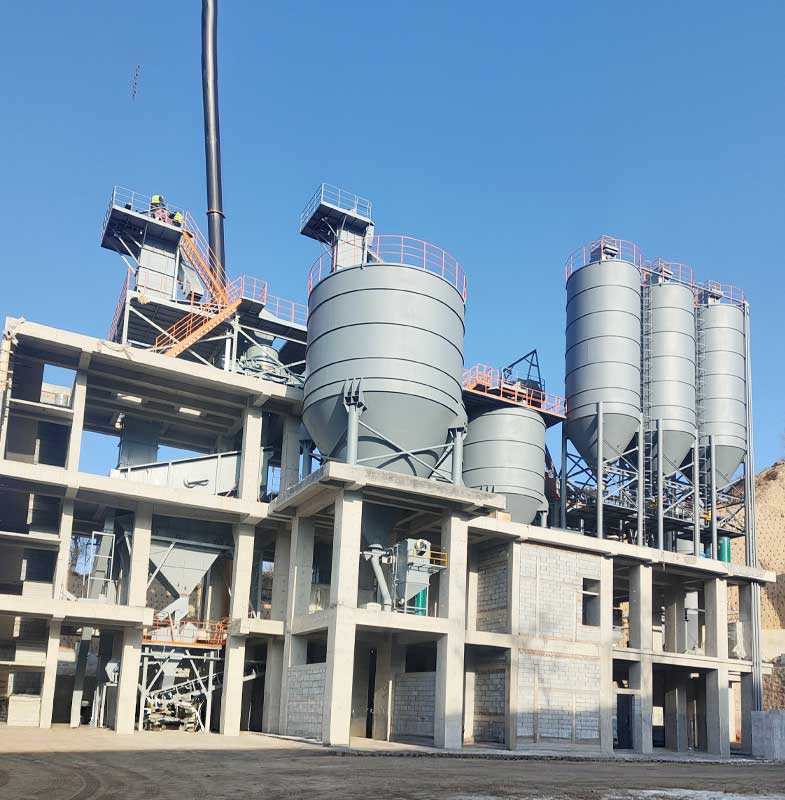
Bring dry mortar plant maintenance into the preskúmanie rozloženia a konfigurácie závodu. Provide the mortar range, expected product changes, site drawing and available maintenance resources.
Request equipment-specific manuals, component identifiers, approved service materials, inspection points and access drawings. For dry mortar plant maintenance, confirm spare-part compatibility against the approved assembly and its revision. Agree the parts list against the final configuration rather than accepting an unrelated generic spares package.
Ask for a demonstration of representative cleaning, inspection and component-removal tasks. Clarify training, test materials and responsibilities for recommissioning. These requirements connect the purchase to the operation you intend to run, without assuming unconfirmed service intervals, cleaning times or supplied accessories.
Záver
Dry mortar plant maintenance is most useful when it protects the complete path from ingredient storage to released product. Plan access, control residual material and verify the affected functions before restarting routine production.
Share your mortar range, production schedule and site layout with our team. Request a dry mortar plant configuration review to discuss the equipment arrangement, cleaning access and maintenance provisions your project needs.
FAQ
How often should dry mortar plant maintenance be performed?
Use the equipment manual and risk assessment to set intervals. Separate startup observations, product-change checks, planned servicing and checks after repair. Adjust the plan using operating duty and inspection findings rather than treating one calendar interval as suitable for every component.
Can water be used to clean a dry mortar mixer?
Only under an approved equipment- and material-specific procedure. Confirm compatibility, electrical protection, residue removal and drying requirements. Do not assume that a washdown method suitable for wet-concrete equipment is suitable for a dry-powder production line.
Does changing the recipe complete a product changeover?
No. Physical residues, shared transfer routes, packaging identity and first-product release still need consideration. Validate the changeover for the actual products and equipment; software selection alone does not clear powder from the line.
Can collected dust go back into the mortar?
Not automatically. Establish its source, composition, condition and destination. A shared collector may contain material from different operations. Any return or reuse needs approval and traceability appropriate to the receiving formulation.
What dry mortar plant maintenance details should buyers request?
Request configuration-specific manuals, service access drawings, component and spare-part identifiers, and agreed inspection and restart requirements. Include cleaning and product-change demonstrations where these influence equipment selection.


