
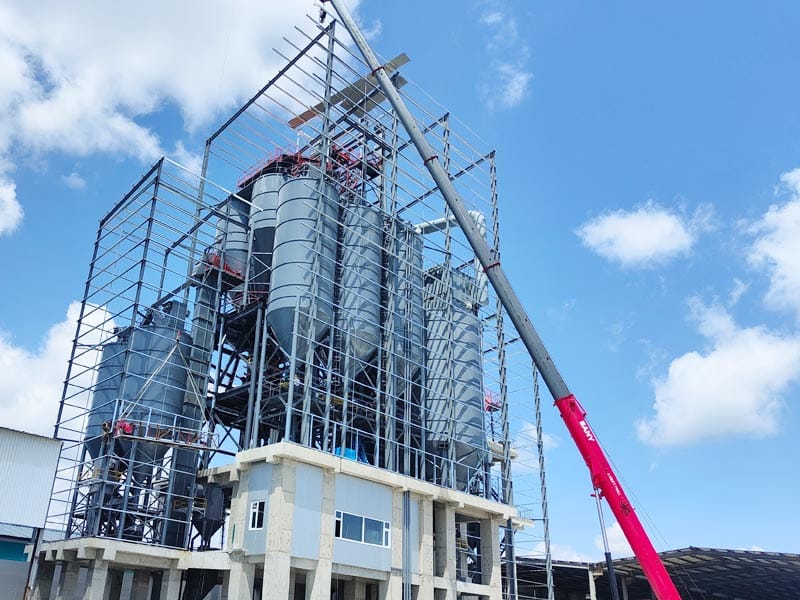
Fine sand for mortar is not a single universal material. Masonry mortar, tile adhesive, self-leveling mortar, waterproof mortar and repair mortar can all use fine aggregate, but they do not necessarily need the same particle-size distribution, powder content, particle shape or sand fraction.
For dry mortar producers, the practical question is therefore not “What is the best sand size?” It is “What sand grading does each mortar product require, and can the production line supply that grading consistently?”
Bizim entegre üretilmiş kum ve özel harç tesisi combines manufactured sand preparation, screening, powder classification, storage, batching and mortar mixing in one process. That integration is useful when a factory needs different sand qualities for different mortar products rather than one fixed sand specification.
What Does Fine Sand for Mortar Actually Mean?

Fine sand for mortar usually refers to the fine aggregate portion of a dry mortar formulation. However, “fine” does not define one exact particle-size range by itself.
A sand can be considered fine in one product and too coarse or too powder-rich in another.
The useful specification should include:
- maximum particle size;
- full sieve distribution;
- fineness modulus where relevant;
- material passing very fine sieves;
- parçacık şekli;
- nem;
- clay or deleterious material.
ASTM C144-26, the current specification for masonry mortar aggregate, accepts both natural and manufactured sand but requires the aggregate to meet defined grading and quality requirements. That is a useful reminder that fine sand for mortar should be judged by measurable properties rather than by source name alone.
Why One Sand Grading Does Not Fit Every Mortar Product
Different mortar products have different application thicknesses, flow requirements, bond demands and finishing behavior.
| Mortar product | Sand-related priority | Neden önemli olduğunu |
|---|---|---|
| Yığma harcı | Controlled grading and workability | Needs practical placement, bond and joint finishing |
| Fayans yapıştırıcı | Fine, controlled aggregate and powder balance | Supports thin-layer application and adhesive consistency |
| Kendiliğinden tesviye harcı | Narrow, consistent fine-aggregate grading | Supports flow, leveling and segregation control |
| Waterproof mortar | Product-specific fine aggregate and fines control | Needs stable packing and formulation repeatability |
| Tamir harcı | Grading matched to repair thickness | Controls placement and packing in the repair zone |
This is why fine sand for mortar should be selected from the product outward rather than from one standard stockpile inward.
Masonry Mortar Can Use a Broader Aggregate Range
Masonry mortar often uses a broader sand grading than highly specialized thin-layer products.
Akım ASTM C144-26 specification covers aggregate for masonry mortar and explicitly includes both natural and manufactured sand.
For a masonry mortar line, the production goal is usually to maintain a stable grading that supports workability and the applicable mortar specification.
That does not mean every sand within a nominal size limit will behave the same.
Fine sand for mortar still needs consistent particle distribution, limited deleterious material and stable moisture before it enters a dry mortar plant.
Tile Adhesive Usually Needs Tighter Fine-Aggregate Control
Tile adhesive is normally applied in a relatively thin layer and contains polymer and rheology-modifying additives. The aggregate system therefore has to fit a much finer and more controlled formulation than a typical general-purpose masonry mortar.
Fine sand for mortar used in tile adhesive should be evaluated for:
- upper particle-size limit;
- distribution in the fine range;
- toz içeriği;
- parçacık şekli;
- kütle yoğunluğu;
- interaction with polymer and filler content.
Bizim tile adhesive production guide explains why micro-additive dosing and packaging should be designed together with sand quality.
A sand that works well in masonry mortar can be too coarse or too variable for a tile adhesive formulation.
Self-Leveling Mortar Needs Stable Flow, Not Simply Finer Sand
Self-leveling mortar is a good example of why “finer is better” is not a reliable rule.
The product needs enough flow to level but also enough stability to resist segregation.
If the sand contains too many coarse particles, the mix can lose flow. If it contains excessive fines, water demand and viscosity can change.
Fine sand for mortar used in self-leveling systems should therefore be controlled as a grading curve rather than one maximum particle size.
Bizim self-leveling mortar production guide explains how aggregate grading, micro-additive dosing and mixing all contribute to product consistency.
Repair Mortar Needs Sand Matched to Repair Thickness
Repair mortar can range from thin surface repair to thicker structural patching products.
A very fine aggregate system may suit a thin skim coat, while a thicker repair product may need a different upper aggregate size to reduce paste demand and improve packing.
This means fine sand for mortar should be selected together with the intended application thickness.
Onarım harcı üretimi için, alıcılar şunları sağlamalıdır:
- minimum layer thickness;
- maximum layer thickness;
- target application method;
- required workability;
- approved sand grading.
The dry mortar line can then be configured with the correct number of sand fractions and storage bins.
Fine Sand Changes Water Demand Through Packing and Surface Area
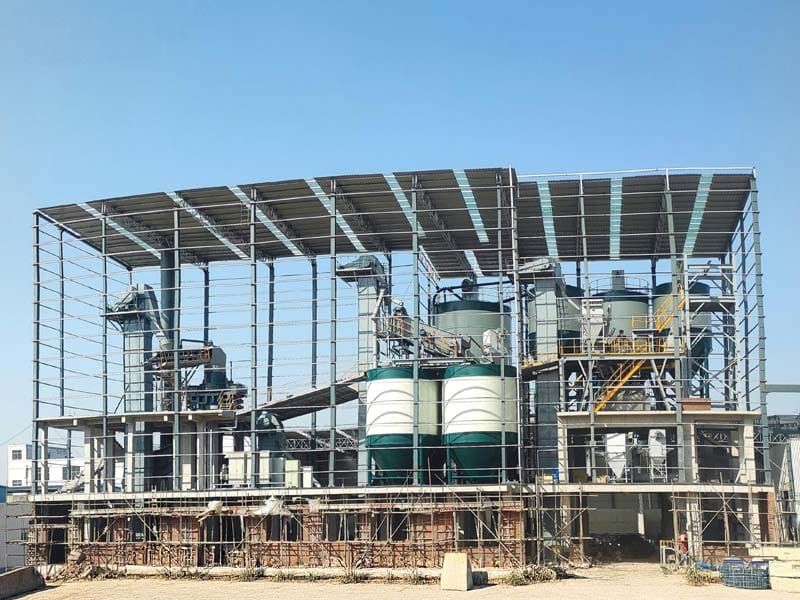
As sand becomes finer, its total particle surface area generally increases. More surface area can increase the amount of paste or water needed to coat and lubricate the particles.
However, grading also matters.
A well-graded blend of several particle sizes can pack more efficiently than a narrow single-size sand, reducing void space between particles.
Fine sand for mortar should therefore be evaluated from both:
- particle size;
- packing efficiency.
Two sands with a similar maximum size can produce different mortar water demand if their distribution and particle shape are different.
Particle Shape Matters Alongside Particle Size
Manufactured fine sand is often more angular than naturally weathered sand.
Angular particles can increase internal friction and change mortar flow. At the same time, rougher surfaces can contribute to mechanical interlock.
For fine sand for mortar, particle shape should not be judged in isolation.
Karşılaştır:
- shape;
- derecelendirme;
- void content;
- surface texture;
- water demand;
- finished mortar performance.
The correct sand is the one that works with the validated formulation, not the one that simply looks more rounded or more angular.
Powder Content Is Not the Same as Useful Fine Sand
Fine sand and mineral powder perform different functions in mortar.
Manufactured sand can contain very fine stone powder created during crushing. Some of this fine material may support particle packing, while excessive or unsuitable fines can change water demand and flow.
For fine sand for mortar, define separately:
- kum derecelendirmesi;
- very fine powder content;
- clay-related contamination;
- filler added intentionally in the formula.
Our integrated sand and mortar line uses screening and powder classification so the sand-making section can control these variables before the mortar batching stage.
Stone Powder and Clay Should Not Be Treated as Equivalent
Material passing a fine sieve can come from sound parent rock or from clay and other unwanted contamination.
These materials can behave very differently in mortar.
For fine sand for mortar, quality control should therefore consider both quantity and type of fines.
Do not assume that every fine fraction is beneficial simply because the product requires a fine aggregate.
Where the project uses manufactured sand, parent-rock quality and clay-related testing should be included in the source approval process.
Manufactured Sand Gives More Control Over Fine Sand Grading
One advantage of manufactured sand is that the producer can actively control crushing, screening and classification.
Our integrated sand and special mortar plant publicly supports 0–3 mm manufactured sand with adjustable fineness and adjustable powder content.
For fine sand for mortar, this means a producer can potentially create several controlled fractions rather than buying one mixed natural-sand stockpile.
However, the adjustable process needs a defined target.
The mortar laboratory should specify which fractions and powder condition are required for each product.
One 0–3 mm Product Is Not Automatically Enough
A 0–3 mm manufactured sand range describes the outer product envelope, but it does not mean every mortar should use the complete fraction unchanged.
For example, one product may use most of the 0–3 mm grading while another may require a narrower fine fraction.
Fine sand for mortar should therefore be stored and blended according to the product portfolio.
A factory may need:
- one broad sand fraction;
- two or more classified fractions;
- a fine powder stream;
- separate storage for different source materials.
The right configuration depends on how many mortar products the factory plans to make.
Separate Sand Fractions Increase Recipe Flexibility
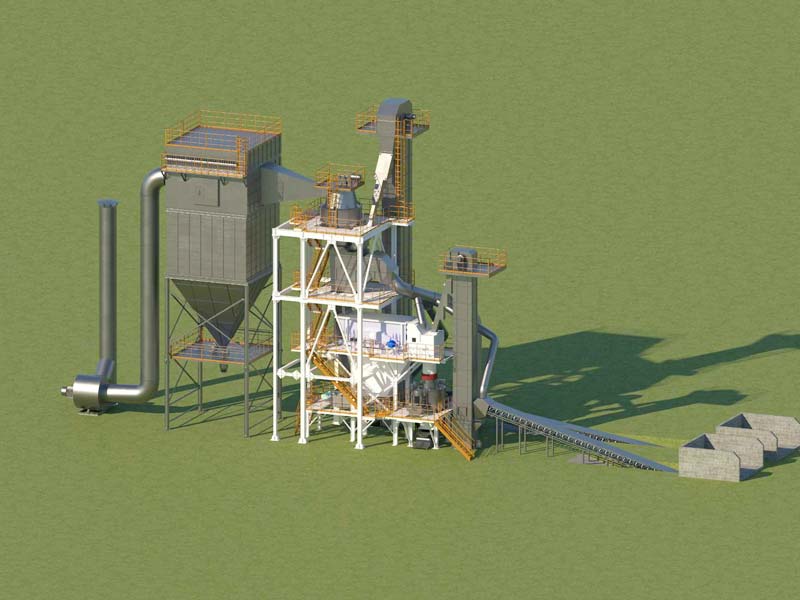
Separate storage bins allow the control system to blend different sand fractions into different recipes.
This can be valuable when the same plant makes masonry mortar, tile adhesive, waterproof mortar and repair mortar.
For fine sand for mortar, the key questions are:
| Planning question | Neden önemli olduğunu |
|---|---|
| How many sand fractions are required? | Determines storage-bin count |
| Which products share the same fraction? | Helps reduce unnecessary storage |
| Which fraction has the highest consumption? | Influences bin size |
| How often are products changed? | Affects blending and scheduling |
| Is external sand sale planned? | May require separate finished-product handling |
More bins are not automatically better. The goal is enough flexibility to support the actual product range.
Sand Classification Capacity Must Match Mortar Demand
An integrated line can produce enough total sand while still failing to produce enough of one critical fine fraction.
Suppose the sand-making section produces 30 tonnes per hour total, but a particular mortar requires 8 tonnes per hour of a narrowly classified fine fraction and the classifier can supply only 5 tonnes per hour.
The mortar line will eventually run short of that fraction even though total sand output looks sufficient.
This example is illustrative.
For fine sand for mortar, balance the production line by fraction demand rather than total sand tonnes alone.
Fine Sand Moisture Must Be Controlled Before Dry Mortar Mixing
Dry mortar production requires dry aggregate.
Fine sand can hold and retain more moisture around its particles than coarser material, especially when the fraction contains significant fines.
Aşırı nem şunlara neden olabilir:
- topaklanma;
- poor flow;
- köprüleme;
- weighing instability;
- storage problems.
Fine sand for mortar should therefore enter the dry mixing system within the moisture condition defined by the production process.
If drying is required, the dryer and cooling arrangement should be designed around the actual feed moisture and fine-sand production rate.
Fine Sand Can Affect Hopper and Screw-Conveyor Flow
Very fine or powder-rich sand can behave differently from a coarser free-flowing aggregate.
It may compact, bridge or load a screw conveyor differently.
For fine sand for mortar, check:
- hopper angle;
- outlet size;
- feeder design;
- screw conveyor capacity;
- material buildup;
- dust extraction.
Do not size the transfer equipment only from tonnes per hour. Material flow behavior matters as well.
Fine Sand Changes Mixer Loading and Mixing Behavior
A mortar containing a larger proportion of very fine sand and powder can have different bulk density and flow behavior inside the mixer.
This can affect:
- mixer fill level;
- karıştırma süresi;
- deşarj süresi;
- residual material;
- dust generation.
Fine sand for mortar should therefore be validated in the actual dry mortar mixer rather than only in laboratory-scale blending.
When a new sand fraction is introduced, compare both dry blend uniformity and finished mortar performance.
Changing Sand Size Can Force Formula Revalidation
If a factory changes from one fine sand grading to another, the mortar formula may no longer behave identically.
Water demand, fresh consistency, open time, flow, strength or bond can change depending on the product.
For fine sand for mortar, a supplier or plant change should therefore trigger an appropriate validation process.
Do not correct every sand change only by changing the water instruction on the bag.
The formulation team should determine whether binder, filler or additive proportions need adjustment and confirm the result through the applicable product tests.
Use Sieve Analysis to Monitor Production Sand
A defined grading is only useful if the factory measures it.
The current ASTM C144 specification requires grading control for masonry mortar aggregate.
For fine sand for mortar used across multiple products, a practical quality plan can include:
- representative sampling;
- sieve analysis;
- powder-content checks;
- moisture checks;
- source identification;
- trend review.
Trend data can show gradual drift before the sand moves completely outside the target range.
Integrated Sand and Mortar Production Improves Feedback
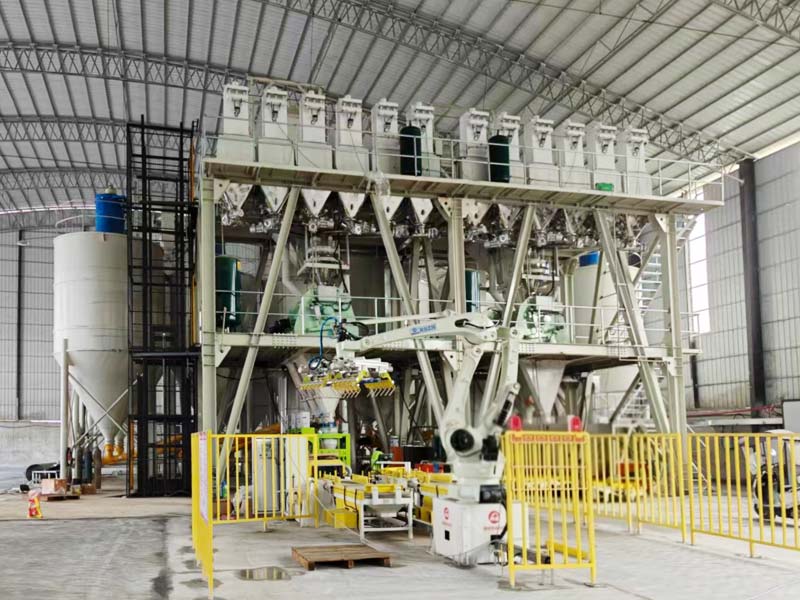
When sand production and mortar production operate in one integrated system, feedback can move faster between the two processes.
If a tile adhesive begins using more water than normal, the quality team can compare the mortar result with the recent sand grading and powder content.
If the fine sand fraction drifts, the sand section can adjust screening or classification before large quantities are consumed.
Bizim üretilen kum çözümleri are designed to integrate sand-making and special mortar production where tighter upstream control is required.
This does not eliminate laboratory testing. It shortens the feedback loop between aggregate production and mortar production.
What Should Buyers Send for Fine Sand and Mortar Line Design?
A useful fine sand for mortar inquiry should include the product portfolio, not only the required total capacity.
Sağlamak:
- mortar product types;
- sand grading required for each product;
- natural or manufactured sand source;
- parent rock where manufactured sand is used;
- powder-content target;
- incoming sand moisture;
- required production rate by product;
- number of sand fractions to store;
- packaging or bulk-dispatch requirements;
- available site layout.
These inputs allow the sand-making and mortar sections to be balanced around actual fraction demand.
Send your sand specifications and mortar product plan through our i̇letişim sayfası for a project-specific integrated line review.
Sonuç
Fine sand for mortar should not be defined by one universal size range. Masonry mortar, tile adhesive, self-leveling mortar, waterproof mortar and repair mortar can all need different aggregate distributions.
The strongest production strategy defines the grading required by each product, separates sand fractions where useful, controls powder and moisture, and verifies the finished mortar after any sand change.
When manufactured sand preparation and dry mortar production are integrated, the factory can control sand quality closer to the source and adjust the upstream process according to real mortar demand.
SSS
What is the best fine sand size for mortar?
There is no single best size for every mortar. The correct grading depends on the product, application thickness, flow requirement and approved formulation. A complete sieve distribution is more useful than one maximum particle size.
Can the same fine sand be used for tile adhesive and masonry mortar?
Sometimes, but not automatically. Tile adhesive often needs tighter fine-aggregate control than general masonry mortar. Each product should be validated with the actual sand grading.
Can manufactured sand be used as fine sand for mortar?
Yes. Manufactured sand can be used when its grading, powder content, cleanliness and parent-rock properties meet the mortar requirements. Both sand quality and finished mortar performance should be verified.
Why should fine sand be separated into different fractions?
Separate fractions allow the dry mortar plant to blend different gradings for different products. This can improve flexibility when one factory makes several mortar families with different aggregate requirements.
What should be tested when fine sand changes?
Check sieve grading, powder content, moisture, bulk behavior and the relevant finished-mortar properties. A new source or grading can change water demand, flow and other product performance.

