
Dry mortar weighing accuracy should be checked across the complete batching sequence, not only at the load cell. A scale can indicate a weight correctly while a screw feeder overshoots, material hangs inside a hopper, or a low-dose additive falls outside the measuring range that the system can handle reliably.
For dry mortar producers, this matters because a formulation often combines large quantities of sand and binder with much smaller quantities of functional additives. The same weighing arrangement is not automatically suitable for every ingredient.
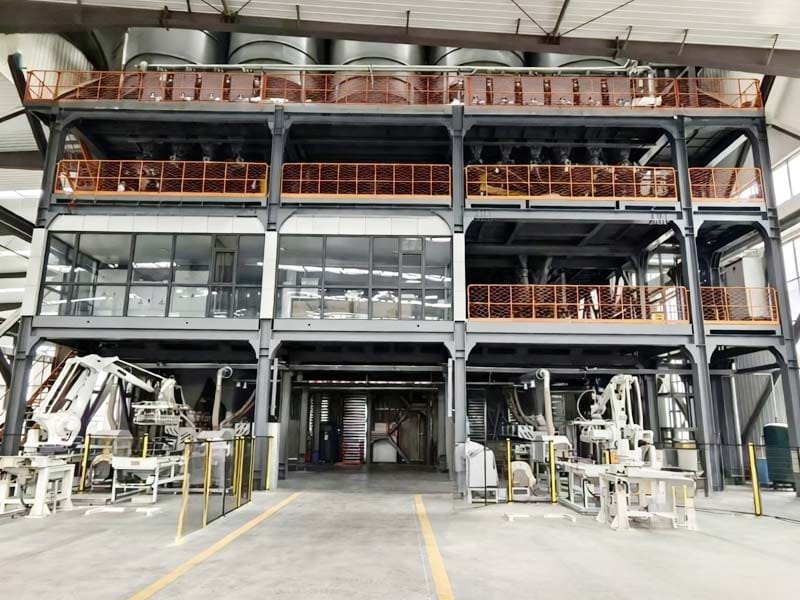
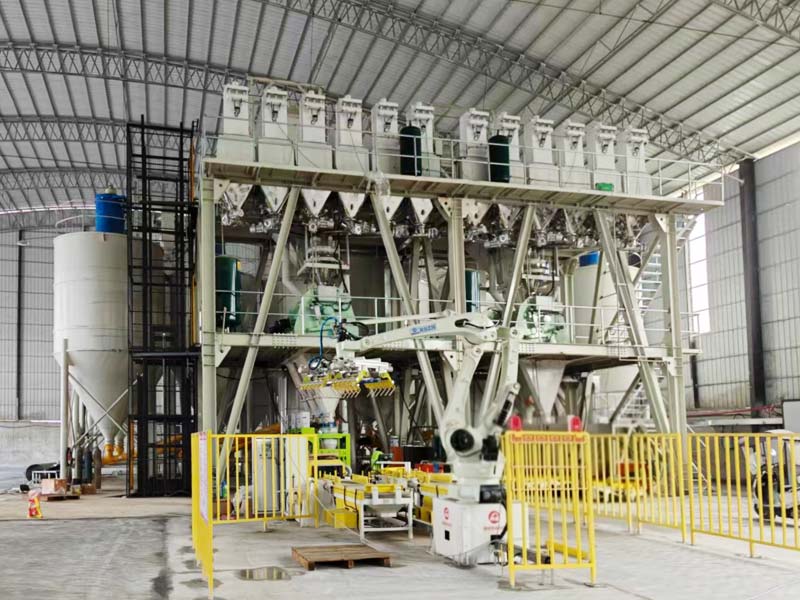
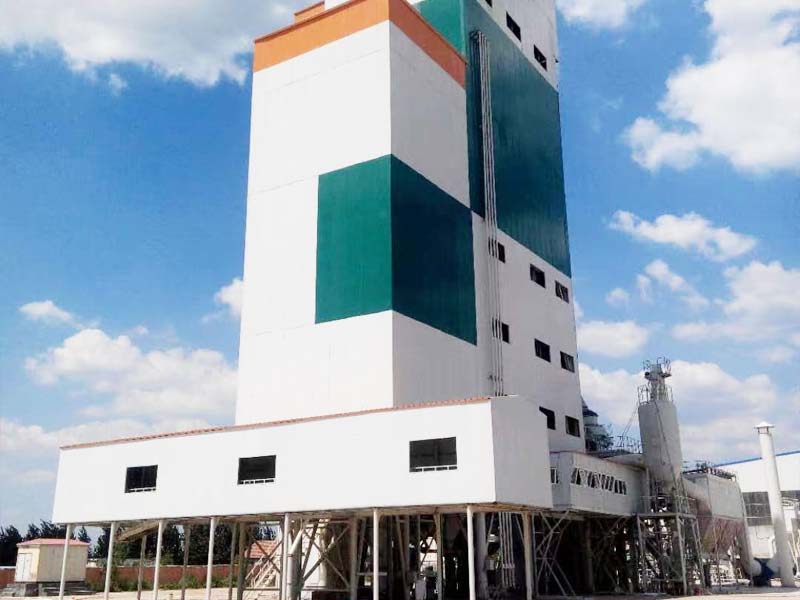
Nuestro planta mezcladora de mortero seco tipo taller uses automated batching, conveying, mixing and packaging interfaces, while our planta de mortero seco tipo torre uses a more vertical gravity-flow layout. This guide explains how to evaluate dry mortar weighing accuracy in either type of production line.
What Does Dry Mortar Weighing Accuracy Actually Mean?
Dry mortar weighing accuracy is often discussed as a single percentage, but that can hide several different questions.
A useful production check separates at least four things:
| Check | Question | Por qué es importante |
|---|---|---|
| Scale indication | Does the weighing system indicate the applied reference load correctly? | Confirms the measuring device itself. |
| Automatic feeding | Does the feeder stop close enough to the recipe target? | Checks the dosing sequence, not just the sensor. |
| Material transfer | Does the weighed material actually reach the mixer? | Residual powder or bridging can change the delivered quantity. |
| Recipe execution | Are the correct materials and targets used for the correct formula? | Prevents a technically accurate scale from weighing the wrong recipe. |
Dry mortar weighing accuracy is therefore a system-level production requirement. The measurement device, feeder, hopper, transfer route and control logic all contribute to the final result.
Why Dry Mortar Weighing Is More Demanding Than One Large Batch Weight
Dry mortar production often combines ingredients with very different batch quantities. Sand may represent the largest share of a formulation, while cellulose ether, polymer powder, pigment or another additive may be added at a much smaller amount.
This creates a range problem. A large-capacity scale may be practical for sand or cement but inappropriate for a trace additive.
For example, a fixed 20 g deviation represents only 0.02% of a 100 kg target, but it represents 4% of a 0.5 kg target. The same absolute deviation therefore has very different significance depending on the ingredient quantity.
That is why dry mortar weighing accuracy should be specified by ingredient system and working range rather than one general percentage for the complete plant.
Separate Major Ingredients from Micro-Additives
A dry mortar production line normally benefits from grouping materials by dose range and feeding behavior.
Major ingredients can include sand, cementitious materials and fillers. Minor ingredients may include pigments, cellulose-based additives, polymer powders, fibers or other product-specific materials.
For dry mortar weighing accuracy, prepare a schedule like this:
| Ingredient group | Información para proporcionar | Pregunta sobre el equipo |
|---|---|---|
| Fracciones de arena | Minimum, normal and maximum quantity per batch | Separate or cumulative weighing? Which feeder controls each fraction? |
| Cement and fillers | Dose range and bulk-flow behavior | What weighing hopper and feeding stages are proposed? |
| Minor additives | Smallest and largest intended dose | Is a dedicated micro-dosing system required? |
| Pigments or specialty powders | Dose range and contamination sensitivity | How are weighing, transfer and cleaning handled? |
This prevents the buyer from accepting a weighing arrangement that is technically suitable for large powders but not for the smallest ingredient in the product portfolio.
Cumulative Weighing Can Hide Ingredient-Level Errors
Some dry mortar lines use cumulative weighing for several materials in one hopper. This can be efficient, but dry mortar weighing accuracy should still be reviewed ingredient by ingredient.
Consider a simple hypothetical example. A recipe requires 500 kg of sand A and 300 kg of sand B. The final hopper total is 800 kg.
If the actual quantities are 490 kg and 310 kg, the total is still exactly 800 kg. Looking only at the final total would suggest a perfect batch, even though the blend proportions are wrong.
For cumulative systems, the control record should therefore preserve each incremental target and achieved value rather than only the final hopper weight.
This is particularly important when several sand fractions are blended to create the grading required by the mortar formula.
Feeder Cutoff and Material in Flight Affect the Final Dose

Automatic dry mortar weighing normally depends on a feeder stopping before the entire moving material stream has settled into the hopper.
When a screw conveyor, valve or other feeding device receives a stop command, some material may still be inside the outlet or already moving toward the weighing hopper. This is often described as material in flight.
Dry mortar weighing accuracy therefore depends on how the control system manages coarse feeding, fine feeding and final cutoff.
A practical production trial should record:
- objetivo de receta;
- coarse-feed cutoff point;
- fine-feed cutoff point where applicable;
- settled final weight;
- time required for feeding and settling;
- repeatability over several batches.
Do not alter scale calibration to compensate for feeder overshoot unless the measurement system itself is proven to be wrong. Scale error and feeder overshoot are different problems.
Small Additive Dosing Needs a Separate Validation Range
Micro-additives are often the most sensitive part of dry mortar weighing accuracy because the quantity can be small relative to the total batch.
A high-resolution display does not prove that the complete feeding system can repeatedly deliver that quantity. The test has to include the actual feeder, material and dose.
For small additives, ask the supplier to demonstrate:
- the minimum validated dose;
- repeatability at that dose;
- timp de alimentare;
- residual material after discharge;
- whether vibration or nearby equipment affects the weighing signal;
- how the additive reaches the mixer without remaining in the transfer path.
Dry mortar weighing accuracy should be tested at the lowest dose the factory realistically plans to use, not only at an easy mid-range quantity.
Vibration and Structural Contact Can Disturb Weighing
Weighing hoppers need mechanical freedom to measure load correctly. Unintended contact with surrounding steelwork, flexible connections that become tight, accumulated material or excessive vibration can distort the reading.
In dry mortar production, the weighing system may be mounted near mixers, conveyors or vibrators, so installation details matter.
During dry mortar weighing accuracy checks, inspect whether the hopper or frame touches another structure when empty and loaded. Review flexible connections and cable routing. Look for accumulated powder that may bridge between the weighing hopper and fixed equipment.
Do not treat a stable electronic signal as proof that the mechanical installation is correct. A physically constrained hopper can give repeatable but biased results.
Static Scale Checks and Production Dosing Tests Are Different
A static scale check uses a known reference load to determine whether the weighing system indicates correctly. A production dosing test evaluates what happens when the actual feeder delivers material automatically.
Both checks are necessary for meaningful dry mortar weighing accuracy verification.
El Vocabulario Internacional de Metrología distinguishes calibration from adjustment and verification. Calibration establishes a relationship between reference values and indications; it does not automatically prove that an automatic production sequence meets a dosing target.
For a dry mortar line, use static checks to verify the measuring device and repeated dosing trials to verify the actual batching process.
Residual Material Can Change the Quantity Reaching the Mixer
A weighing hopper can contain the correct quantity and still deliver less than that amount to the mixer if powder remains inside the hopper, screw or transfer chute.
For dry mortar weighing accuracy, define the measurement boundary. Is acceptance based on the settled quantity in the weighing hopper or the material that reaches the mixer?
Sticky powders, very fine fillers and low-dose additives can remain on internal surfaces. Product changeovers can make this especially important because residual material may also contaminate the next formula.
A practical trial can include controlled inspection of residual material after discharge, using safe access procedures and an agreed method.
This links weighing accuracy with the dry mortar production layout and cleaning strategy rather than treating the scale as an isolated component.
Dust Extraction Can Affect the Weighing Environment
Dry mortar plants need dust control around weighing, transfer and mixing points. However, air movement through a weighing hopper can influence measurement if the system is not designed correctly.
Dust extraction should remove displaced air without creating a force that disturbs the scale reading. Flexible connections and vent paths should be arranged so the weighing hopper remains mechanically independent.
When reviewing dry mortar weighing accuracy, verify the weighing system under realistic dust-extraction conditions rather than with the ventilation system turned off simply to obtain a stable result.
The UK Health and Safety Executive’s guidance on local exhaust ventilation emphasizes commissioning extraction systems under the operating conditions they are intended to control. The same principle is useful here: production-related systems should be tested together, not in unrealistic isolation.
Recipe Management Is Part of Weighing Accuracy
A production system can weigh perfectly and still make the wrong product if the wrong formula or ingredient mapping is selected.
For dry mortar weighing accuracy, the batch-control system should distinguish:
- recipe identity;
- recipe revision;
- ingredient code;
- cantidad objetivo;
- actual measured quantity;
- adiciones manuales;
- operator changes;
- batch timestamp.
Our workshop and tower dry mortar equipment uses automated batching and control. For a project-specific line, confirm which records are stored, how long they are retained and whether recipe revisions are traceable.
This is especially important when one plant produces tile adhesive, wall putty, plastering mortar and other products on the same equipment.
Use Batch Records to Detect Drift Before Product Quality Changes
Dry mortar weighing accuracy problems may develop gradually. A feeder can begin overshooting slightly more each week, or an empty scale can drift after repeated cleaning and maintenance.
Batch records can reveal these trends before the finished product shows obvious variation.
For each ingredient, calculate signed deviation:
Deviation = actual quantity − target quantity
Do not look only at the average absolute error. If one batch is +3 kg and another is −3 kg, the average signed deviation is zero even though neither batch is exactly on target.
Group the data by ingredient, dose range and product. A large sand dose and a small additive dose should not be analyzed as if they represent the same measurement challenge.
Compare Accuracy with Production Speed
Dry mortar weighing accuracy and production cycle time are connected. A feeder can often improve final dosing by slowing down, but excessive fine feeding can become a bottleneck.
Consider a hypothetical additive feeder. At a fast setting, it reaches the target area in 12 seconds but repeatedly overshoots. At a slower setting, it takes 24 seconds and meets the agreed dosing criteria.
The correct engineering question is not simply “Which setting is faster?” It is whether the complete plant can meet both accuracy and production requirements.
If additive dosing occurs in parallel with sand or binder weighing, the longer time may not affect the overall cycle at all. A complete timing diagram is more useful than optimizing one feeder independently.
How Should a Production Check Be Structured?

A good dry mortar weighing accuracy check should cover the full intended operating range rather than one test point.
| Test stage | What to check | What it proves |
|---|---|---|
| Empty condition | Zero stability and mechanical freedom | Basic weighing-system condition |
| Reference-load test | Indication at several loads | Measurement performance |
| Repeated dosing | Automatic feeder result at normal target | Production dosing behavior |
| Minimum-dose test | Smallest planned ingredient quantity | Suitability for micro-additives |
| Transfer check | Residual material after discharge | Whether weighed material reaches the next stage |
| Batch-record review | Targets, actuals, alarms and manual actions | Traceability of recipe execution |
This structure makes dry mortar weighing accuracy measurable and reviewable without relying on one general marketing percentage.
What Should Buyers Ask Before Approving a Dry Mortar Plant?
If weighing performance is important to your product portfolio, include it in the technical specification before purchase.
Proporcionar al proveedor:
- each ingredient category;
- minimum, normal and maximum batch quantities;
- numărul fracții de lijă;
- numărul materiale de pudră;
- doză de adiție mai mică;
- planned batch size range;
- product changeover frequency;
- required production rate.
Then ask which materials use independent weighing systems, which use cumulative weighing and which require dedicated micro-dosing.
Nuestro planta de mortero seco tipo taller is suited to flexible production in existing buildings, while the tower-type plant uses a more vertical gravity-flow arrangement. In both cases, the weighing configuration should be selected around the product range rather than copied from a generic line.
Conclusión
Dry mortar weighing accuracy depends on more than the load cell. Major ingredients, cumulative weighing, feeder cutoff, micro-additives, vibration, residual material and recipe control all affect whether the intended formulation actually reaches the mixer.
The strongest production check separates measurement accuracy from dosing performance and then verifies both across the real operating range. It also preserves batch records so small changes can be identified before they become product-quality problems.
Send your product range, ingredient list, batch sizes and smallest additive doses through our página de contacto so the weighing and batching configuration can be reviewed for your dry mortar production plan.
Preguntas frecuentes
What is dry mortar weighing accuracy?
Dry mortar weighing accuracy describes how reliably the production system measures and doses the required ingredient quantities. A complete check includes scale indication, automatic feeding, material transfer and recipe execution.
Why do small additives need separate weighing equipment?
Very small doses can fall outside the practical working range of a large-capacity weighing system. Dedicated micro-dosing can provide a more appropriate measuring and feeding range for those ingredients.
Is cumulative weighing accurate enough for dry mortar?
It can be, but each ingredient increment should still be recorded and verified. A correct final total can hide an error in the proportion between two materials.
Does calibration guarantee correct dry mortar batching?
No. Calibration verifies the measurement relationship under test conditions. The feeder, material flow, cutoff timing and transfer path still need production dosing tests.
What should be included in a dry mortar weighing accuracy test?
Check zero stability, several reference loads, repeated dosing at normal and minimum quantities, material transfer after discharge and the batch record. Use acceptance criteria defined for the actual production requirement.


