
Inhoudsopgave
A cement storage silo can contain the right quantity and still hold the wrong material for tomorrow's production. Delivery identity therefore belongs in the plant specification alongside storage capacity. The receiving connection, supplier paperwork, destination label and control-system material name must describe the same intended destination before a delivery begins. A discrepancy discovered after unloading is more difficult to resolve because several batches may already depend on the affected storage.
This guide concerns delivery coordination and traceability. It does not provide instructions for operating a tanker, setting pressure limits or entering a silo. Those activities require the equipment documentation and the site's approved procedures. The buyer's task is to make the interfaces clear enough that the receiving team can recognize an uncertain delivery and stop it before material identity is lost.
Assign a permanent identity to every storage destination
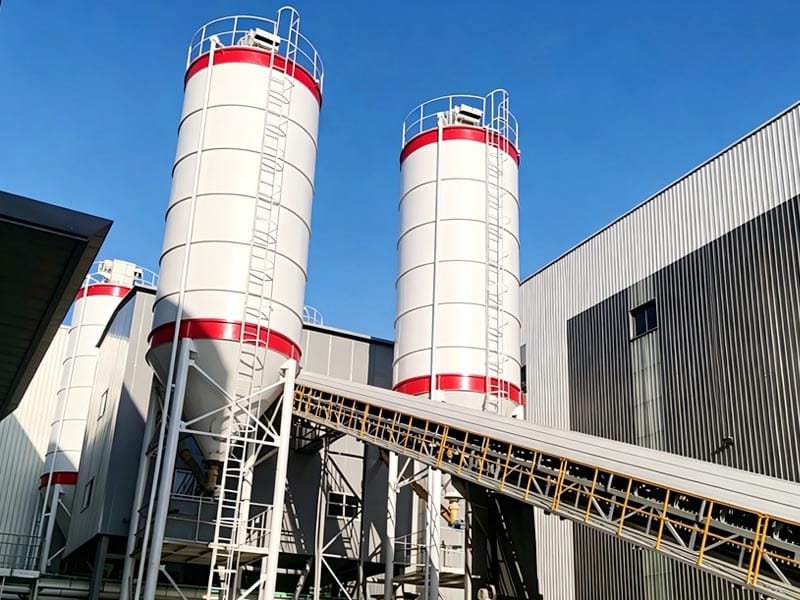
Give each cement storage silo a unique equipment identifier that remains stable when its assigned material changes. A label such as S-03 identifies the vessel; a separate controlled field identifies the material currently permitted in it. Combining both concepts into a single informal name can create confusion when the production team changes cement source or reserves a vessel for another powder.
Use the identifier on the physical filling connection, process diagram, inventory screen and receiving record. Review the arrangement from the delivery driver's normal working position, under the expected lighting and weather conditions. A label that is obvious on an office drawing may be hidden by pipework or too far from the connection to support a reliable check.
Record the relationship between the external connection and the actual vessel. Where pipes cross or several connections sit together, the routing should be verified during installation and reflected in the as-built documents. Do not rely on paint color alone; color can supplement a clear identifier but may fade or be interpreted differently by contractors.
Separate delivery approval from the physical connection
The receiving record should establish what is arriving, where it is intended to go and who approved that destination. Include the supplier, delivery reference, material designation, intended vessel and quantity basis. If the supplier's designation differs from the plant's internal code, maintain an approved mapping rather than expecting the receiving operator to infer equivalence from similar names.
Before accepting material into a cement storage silo, the designated receiving person should reconcile the delivery information against the purchase and storage assignment. Define what happens if the supplier sends a substitute, the destination has changed or the paperwork is incomplete. A receiving exception should lead to an identifiable decision by an authorized person, not an undocumented verbal workaround.
Distinguish administrative approval from permission to unload. A purchase order may be valid while the destination is temporarily unavailable. The site's approved unloading procedure should establish the equipment checks and communication needed for the specific installation. Keep these responsibilities visible in the supply contract so that neither the plant team nor the transport company assumes the other has completed them.
Review available space using an agreed inventory basis
Storage planning becomes unreliable when one record expresses inventory in estimated tonnes and another expresses remaining vessel volume. Ask the supplier to explain the measurement basis and practical interpretation of the installed level or inventory system. The receiving team needs to understand what the available-space indication means for the actual material and vessel configuration.
As an illustrative bookkeeping example, a recorded opening inventory of 28 tonnes plus an accepted delivery of 24 tonnes less 17 tonnes issued to production gives 35 tonnes on the same mass basis. This calculation is an inventory reconciliation, not proof that a cement storage silo can safely receive the delivery. Physical receiving capacity and protective functions require their own verified basis.
Agree how discrepancies are investigated. Delivery weights, consumption estimates, residual material and measurement uncertainty can all affect a reconciliation. Preserve the original observations rather than adjusting the opening inventory simply to make the records agree. A correction should state its reason, supporting evidence and the person who authorized it.
Specify cement storage silo receiving equipment
A cement storage silo delivery interface includes more than the vessel. Ask the equipment supplier to identify the filling connection, pipe route, venting and filtration arrangements, protective devices, indicators and any control interlocks included in the proposal. Establish the boundary between the supplied equipment and the transport operator's equipment.
Require project-specific operating limits and an approved unloading procedure from the responsible parties. Do not copy a pressure, delivery rate or protection setting from another plant. Changes to the vessel, material, filling arrangement or filtration equipment can affect the receiving assessment and should be reviewed by the relevant specialists.
For the machinery design review, the ISO 12100 overview describes a framework for risk assessment and risk reduction. Use that as context for requesting documented design decisions. It does not establish that a particular silo is certified or provide the installation's operating settings.
Keep material changes separate from ordinary replenishment

Replenishing the same approved material and changing the assigned material are different events. Define who can authorize a new material for a cement storage silo and what evidence is needed before the change. The review may involve the production manager, quality team and equipment supplier, depending on the proposed material and equipment compatibility.
Identify any remaining material and its disposition. An empty indication, an estimated inventory of zero and a physically verified condition are different forms of evidence. The approved change procedure should address the actual arrangement without assuming that all retained powder disappears when the last normal batch is issued.
Update the storage assignment, recipe permissions, delivery instructions and labels together. The transition date and first receiving record should be traceable. If the supplier uses a different designation for the replacement material, revise the approved mapping before the truck arrives so that the receiving operator sees a clear decision rather than an unresolved procurement discussion.
Choose records that expose a delivery mismatch
The following comparison helps buyers define evidence at each handover. It is a proposed document structure, not a universal regulatory checklist. Adapt the fields to the materials, receiving equipment and responsibilities at the project site.
| Handover | Weak record | More useful evidence | Question resolved |
|---|---|---|---|
| Purchasing to receiving | Supplier name only | Approved material code and delivery reference | Is this the ordered material? |
| Receiving to storage | Informal vessel nickname | Permanent vessel ID and current assignment | Is this the intended destination? |
| Storage to production | Total stock estimate | Vessel-specific receipts, issues and adjustments | Which inventory supports this batch? |
| Material change | Updated screen label | Authorized change record and affected document list | When did the assignment change? |
| Exception handling | Unrecorded phone approval | Decision, evidence, owner and time | Why was the exception accepted? |
Test the proposed records using an intentionally inconsistent example in a desk exercise. Give the team a delivery reference for one approved material and a destination currently assigned to another. The exercise should show where the mismatch is found, who decides the next action and how the unresolved delivery is kept out of normal production records.
Coordinate storage identity with batching controls
Trace the cement storage silo identifier through the conveying route to the weighing and batching system. The process diagram, operator screen and batch record should agree on the source used for each production material. This becomes especially important when several vessels can feed a shared conveying or weighing arrangement.
Ask the controls supplier how a material reassignment affects recipe selection and historical reports. Changing today's displayed material name should not silently rewrite the meaning of yesterday's records. Preserve the historical relationship between the batch, source vessel and material assignment in a form the quality team can retrieve.
Review the interfaces alongside the proposed betonnen mengtoren. For a plant with a different transfer arrangement, the betonmenginstallatie voor bovengrondse banden offers another product discussion point. These links support equipment selection; the receiving controls still need project-specific confirmation.
Verify the handover before routine deliveries begin
Include identity checks in commissioning. Confirm the installed connection-to-vessel relationship against the approved drawings, check the labels and demonstrate the relevant indications using the supplier's approved test methods. Record the actual configuration rather than signing off only the intended arrangement in a tender drawing.
Provide a receiving information pack with the vessel list, current assignments, approved supplier-material mappings, escalation contacts and document revision. Define how temporary changes are communicated across shifts. A notice understood by the day operator but absent from the night team's handover leaves the same physical installation operating under two different assumptions.
When requesting a quotation, send your material list, delivery pattern, proposed vessel assignments and storage-to-batching diagram. Ask for a coordinated cement storage silo proposal that identifies receiving boundaries, inventory information, controls and documentation. This gives the supplier a concrete basis for resolving delivery interfaces before equipment and operating procedures are finalized.
Veelgestelde vragen
Does the supplier’s cement name identify the right cement storage silo?
No. Match the supplier designation to an approved internal material code and a specific vessel assignment. Similar commercial names should not replace an authorized material mapping.
Can a level indication alone approve a delivery?
No. The receiving decision also depends on material identity, available-space interpretation, equipment condition and the site's approved unloading procedure. A bookkeeping balance is not a protective-system test.
What changes when one silo receives a different cement?
Review the remaining inventory, compatibility, assignment, labels, recipe permissions and delivery instructions. Record who authorized the transition and preserve the historical material identity.
Should every delivery record include the vessel identifier?
Yes. A vessel-specific record connects the incoming lot to storage and subsequent production. A plant-wide receipt total cannot show which destination received an uncertain delivery.
What information should accompany a silo quotation request?
Provide the approved material designations, delivery quantities and frequency, proposed storage assignments, receiving arrangement and batching interfaces. Ask the supplier to state its equipment and documentation boundaries.