
Repair mortar production is more demanding than simply blending cement and sand. A repair mortar may need carefully controlled aggregate grading, polymer powder, fibers, shrinkage-control components, accelerators, retarders or other low-dose ingredients. The production line has to reproduce that formulation consistently while keeping product changeovers, dust, packaging and traceability under control.
For equipment buyers, the right question is not only “Can this plant make repair mortar?” It is “Can the plant handle the specific sand grading, additive range, fiber system, batch size and packaging method required by my approved repair products?”
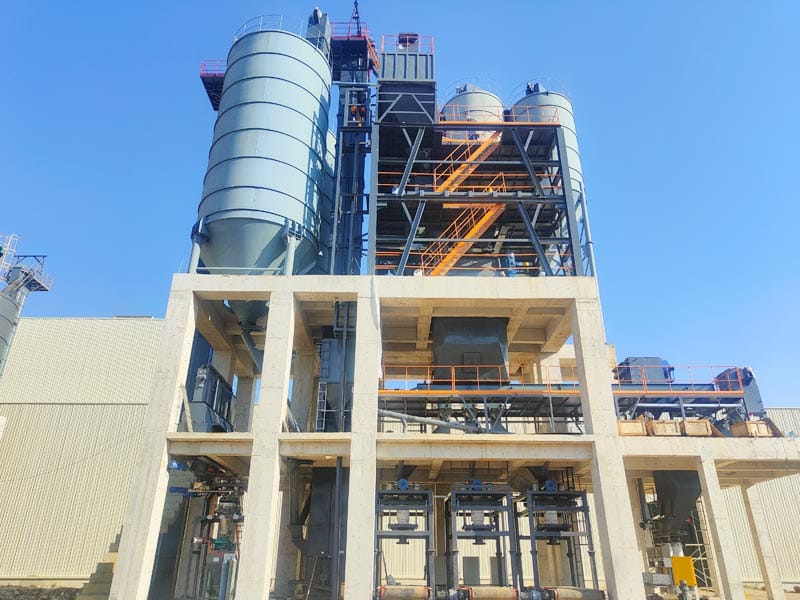
Nasz warsztatowa mieszalnia zapraw suchych is designed for flexible special-mortar production, while our zaprawa sucha typu wieżowego supports larger vertically integrated production systems. This guide explains how repair mortar production requirements should be translated into real equipment decisions.
What Is Repair Mortar Production?
Repair mortar production is the controlled manufacture of dry, cementitious repair products intended to restore damaged concrete or masonry after water or another approved mixing liquid is added at the jobsite.
ASTM C928/C928M-25 covers packaged, dry, cementitious mortar and concrete materials for rapid repair of hardened hydraulic-cement concrete. The standard distinguishes mortar from concrete by aggregate size distribution and includes performance testing such as compressive strength, length change, scaling resistance and slant-shear bond strength.
That standard does not define every repair mortar sold in every market, but it illustrates an important production principle: repair mortar is a finished technical product whose performance must be validated after manufacturing.
The plant’s role is to reproduce the approved formulation accurately and consistently.
Start with the Repair Application
Not all repair mortars serve the same application.
A production line may need to support:
- thin cosmetic repair;
- vertical patching;
- overhead repair;
- structural repair;
- rapid-setting repair;
- floor repair;
- bridge or infrastructure repair;
- fiber-reinforced repair mortar.
Each product can use a different aggregate grading, additive package and batch size.
For repair mortar production, define the product range before selecting the storage, weighing and mixing systems.
Repair Thickness Changes the Sand Requirement
The intended placement thickness is one of the most important inputs for aggregate selection.
| Repair condition | Aggregate consideration | Production implication |
|---|---|---|
| Thin surface repair | Finer aggregate may be required | Needs tighter fine-sand control |
| Medium-depth patching | Broader grading may improve packing | May use multiple sand fractions |
| Thicker repair | Larger aggregate can reduce paste demand | Storage and mixer should suit the approved grading |
| Fiber-reinforced repair | Aggregate must work with fiber dispersion | Feeding and mixing sequence become more important |
Repair mortar production should therefore be designed around the approved particle-size distribution rather than one universal “fine sand” specification.
Sand Grading Controls More Than Workability
Aggregate grading affects packing, water demand, application behavior and the proportion of paste needed to fill voids.
For repair mortar production, buyers should provide:
- maximum aggregate size;
- full sieve curve;
- sand fractions;
- zawartość proszku;
- gęstość nasypowa;
- moisture condition.
Nasz drobny piasek do prowadnicy zaprawy explains why different mortar families need different fine-aggregate distributions.
A plant producing several repair mortars may benefit from separate sand fractions that can be blended recipe by recipe.
Manufactured Sand Can Support Repair Mortar When Validated
Manufactured sand can be used in repair mortar production when grading, powder content, particle shape and raw-material quality are suitable.
However, the term “manufactured sand” alone does not prove suitability.
Sprawdzać:
- skała macierzysta;
- grading stability;
- zanieczyszczenie gliny;
- fine-powder content;
- kształt cząstek;
- wilgoć;
- finished repair-mortar test results.
Nasz zintegrowana fabryka piasku i specjalnej zaprawy can connect controlled sand preparation with special mortar production where the project needs closer upstream sand control.
Dry Sand Condition Is Essential
Repair mortar production relies on dry raw materials.
Excess moisture can cause:
- caking;
- bridging;
- unstable weighing;
- poor storage stability;
- material buildup inside screws and hoppers.
If sand arrives wet, the project may require drying and cooling before storage.
The drying system should be sized from the actual incoming moisture condition and required dry-sand output rather than one nominal wet-feed tonnage.
Polymers Need Controlled Low-Dose Handling
Many repair mortars use redispersible polymer powders or other functional additives to modify bond, flexibility, water retention or application behavior.
These materials are commonly dosed at much lower quantities than sand or cement.
Repair mortar production should therefore separate bulk-material weighing from micro-dosing where necessary.
For every polymer or additive, define:
- minimalna dawka;
- normalna dawka;
- maksymalna dawka;
- storage method;
- feeder type;
- weighing method;
- transfer route to the mixer.
Nasz przewodnik dokładności ważenia suchej zaprawy explains why a small production dose should be validated separately from larger ingredients.
Fiber Feeding Needs Its Own Process Review
Some repair mortars contain fibers for crack control, toughness or structural performance.
Fibers can behave very differently from powders.
Repair mortar production should review:
- fiber type;
- długość włókna;
- gęstość nasypowa;
- normal dosage;
- tendencja pomostowa;
- feeding method;
- dispersion sequence;
- cleaning access.
Do not assume a normal screw feeder can handle every fiber system.
Fiber balling or uneven distribution can occur if feeding and mixing are poorly matched to the material.
Manual Addition Still Needs Traceability
Some specialty repair mortar plants manually add fibers, pigments or low-volume additives.
Manual addition can be appropriate for small production campaigns, but it should still be controlled.
For repair mortar production, record:
- ingredient identity;
- ilość docelowa;
- actual quantity;
- numer partii;
- operator confirmation;
- addition time.
A manual process should not become an unrecorded step outside the production system.
Mixing Sequence Can Affect Additive Dispersion
The order in which ingredients enter the mixer can influence how well low-dose additives and fibers disperse.
Repair mortar production should use a validated sequence rather than loading every ingredient at once by default.
A representative process may involve:
- major sand and binder pre-blending;
- controlled addition of fillers;
- micro-additive feeding;
- fiber addition at a defined stage;
- final homogenization.
The actual order depends on the formulation and mixer.
During commissioning, record both mixing time and ingredient sequence so later quality changes can be traced to process execution.
Mixing Time Must Be Product-Specific
Repair mortar production does not have one universal mixing time.
The correct duration depends on:
- mixer design;
- batch fill level;
- number of ingredients;
- powder fineness;
- fiber content;
- polymer content;
- mixing sequence.
Use representative production batches to determine when the blend reaches the required uniformity.
Then optimize the cycle without reducing product consistency.
Small Repair Mortar Batches Need Validation
Repair mortar is often produced in multiple grades, some of which may have lower demand.
This can lead to smaller batch sizes.
A mixer that performs well at full load may behave differently at lower fill levels.
For repair mortar production, validate:
- minimum routine batch;
- normal batch;
- maximum batch;
- mixing uniformity;
- zachowanie rozładowania;
- residual material.
Small-batch capability is especially important for factories producing several specialty repair products on one line.
Workshop-Type Lines Can Suit Flexible Repair Mortar Production
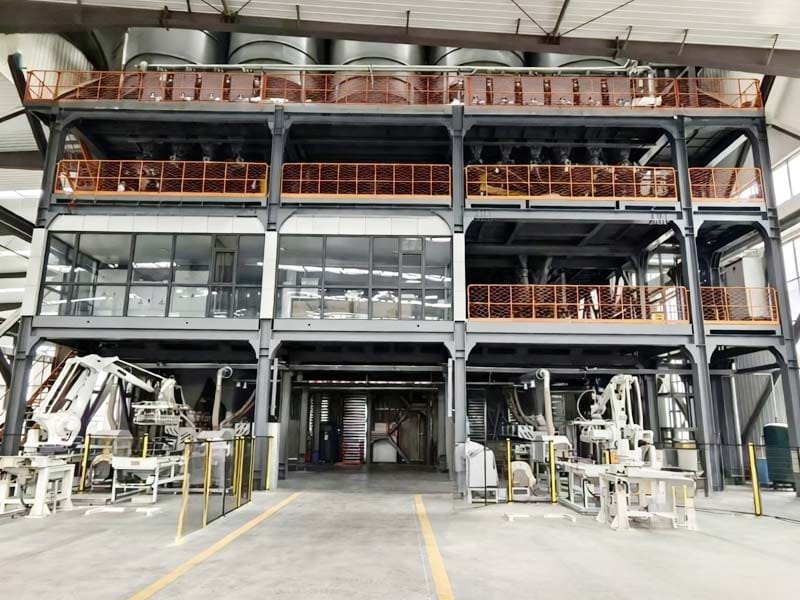
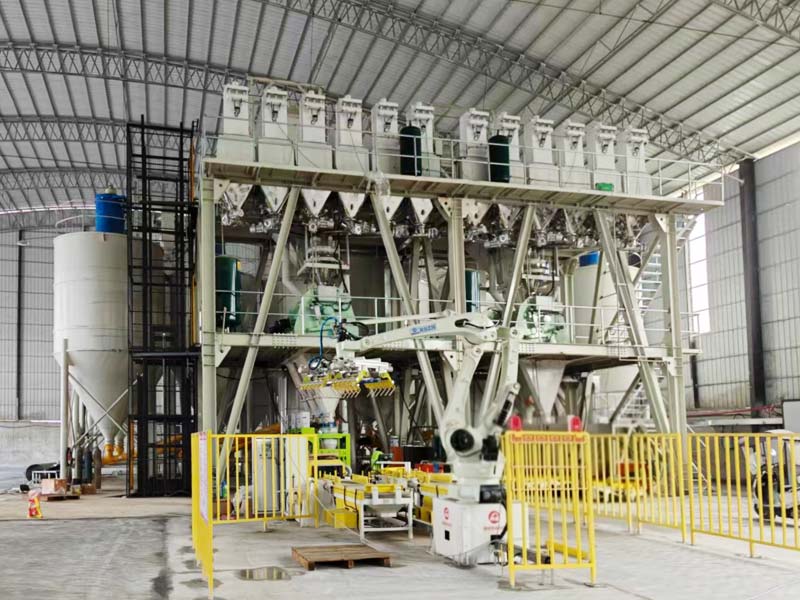
Our workshop-type dry mortar plant uses a horizontal arrangement with screw conveyors and is intended for flexible special-mortar manufacturing.
For repair mortar production, this layout can be useful when:
- several product grades share one line;
- small-batch production is common;
- operators need easy access to feeders;
- frequent cleaning is required;
- the plant is installed inside an existing workshop.
However, the building still needs sufficient clear height, floor capacity, access and packaging space.
Nasz warsztatowy przewodnik po zaprawie suchej explains these building checks in more detail.
Tower-Type Lines Can Suit Larger Repetitive Production
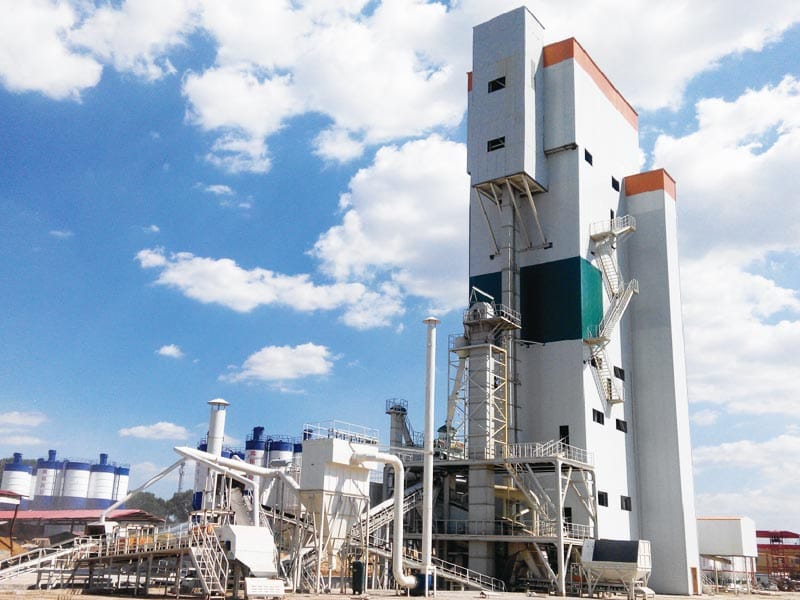
A tower-type dry mortar line organizes major process stages vertically so gravity supports material flow.
For repair mortar production, this can be useful when the product portfolio is stable and production volume justifies a more integrated vertical system.
Recenzja:
- structure height;
- raw-material storage;
- liczba frakcji piasku;
- micro-dosing arrangement;
- cleaning access;
- packaging below the mixer;
- future expansion.
The plant type should follow the production program rather than one generic capacity category.
Prevent Segregation After the Mixer
A repair mortar can be well mixed inside the mixer and then segregate during transfer.
Differences in particle size and density can cause sand, powder or fibers to redistribute during long drops or repeated transfer.
Repair mortar production should review:
- mixer discharge height;
- finished-product conveyor type;
- number of transfer points;
- buffer-hopper geometry;
- storage time before packaging;
- packer feed method.
The finished product should remain as uniform as possible from mixer discharge to sealed package.
Changeover Cleaning Is Important in Multi-Product Plants
Repair mortar factories may produce rapid-setting, fiber-reinforced, polymer-modified and standard products on the same line.
Residual material from one grade can affect the next.
Check residue locations in:
- micro feeders;
- weighing hoppers;
- przenośniki śrubowe;
- mixer surfaces;
- pojemniki na gotowe produkty;
- packers.
Repair mortar production should include defined cleaning or purge rules for product changes.
Changeover time should also be included in practical plant-capacity calculations.
Dust Control Should Cover Additive and Packaging Areas
Repair mortar production handles cementitious powders, fillers, polymer powder and fine aggregate.
Dust can be generated during:
- bag opening;
- silo filling;
- weighing;
- ładowanie miksera;
- rozładowanie;
- packaging.
Brytyjski Urząd ds. Zdrowia i Bezpieczeństwa lokalne prowadzenie wentylacji wyciągowej emphasizes capturing airborne contaminants close to the source and commissioning extraction under real operating conditions.
Dust-control layout should therefore be included during plant engineering rather than added after installation.
Packaging Needs to Match Product Density and Flow
Different repair mortars can have different bulk densities and powder flow characteristics.
Repair mortar production should test packaging with the actual product.
Recenzja:
- bag weight;
- rodzaj torby;
- filling rate;
- poziom leja zasypowego;
- packer cutoff;
- dust extraction;
- finished package verification.
Nasz przewodnik po zmianie ciężaru worka na zaprawę explains why packaging stability depends on both weighing and powder flow.
Finished Product Testing Should Drive Acceptance
The production line should be accepted on both equipment function and finished repair-mortar performance.
ASTM C928/C928M-25 includes performance tests for packaged dry rapid-hardening repair materials such as compressive strength, length change, scaling resistance and slant-shear bond strength.
The exact test program for a repair mortar depends on the product specification and target market.
Possible acceptance properties can include:
- workability;
- setting time;
- compressive strength;
- flexural strength;
- bond strength;
- length change;
- water resistance;
- product-specific durability.
Do not approve a production line from mixer uniformity alone. The finished product needs to meet the applicable technical requirements.
Batch Records Help Trace Production Variation
Repair mortar performance can change because of raw-material variation, formula revision or process execution.
Useful production records include:
| Pole rekordu | Dlaczego ma to znaczenie |
|---|---|
| Przepis i rewizja | Confirms the intended formulation |
| Target and actual ingredient quantities | Shows whether the batch matched the recipe |
| Manual additions | Keeps fibers and specialty additives traceable |
| Mixing time | Connects process duration with finished testing |
| Batch ID | Links production with packaging and laboratory results |
| Alarm or override | Shows abnormal events during production |
Repair mortar production becomes easier to troubleshoot when laboratory results can be traced to actual process conditions.
Commission with the Most Demanding Planned Product
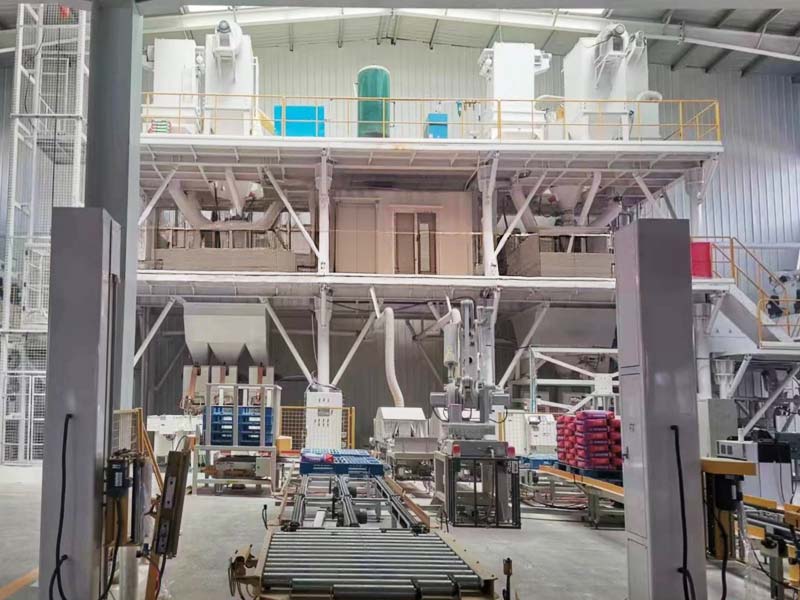
A new line should not be commissioned only with the easiest mortar formula.
For repair mortar production, include at least one technically demanding product such as a fiber-containing, highly modified or small-batch formulation.
Zweryfikować:
- sand storage and weighing;
- bulk-powder batching;
- micro-dosing;
- fiber feeding where applicable;
- sekwencja mieszania;
- mixing uniformity;
- post-mixer transfer;
- packaging;
- zbieranie kurzu;
- generowanie rekordów wsadowych;
- finished-product testing.
Repeat production to demonstrate consistency rather than relying on one successful batch.
What Should Buyers Send for a Repair Mortar Line Review?
A useful equipment inquiry should define the product portfolio.
Zapewnić:
- repair mortar types;
- application thickness;
- klasyfikacja piasku;
- main binders;
- polymer and additive categories;
- fiber information;
- najmniejsza dawka dodatku;
- normalna wielkość partii;
- product changes per shift;
- bag size;
- required production schedule;
- site or workshop dimensions.
Nasz dry mortar solutions can then be reviewed around the actual repair mortar production requirements.
Send your product data and raw-material information through our strona kontaktowa for a project-specific line review.
Wniosek
Repair mortar production is a precision dry-mixing process that can involve controlled sand grading, polymers, fibers and small-dose functional additives.
The right production line should match the product portfolio, application thickness, batch size, dosing range, mixing sequence, cleaning frequency and packaging method.
Workshop and tower layouts can both support repair mortar under different project conditions. The strongest equipment decision starts with the approved product and then configures storage, weighing, feeding, mixing and packaging around that product.
FAQ
What equipment is needed for repair mortar production?
A repair mortar line can include sand and powder storage, bulk weighing, micro-dosing, fiber feeding where required, dry mixing, dust collection, finished-product transfer and packaging. The exact configuration depends on the product formula.
Can manufactured sand be used in repair mortar?
Yes, when its grading, powder content, cleanliness and other relevant properties have been validated for the product. The finished repair mortar should also pass the required performance tests.
Why are fibers difficult to handle in repair mortar production?
Fibers can bridge, clump or feed unevenly depending on type and length. Their feeder and mixing sequence should be selected specifically for the fiber used.
Which plant layout is better for repair mortar?
There is no universal best layout. Workshop plants can suit flexible multi-product and small-batch production, while tower plants can suit more repetitive vertically integrated production. The decision should follow the actual project.
How should a repair mortar line be commissioned?
Use representative raw materials and demanding production formulas, verify weighing, micro-dosing, fiber addition, mixing, transfer and packaging, then confirm the finished product through the applicable laboratory tests.


