
Self-leveling mortar production requires more than a dry mixer and a packaging machine. The finished product must flow, level and develop the required hardened properties after water is added on site, which means the factory has to reproduce a sensitive dry formulation batch after batch.
For equipment buyers, the main challenge is translating that formulation into a reliable production system. Sand grading, binder storage, micro-additive dosing, mixing uniformity, segregation control, dust extraction and packaging all influence whether the dry blend leaving the plant is consistent enough for laboratory and field performance.
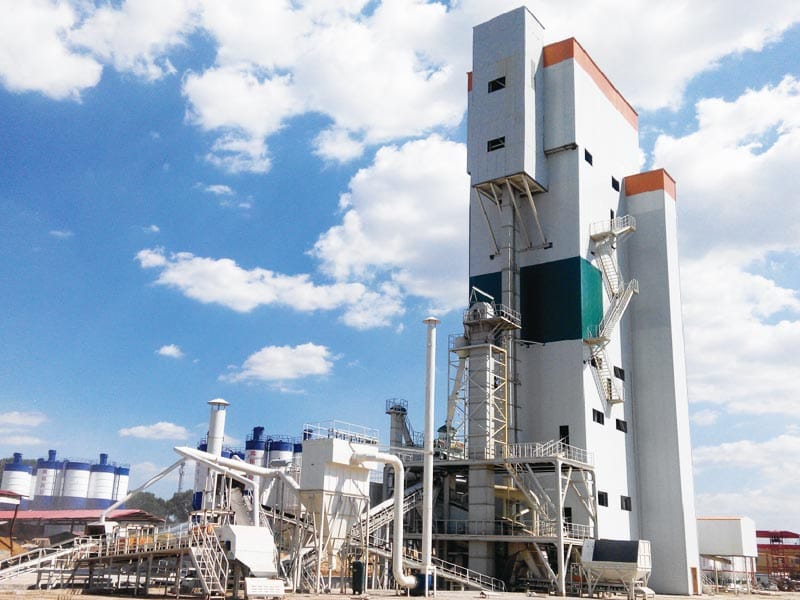
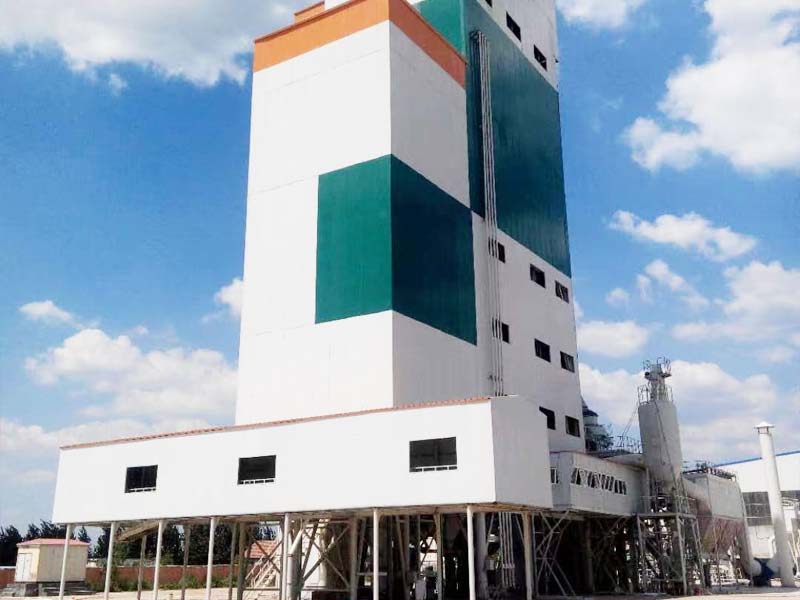
Nasz tower-type dry mortar mixing plant lists self-leveling mortar among its intended applications, while our zakład zapraw suchych typu warsztatowego also supports self-leveling mortar production where a lower, horizontally distributed layout better suits the building. This guide explains how to turn product requirements into a practical self-leveling mortar production line.
What Is Self-Leveling Mortar Production?
Self-leveling mortar production is the controlled manufacture of a dry blend that typically contains hydraulic binders, fine aggregate, fillers, polymers and other functional additives. Water is added later during application according to the approved product instructions.
ASTM C1708/C1708M describes self-leveling mortars containing hydraulic cements as proprietary blends of hydraulic cement, fine aggregate, polymers, fillers and other additives. The standard includes tests for fresh properties such as initial flow, flow retention and healing time, as well as hardened properties such as compressive and flexural strength. See the current ASTM C1708/C1708M self-leveling mortar test methods.
For self-leveling mortar production, those performance requirements belong to the finished product laboratory program. The production line does not create a classification by itself; it must reproduce the approved formulation accurately enough for the finished mortar to meet the required tests.
Start with the Finished Product, Not the Mixer Capacity
A self-leveling mortar production project should begin with a product brief. Define what type of floor system the mortar will serve, the intended layer thickness, whether it is an underlayment or wearing surface, the target flow behavior and the packaging format.
Then translate those requirements into equipment questions.
| Product requirement | Production implication | Pytanie o sprzęt |
|---|---|---|
| Controlled flow and leveling | Ingredient proportions must be highly repeatable. | Can the dosing system handle both bulk and small-dose materials? |
| Stable sand distribution | Aggregate grading must remain consistent. | How many sand fractions need separate storage and weighing? |
| Polymer and functional additives | Low-dose materials need controlled feeding. | Is dedicated micro-dosing required? |
| Several product grades | Recipe changeover and residue become important. | How will cleaning and formula management be handled? |
| Bagged finished product | Packaging must keep pace without segregation. | What buffer and packing arrangement is proposed? |
This product-first approach keeps self-leveling mortar production focused on the material the customer will sell rather than the largest theoretical mixer output.
Sand Grading Is a Core Process Variable
Self-leveling formulations often rely on a tightly controlled particle-size distribution. The sand fraction contributes to packing, flow, stability and the balance between fluidity and segregation resistance.
For self-leveling mortar production, do not specify sand only by a maximum particle size. Define the complete grading or the separate fractions required by the approved formulation.
If one line produces several self-leveling products, separate sand storage can allow the control system to blend fractions in different proportions. Where only one approved sand blend is used, a simpler arrangement may be sufficient.
The equipment decision should follow laboratory evidence. A production line should reproduce the sand system that has already been validated rather than forcing the formulation to fit whatever aggregate bins happen to be available.
Manufactured Sand Can Work Only When Its Quality Is Controlled
Manufactured sand may be used in self-leveling mortar production when the material properties and formulation have been validated. However, the label “manufactured sand” does not establish suitability.
Check grading, fine-particle content, clay contamination, particle shape and moisture condition. Very fine material generated from sound rock can behave differently from clay-rich contamination, so powder quantity and powder quality should not be treated as the same question.
Nasz zintegrowana fabryka piasku i specjalnej zaprawy is designed to connect sand preparation with special mortar production. For a self-leveling mortar production project using in-house sand, define the finished sand specification before configuring the crushing, screening and classification section.
The mortar laboratory should approve the sand blend before the full production line is accepted.
Sand Moisture Must Be Low and Stable Before Dry Mixing
Dry mortar production requires dry raw materials. Excessive sand moisture can create caking, poor flow, dosing problems and storage instability before the product even reaches the mixer.
For self-leveling mortar production, establish the permitted incoming sand moisture condition and determine whether drying is required upstream.
If a dryer is included, size it according to the actual moisture load, not only tonnes per hour. For example, removing water from sand arriving at a higher seasonal moisture condition can require substantially more drying duty than processing the same tonnage during a dry period.
After drying, the sand temperature may also need consideration before storage or contact with temperature-sensitive additives. The required cooling arrangement depends on the project and should be confirmed during process design rather than assumed as a standard feature.
Bulk Binder Dosing and Micro-Additive Dosing Are Different Tasks
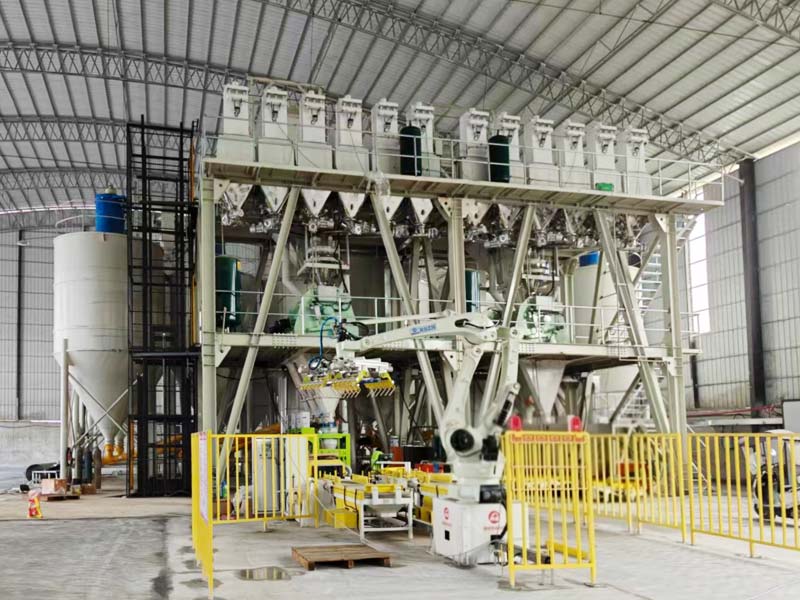
Self-leveling mortar production can combine large binder quantities with additives used at much smaller doses. These two groups should not automatically share the same weighing concept.
A scale designed for hundreds of kilograms may not provide a practical operating range for an additive used at less than one kilogram per batch.
Consider a simple sensitivity example. A 20 g dosing deviation equals 0.02% of a 100 kg ingredient target, but it equals 4% of a 0.5 kg target. The absolute error is identical while its relative effect changes dramatically.
For each self-leveling mortar production formula, list the minimum, normal and maximum dose of every ingredient. Then assign each material to a weighing and feeding system that can be validated across that range.
Micro-Additives Need More Than a High-Resolution Display
Functional additives can strongly influence flow retention, setting, water demand and other product properties. Their production control therefore deserves specific attention.
A display showing three decimal places does not prove that the feeder can repeatedly deliver a small target. Self-leveling mortar production should validate the complete dosing sequence.
For micro-additives, check:
- minimum validated dose;
- feeder cutoff behavior;
- repeatability over multiple batches;
- residual material in the hopper or transfer route;
- dust extraction at the dosing point;
- ingredient identification and recipe mapping.
Where manual addition is used for certain specialty ingredients, the production procedure should still preserve material identification, quantity verification and batch traceability.
Choose the Plant Layout Around Production Scale and Product Variety
Self-leveling mortar production can be arranged in tower, workshop or another project-specific dry mortar layout. The right arrangement depends on production volume, building conditions and how many products share the line.
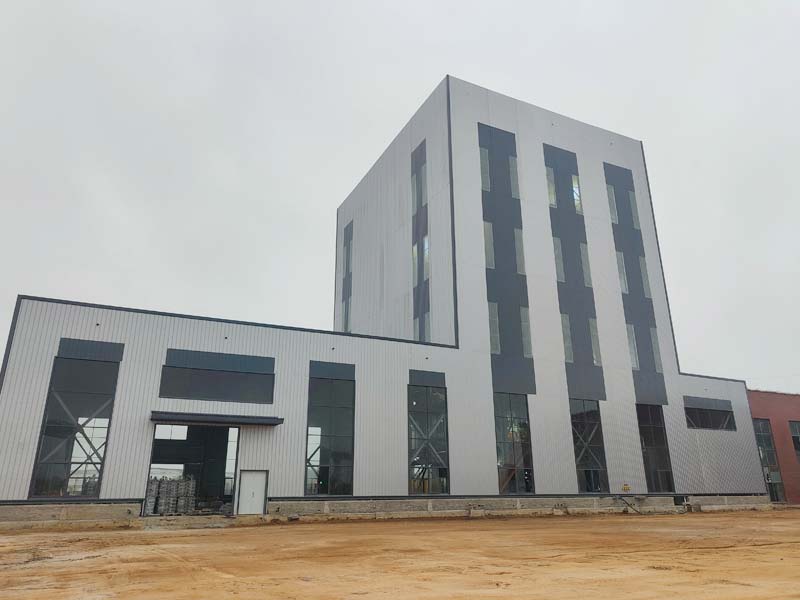
A tower-type dry mortar plant places more stages vertically, allowing gravity to support material flow from storage through batching, mixing and downstream handling. It is appropriate for long-term, higher-output production where the site supports a taller structure.
A workshop-type plant uses a more horizontal arrangement connected by screw conveyors. It can suit existing buildings, pilot lines and flexible special-mortar production.
MixingPlantPro also offers a step-type dry mortar plant with a semi-vertical, semi-horizontal arrangement for multi-category mortar production. Its public application list does not specifically name self-leveling mortar, so suitability for a specific self-leveling mortar production project should be confirmed during engineering rather than assumed from the general mortar capability.
Mixing Uniformity Must Be Proven with the Actual Formula
The mixer is central to self-leveling mortar production, but uniformity depends on more than mixer geometry. Batch fill level, ingredient sequence, powder properties and mixing duration all affect the dry blend.
Use a representative production formula during validation. Sample the finished dry mix according to an agreed procedure and evaluate whether the blend remains sufficiently uniform for subsequent mortar testing.
Do not optimize for the shortest mixing time first. Establish acceptable product uniformity, then determine whether the cycle can be shortened without degrading performance.
Also test the smallest and largest planned batch sizes. A self-leveling mortar production line that performs well at full load may not behave identically when production switches to a smaller specialty batch.
Ingredient Sequence Can Matter as Much as Mixing Time
Some powders disperse more effectively when introduced in a controlled sequence. Dumping every ingredient into the mixer simultaneously may not be the best method for every formulation.
For self-leveling mortar production, the laboratory and equipment team should agree which ingredients enter first, which are added later and whether micro-additives need a pre-blending step.
The control system should then reproduce that sequence automatically or guide operators through the approved manual steps.
During trials, record the sequence with the mixing time. If finished performance changes later, production teams need to know whether the formulation changed or the equipment executed the same formulation differently.
Prevent Segregation After the Mixer
A homogeneous dry mix can segregate after discharge if particles experience excessive free fall, repeated transfer or long storage before packaging.
Self-leveling mortar production often combines materials with different particle sizes and densities, so post-mixer handling deserves specific review.
Sprawdzać:
- mixer discharge height;
- finished-product conveyor type;
- number of transfer points;
- finished-product hopper geometry;
- storage time before bagging;
- packer feed method.
The goal is to preserve the blend created in the mixer until the product reaches the sealed bag.
Packaging Capacity Must Match the Real Mixing Rate
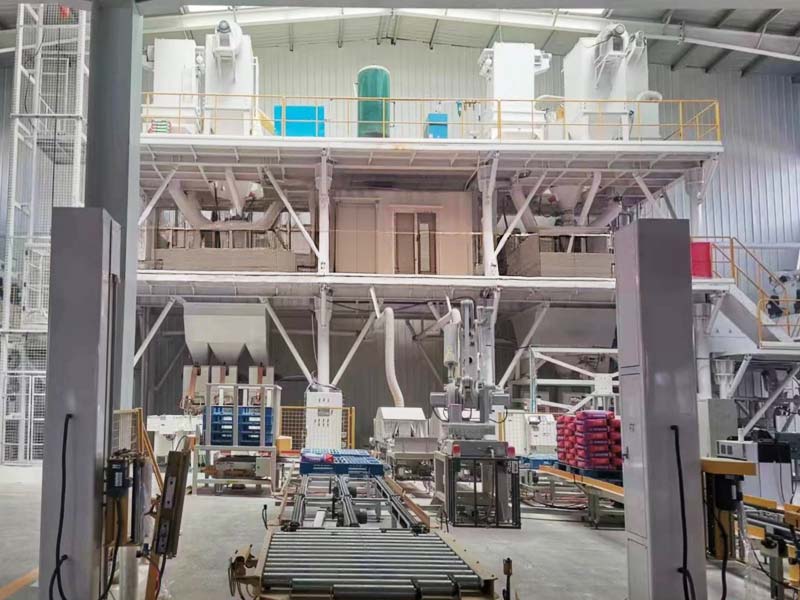
A plant cannot sustain more finished-product output than its slowest downstream stage.
Consider an illustrative self-leveling mortar production line where mixing produces 16 tonnes per hour during uninterrupted operation, but the packaging section can reliably handle 11 tonnes per hour. A finished-product buffer can absorb the difference temporarily, but the mixer eventually has to slow or stop.
This is why line capacity should be calculated from the complete material path.
| Production stage | Ilustrująca stawka | Long-term effect |
|---|---|---|
| Batching and mixing | 16 t/h | Creates product faster than downstream packaging |
| Finished-product transfer | 15 t/h | Minor intermediate restriction |
| Packaging | 11 t/h | Becomes the sustained output limit |
These values are illustrative only. For a real self-leveling mortar production project, use the actual bag size, packaging method, product density and operating schedule.
Dust Control Is Especially Important for Fine Powders
Self-leveling mortar production handles cementitious powders, fillers and fine additives. Dust can be generated during silo filling, bag opening, weighing, mixer charging, discharge and packaging.
Brytyjski Urząd ds. Zdrowia i Bezpieczeństwa lokalne prowadzenie wentylacji wyciągowej emphasizes capturing contaminants close to the source and commissioning extraction systems under realistic operating conditions.
Our tower-type plant uses an enclosed production arrangement with pulse dust collection, while the workshop line also incorporates dust collection around the process. For the final project, map every dust source and confirm the extraction point, duct route, filter access and collected-material handling method.
Do not use one general dust-collector specification as proof that all self-leveling mortar production dust sources are controlled.
Recipe Changeover Can Affect More Than Downtime
A line producing several special mortars must manage residue from the previous product.
For self-leveling mortar production, residual pigment, binder, filler or functional additive can influence the next formulation even when the quantity is small.
Identify where material can remain:
- weighing hoppers;
- micro-additive feeders;
- przenośniki śrubowe;
- mixer surfaces;
- pojemniki na gotowe produkty;
- packaging feeders.
Then define the cleaning or purge procedure and the release criteria for the next product.
Changeover time should be included in daily capacity calculations. A flexible line making several formulations may have lower practical output than the same equipment running one product continuously.
Batch Records Should Connect Production with Laboratory Results
Self-leveling mortar performance is ultimately verified through product testing. That makes traceability important.
A useful batch record should include:
- recipe name and revision;
- raw-material lot information where required;
- target and actual ingredient quantities;
- dodatki ręczne;
- mixing sequence and duration;
- batch time;
- alarms or overrides;
- packaging lot or batch reference.
When laboratory flow, setting or strength results change, these records help determine whether the cause may be raw-material variation, formulation revision or production execution.
Self-leveling mortar production becomes much easier to improve when product tests can be traced to specific manufacturing conditions.
Use Finished-Mortar Tests to Validate the Production Process
A mixer-uniformity check alone does not prove that the final self-leveling product performs as required.
ASTM C1708/C1708M includes standardized tests for initial flow, flow retention, healing time, setting and strength properties of hydraulic-cement self-leveling mortars. These tests are conducted under standardized conditions for comparison; they do not by themselves reproduce every field condition.
For self-leveling mortar production validation, agree which product tests apply to the intended market and specification. Then produce representative plant batches and send traceable samples to the laboratory.
If laboratory results are acceptable, repeat production to demonstrate consistency rather than relying on one successful batch.
What Should Buyers Verify During Plant Commissioning?
A new self-leveling mortar production line should be commissioned using representative raw materials and at least one technically demanding product from the planned portfolio.
Zweryfikować:
- sand fraction storage and weighing;
- binder and filler batching;
- minimum additive dosing;
- recipe sequence;
- mixing uniformity;
- material transfer after mixing;
- dust-control operation;
- packaging rate;
- generowanie rekordów wsadowych;
- finished-product laboratory results.
Factory testing can confirm control logic and equipment functions before shipment, but site commissioning should establish performance with the actual building, materials and production arrangement.
What Information Should You Send Before Requesting a Line?
A useful self-leveling mortar production inquiry should define the product and material requirements instead of asking only for tonnes per hour.
Zapewnić:
- planned self-leveling mortar products;
- main binder types;
- sand fractions and grading;
- smallest additive quantities;
- normal and minimum batch size;
- target production schedule;
- bag sizes and packaging method;
- available site or workshop dimensions;
- whether sand preparation is included upstream;
- future special mortar products expected on the same line.
Nasz rozwiązania do produkcji zapraw suchych can then be reviewed around the real product range and building conditions.
Send your project information through our strona kontaktowa for a self-leveling mortar production line configuration review.
Wniosek
Self-leveling mortar production is a precision dry-mixing process in which sand grading, small-dose ingredients, mixing sequence and post-mixer handling all influence the consistency of the finished powder.
The best plant design starts with the approved product, then chooses storage, weighing, micro-dosing, mixing, dust control and packaging systems that can reproduce that formulation across the required batch range.
When the production line is validated with real materials and linked to finished-product laboratory testing, equipment selection becomes a quality-control decision rather than a simple mixer-capacity comparison.
FAQ
What equipment is needed for self-leveling mortar production?
A self-leveling mortar production line can include sand and binder storage, weighing equipment, micro-additive dosing, a dry mixer, dust collection, finished-product transfer and packaging. The exact configuration depends on the formulation and production scale.
Why is additive dosing important in self-leveling mortar production?
Functional additives can be used at much smaller quantities than sand or binders and can strongly influence flow, setting and other properties. Their measuring and feeding system therefore needs validation at the actual minimum production dose.
Can manufactured sand be used for self-leveling mortar?
Yes, when the manufactured sand grading, fines, cleanliness and other relevant properties are validated for the formulation. The finished mortar should then be confirmed through the applicable laboratory tests.
Which dry mortar plant layout is best for self-leveling mortar production?
There is no universal best layout. Tower plants can suit long-term higher-output production, while workshop layouts can suit existing buildings and flexible special-mortar lines. The decision should follow product range, site conditions and required production scale.
How should a self-leveling mortar production line be accepted?
Commission the line with representative materials, verify bulk and micro-dosing, mixing, transfer, dust control and packaging, then test traceable finished-product samples using the applicable product methods and acceptance criteria.


