
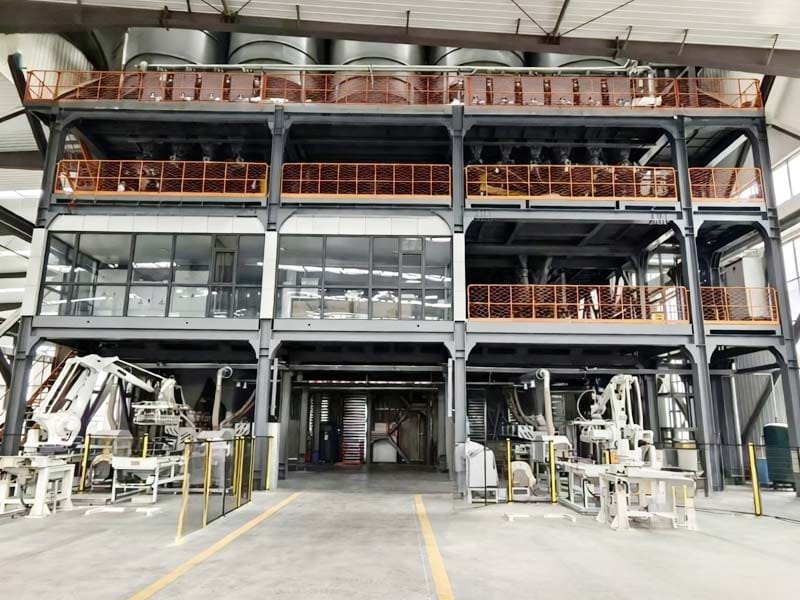
Wall putty production should begin with the products a factory intends to make, not with the mixer capacity printed on an equipment brochure. Interior putty, exterior putty, cement-based products and gypsum-based products can require different raw materials, additive handling, mixing sequences and packaging plans.
That is why a wall putty production line should be specified around the formulation family, expected batch range, dust-control needs, changeover frequency and packaging format. A plant that produces one stable product all day has different priorities from a factory that changes recipes several times per shift.
Náš dielňa typu suché malty miešanie rastlín lists wall putty among its applicable products and combines ingredient metering, conveying, mixing, dust collection and packaging interfaces. This guide explains how to translate wall putty production requirements into a practical equipment specification.
What Does Wall Putty Production Actually Involve?

Wall putty production is a dry-powder manufacturing process in which mineral fillers, binders and functional additives are accurately dosed, blended and packaged as a finished powder product. Water is normally added later during use, according to the product formulation and application instructions.
The manufacturing line therefore needs to control the dry ingredients before they reach the bag. The important stages usually include raw-material receiving, storage, metering, additive dosing, dry mixing, finished-product transfer, dust collection and packaging.
For equipment buyers, the most important distinction is that wall putty production is not only a mixing task. A mixer can produce a uniform batch while the overall line still performs poorly because a low-dose additive is not metered consistently, powder transfer causes segregation, or the packaging section cannot keep up with mixing.
The complete line should therefore be evaluated as one material-flow system.
Start with the Wall Putty Product Family
Before choosing equipment, define the products that the wall putty production line must manufacture. Avoid using one generic label such as “putty powder” if the factory plans several formulations.
| Product question | Why it affects the line | What to confirm |
|---|---|---|
| Is the product cement-based or gypsum-based? | Binder properties can change storage, dosing and cleaning requirements. | Material compatibility and recipe sequence. |
| Will interior and exterior grades share one line? | Different formulas may require different additives and changeover control. | Cleaning method and recipe segregation. |
| Are pigments used? | Color carryover can make product changeovers more demanding. | Residue control and cleaning access. |
| Are low-dose functional additives used? | Small quantities can become a major dosing challenge. | Minimum validated dose and feeder design. |
| Will several package sizes be sold? | Packaging rate and machine setup may change. | Bagging interface and changeover time. |
A useful wall putty production specification should list each product family, not only the expected total annual output. This gives the equipment designer a realistic view of how many ingredients, silos, dosing points and cleaning procedures may be required.
Map Every Raw Material Before Designing Storage
Raw-material storage determines how easily a wall putty production line can run different formulations without manual handling or cross-contamination.
Start by dividing ingredients into major materials and minor additives. Major materials may include mineral fillers and binders. Minor ingredients may include polymers, cellulose-based additives, fibers, pigments or other formulation-specific materials.
Do not assume every powder should use the same storage and feeding method. Bulk materials may justify silo storage and screw conveying, while low-dose additives may require smaller bins or dedicated dosing stations.
For each material, record:
- bulk density range;
- typical quantity per batch;
- minimum quantity per batch;
- flowability and tendency to bridge;
- moisture sensitivity;
- dust characteristics;
- cross-contamination concerns.
These values allow the wall putty production line to be designed around real material behavior. A powder that flows freely in one test can still behave differently after long storage or under humid conditions, so representative handling trials are valuable for difficult materials.
Low-Dose Additives Need Their Own Dosing Strategy
One of the most important issues in wall putty production is the difference between weighing a large filler quantity and dosing a small functional additive.
A scale that works well at hundreds of kilograms may not automatically be suitable for a material added at a much smaller mass. Display resolution alone does not prove that the feeder can repeatedly stop at the required quantity.
For a simple example, a 20 g deviation equals 0.2% of a 10 kg target but 4% of a 0.5 kg target. The same physical deviation therefore has very different significance depending on dose size.
When planning a wall putty production line, list the minimum, normal and maximum dose for every additive. Then ask the equipment supplier to demonstrate the proposed measuring and feeding range using representative materials.
Do not rely on a single generic “weighing accuracy” percentage. The test should identify the target quantity, repeated results, operating conditions and acceptance limit.
This is especially important when the same line will produce multiple wall putty formulations with different additive packages.
Choose the Layout Around the Building and Material Flow
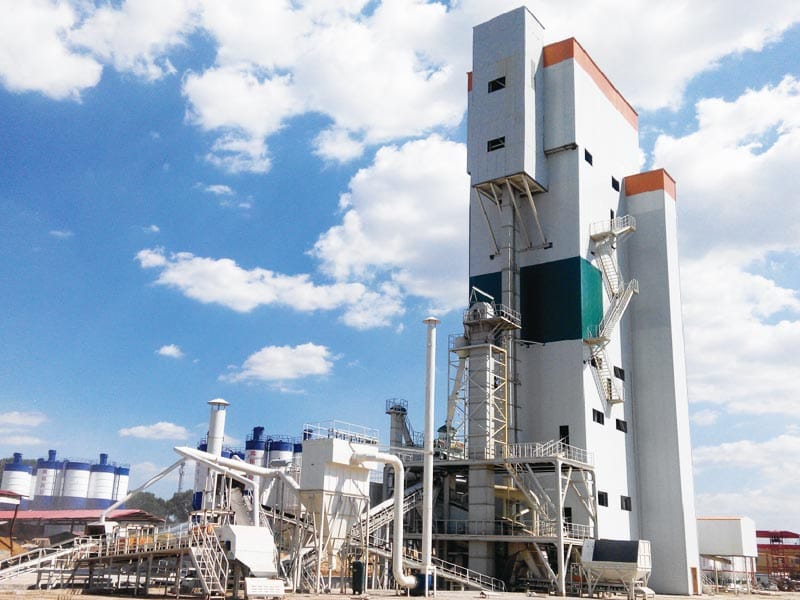
Wall putty production can be arranged in different plant layouts. The correct choice depends on the building, production scale, product variety and required material flow.
A dielňa typu suchá malta uses a more horizontal arrangement that can suit existing industrial buildings where available height is limited. Screw conveyors connect several process stages and the layout can be adapted around workshop dimensions.
A suchá malta vežového typu arranges more of the process vertically so that gravity assists material movement between storage, weighing, mixing and downstream stages.
For wall putty production, neither arrangement is automatically better. A workshop layout may be easier to fit into an existing building, while a tower layout can reduce some horizontal conveying. The comparison should include:
- available floor area;
- building height;
- material receiving routes;
- prístup k údržbe;
- future expansion;
- product-change frequency;
- packaging position.
The best layout is the one that keeps the material route understandable and maintainable while fitting the actual site.
Mixing Uniformity Must Be Verified with the Real Formula
The mixer is the center of a wall putty production line, but uniformity cannot be guaranteed by mixer type alone. Ingredient properties, filling level, addition sequence and mixing time all affect the result.
A useful trial should use the real or technically representative wall putty formulation. Record how the major powders enter the mixer, when small additives are introduced and whether any ingredient is prone to floating, clumping or adhering to equipment surfaces.
Then take samples using an agreed method and evaluate whether the mixture is sufficiently uniform for the finished product.
Do not shorten the mixing time until acceptable uniformity has first been demonstrated. Production optimization should follow quality verification.
For wall putty production, test more than one batch size if the factory expects variable demand. A mixer that performs well near its normal load may behave differently at a much smaller batch.
Control Segregation After Mixing
Uniform mixing does not guarantee that the product remains uniform until it reaches the bag. Dry powders can segregate during discharge, conveying and storage when particles differ significantly in size, density or shape.
This makes post-mixer handling an important wall putty production consideration.
Review the drop height from the mixer, the conveying method, the finished-product hopper and the packaging feed arrangement. Ask whether the proposed route creates unnecessary transfers or long storage periods before packaging.
If screw conveying is used, confirm how the screw is sized and operated for the finished product. If gravity transfer is used, review the hopper geometry and discharge sequence.
Where a finished-product bin is included, define its role. Is it only a buffer between the mixer and packaging machine, or will product remain there for longer periods? The answer affects how much attention should be given to segregation and cleaning.
Dust Control Is Part of Product and Workplace Control
Wall putty production handles fine powders, so dust collection should be designed into the material-flow system rather than added after installation.
Dust can be generated during bag breaking, silo filling, weighing, mixer charging, discharge and packaging. Each source may need a different capture arrangement.
The UK Health and Safety Executive explains in its guidance on local exhaust ventilation that effective dust control depends on capturing contaminants close to the source and commissioning the system so that it performs as intended.
For a wall putty production line, identify every dust-generating point on the process drawing. Then define:
- where extraction hoods or enclosed connections are required;
- which dust collector serves each point;
- how collected powder is handled;
- how filters are inspected and maintained;
- how airflow performance is checked during commissioning.
Our workshop-type dry mortar plant includes pulse dust collection within the production configuration. The final dust-control arrangement should still be confirmed according to the actual material and site requirements.
Packaging Capacity Can Limit the Entire Production Line
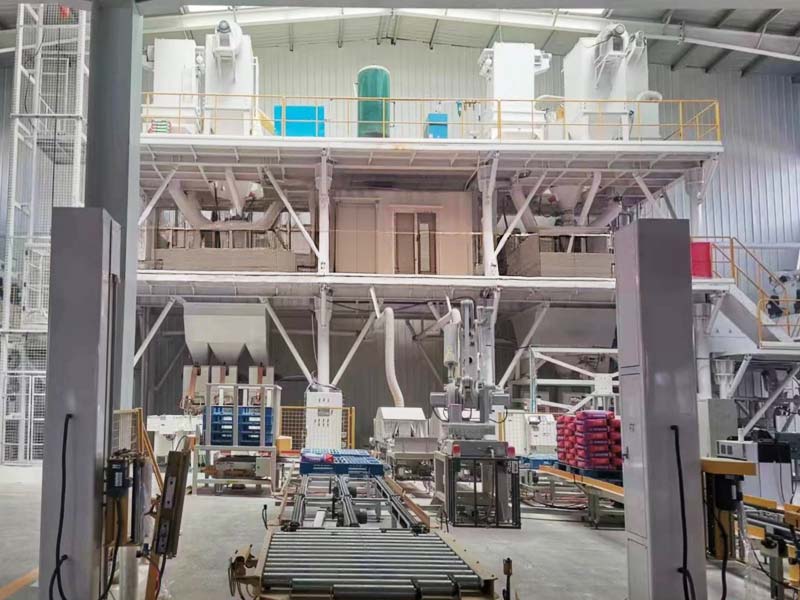
A common mistake in wall putty production planning is selecting the entire plant based on mixer throughput while treating packaging as a secondary detail.
Consider a hypothetical example. Suppose the mixer produces 3 tonnes per batch every 8 minutes. The uninterrupted mixing rate would be 22.5 tonnes per hour.
If the packaging section can only fill 15 tonnes per hour, the finished-product hopper will gradually fill. Once the buffer reaches its limit, the mixer must slow down or stop.
| Stage | Illustrative capacity | Effect on line |
|---|---|---|
| Mixing | 22,5 t/h | Creates finished powder faster than packaging. |
| Balenie | 15 t/h | Becomes the long-term bottleneck. |
| Finished-product buffer | Temporary storage only | Delays but does not remove the bottleneck. |
These figures are illustrative and do not describe product performance. They show why the wall putty production line must be balanced from raw-material intake through final packaging.
If several bag sizes or packaging formats are required, include their actual operating rates and changeover times in the calculation.
Plan Recipe Changeovers Before the Line Is Built
A factory producing several products needs a defined changeover method. Wall putty production can involve color changes, binder changes or different additive packages, and residual material from the previous batch can affect the next product.
Map where powder can remain:
- vážiace násypky;
- skrutkové dopravníky;
- mixer corners and discharge gates;
- zásobníky hotových výrobkov;
- packaging feed screws.
Then decide which areas require dry cleaning, purge material, inspection or another validated method.
The dry mortar plant maintenance approach should distinguish between “equipment is mechanically ready” and “the line is clean enough for the next product.”
For wall putty production, changeover time should be included in daily capacity planning. A factory that changes formulations frequently may achieve a lower practical output than one running a single product continuously, even when both use the same mixer.
Decide What Production Records You Need
Wall putty production becomes easier to troubleshoot when the control system records enough information to reconstruct a batch.
A useful record can include:
- recipe version;
- target quantity for each ingredient;
- actual measured quantity;
- batch time;
- operator or user action;
- alarms and manual additions;
- mixing duration;
- packaging lot or batch reference.
These records connect raw materials, equipment operation and finished-product testing. If a laboratory result is unusual, the production team can identify which batch, recipe and ingredient lots were involved.
When specifying a wall putty production line, ask what data the control system stores and exports. Do not assume every field displayed on the operator screen is automatically retained in the batch report.
What Should a Factory Acceptance Test Cover?
A factory acceptance test should verify the equipment functions that can reasonably be demonstrated before shipment. For wall putty production, this may include control logic, feeder response, weighing functions, mixer operation, interlocks and packaging interfaces, depending on the agreed test scope.
However, factory testing with substitute materials does not fully establish production performance with your actual formula.
Site commissioning should therefore include representative raw materials and at least one agreed production recipe. Verify ingredient dosing, mixing, transfer, dust-control operation and packaging under the intended operating conditions.
If several formulations are important, test the product that is most demanding from an equipment perspective rather than only the easiest recipe.
A successful wall putty production acceptance process should answer two different questions: does the equipment operate correctly, and can the complete line reproduce the agreed production process?
What Information Should You Send Before Requesting a Line Configuration?
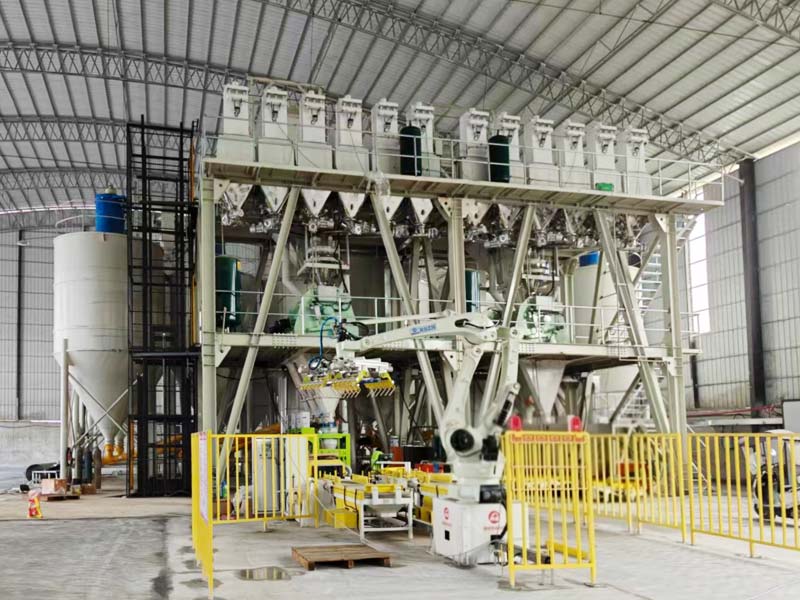
A useful wall putty production inquiry should include enough detail to define the process.
Provide the main product families, major raw materials, additive list, smallest and largest batch, target production window, package sizes and available workshop dimensions.
Also describe:
- whether raw materials arrive in bulk or bags;
- whether sand or filler preparation is required upstream;
- how many recipes will be produced;
- how often recipes change;
- whether palletizing or downstream handling is required;
- which dust-control or local compliance requirements apply.
Náš riešenia na výrobu suchej malty can then be configured around a real product and workshop rather than a generic throughput request.
Send the project information through our kontaktná stránka so storage, dosing, mixing and packaging can be reviewed as one complete wall putty production system.
Záver
Wall putty production depends on much more than selecting a mixer. Product families determine raw-material storage, low-dose additive handling, cleaning, dust control and packaging requirements. The complete line must preserve the intended formulation from weighing through the sealed bag.
The strongest equipment specification starts with the product range, maps every material and dose, defines realistic batch sizes, and verifies the complete line with representative materials. That approach makes the plant easier to operate, maintain and adapt as the product portfolio grows.
FAQ
What equipment is needed for wall putty production?
A typical wall putty production line can include raw-material storage, weighing and dosing equipment, conveyors, a dry mixer, dust collection, a finished-product buffer and packaging equipment. The exact configuration depends on the formulation, production scale and workshop conditions.
Can one wall putty production line make several products?
Yes, if the storage, dosing, mixing and cleaning arrangement supports the required formulas. Product changeovers should be planned carefully when colors, binders or low-dose additives differ between products.
Why are small additives important in wall putty production?
Functional additives may be used at much lower quantities than fillers or binders, so the dosing system must demonstrate suitable performance at those small targets. A general large-scale weighing result does not prove small-dose repeatability.
Can a workshop-type dry mortar plant produce wall putty?
Yes. Our workshop-type dry mortar mixing plant lists wall putty among its applications. The final configuration still needs to match the actual raw materials, batch sizes, additive requirements and packaging plan.
What can limit the output of a wall putty production line?
The limiting stage may be raw-material feeding, dosing, mixing, transfer, cleaning or packaging. Practical output should therefore be calculated from the complete production sequence instead of mixer capacity alone.


