

Hopper bridging in dry mortar plants can stop material flow even when a storage bin still contains plenty of product. Fine sand, cement, fillers and additives can form a stable arch above the outlet, leaving the feeder starved while material remains suspended inside the hopper.
For plant teams, the problem is more serious than a temporary blockage. Bridging can cause unstable weighing, long batch cycles, sudden material surges, screw-conveyor starvation and repeated operator intervention. If the real cause is not understood, the same hopper may keep blocking even after the material is manually cleared.
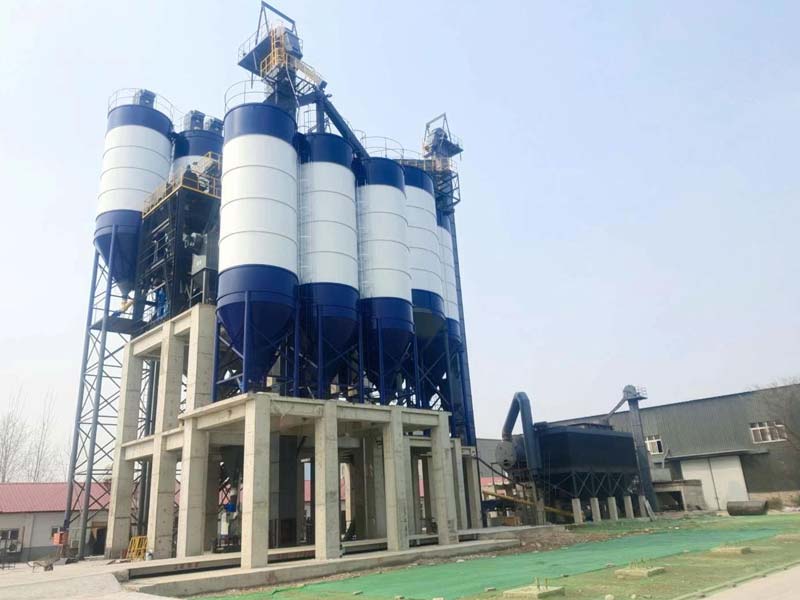
हमारे कार्यशाला-प्रकार सूखी मोर्टार मिश्रण संयंत्र uses storage bins, screw conveyors and metering hoppers to move sand, powder and additives into the mixer, while step-type layouts combine gravity flow with mechanical conveying between platforms. This guide explains how hopper bridging in dry mortar plants should be investigated from both the material and equipment sides.
What Is Hopper Bridging in a Dry Mortar Plant?
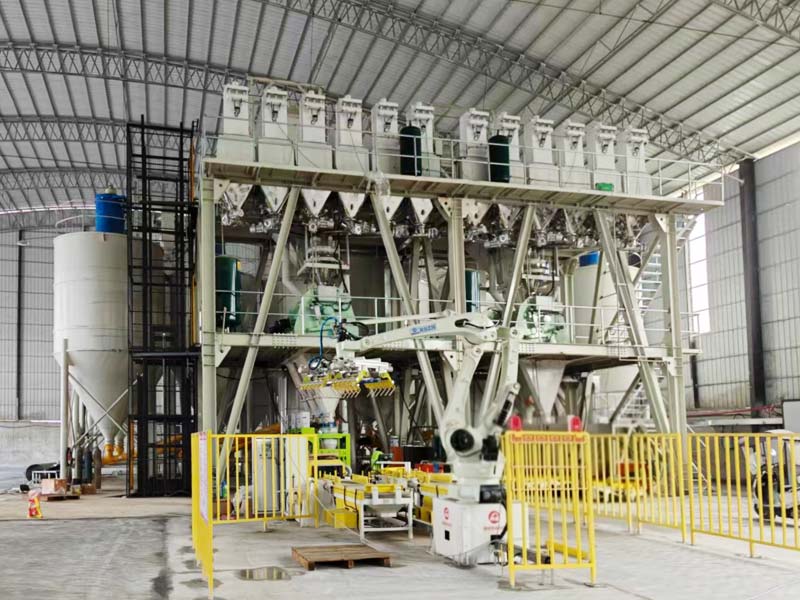
Hopper bridging occurs when bulk material forms a self-supporting arch across the outlet of a hopper or silo. Material below the bridge discharges, but the material above remains suspended.
Bridging is different from simply having an empty bin.
A bridged hopper may show:
- a low-level alarm even though material is visible above;
- no feed from the outlet;
- intermittent material flow;
- long feeder run times;
- sudden surges after a blockage collapses;
- repeated operator intervention.
For hopper bridging in dry mortar plants, the important question is why the material can support itself above the outlet.
Bridging and Ratholing Are Different Problems
Bridging blocks the entire hopper outlet. Ratholing creates a narrow flow channel through the material while a stagnant layer remains around the walls.
| Flow problem | What happens | Typical production symptom |
|---|---|---|
| ब्रिजिंग | A stable arch forms above the outlet. | Flow stops completely. |
| Ratholing | A central channel empties while material remains along the walls. | Flow continues but usable capacity drops and discharge becomes unstable. |
| Caking | Material consolidates into hard lumps. | Feed becomes irregular or impossible after storage. |
| Flooding | A fine powder becomes aerated and flows too freely. | Unexpected surges or loss of feeder control. |
Hopper bridging in dry mortar plants should therefore not be used as a generic term for every poor-flow problem.
Fine Powders Can Form Cohesive Bridges
Cement, mineral fillers and some additives can behave as cohesive powders.
These materials can develop enough internal strength to span the outlet when they are compressed or stored for a period of time.
Factors that can increase cohesive behavior include:
- very fine particle size;
- नमी;
- long storage time;
- consolidation pressure;
- electrostatic effects;
- surface chemistry.
For hopper bridging in dry mortar plants, a powder that flows well during one trial may behave differently after several hours or days of storage.
That is why plant design should use representative stored material rather than only freshly opened laboratory samples.
Fine Sand Can Bridge for Different Reasons
Fine sand can bridge even when it is less cohesive than cement powder.
Particle shape, moisture, fines content and hopper outlet size all matter.
Manufactured sand may contain angular particles and fine stone powder. Natural sand may contain varying moisture and fine contamination. Either material can become difficult to discharge if the actual bulk behavior does not match the hopper design.
हमारे fine sand for mortar guide explains why particle-size distribution and powder content should be controlled for the mortar product. Those same properties also affect bulk flow through storage equipment.
Moisture Is a Major Bridging Risk
Dry mortar production depends on dry raw materials, and excess moisture can change powder and sand flow dramatically.
Moisture can create liquid bridges between particles, increase cohesion and cause material to stick to hopper walls.
For hopper bridging in dry mortar plants, check whether the problem becomes worse:
- during rainy seasons;
- after a dryer upset;
- after long storage;
- with one specific sand source;
- when warm material cools and condensation forms.
If a hopper bridges only when material moisture rises, changing the hopper vibrator may treat the symptom without solving the upstream material problem.
Hopper Outlet Size Can Be More Important Than Hopper Volume
A large hopper can still bridge if its outlet is too small for the material. In practice, hopper bridging in dry mortar plants often begins where outlet geometry and material strength are mismatched.
The outlet has to be large enough that the material cannot form a stable arch across it under the actual stress condition.
For hopper bridging in dry mortar plants, buyers should avoid sizing outlets from throughput alone.
समीक्षा:
- material cohesion;
- कण आकार;
- particle shape;
- wall friction;
- hopper angle;
- expected consolidation.
A feeder may be able to handle the required tonnes per hour, but that does not guarantee the hopper above it can deliver material continuously.
Wall Angle and Wall Friction Control How Material Moves
Material sliding along the hopper wall experiences friction.
If the wall is too shallow or the material has high wall friction, a stagnant region can develop and support bridging or ratholing.
Hopper bridging in dry mortar plants should therefore be reviewed with the actual wall material and bulk solid.
Changing only the hopper angle without considering surface condition may not solve the problem.
चेकः
- wall material;
- surface roughness;
- welds and transitions;
- liners;
- corrosion or buildup;
- hopper geometry.
A smooth hopper when new can behave differently after residue, wear or corrosion changes the wall surface.
Mass Flow and Funnel Flow Behave Differently
Bulk solids can discharge in different flow patterns.
In mass flow, material moves throughout most of the hopper as discharge occurs. In funnel flow, a central channel moves while material near the walls can remain stagnant.
For hopper bridging in dry mortar plants, the choice between these behaviors matters because stagnant zones can:
- hold old product;
- increase caking;
- create recipe contamination;
- reduce usable storage;
- make first-in/first-out behavior difficult.
The correct hopper design depends on material characteristics and process goals. Not every dry mortar hopper needs the same flow pattern, but the intended behavior should be understood before the equipment is finalized.
Transitions and Dead Corners Can Start a Flow Problem
A hopper can have an adequate outlet and still develop poor flow around internal ledges, abrupt transitions or poorly designed connections. Hopper bridging in dry mortar plants can therefore originate above the nominal outlet itself.
For hopper bridging in dry mortar plants, inspect:
- bin-to-screw transitions;
- gate frames;
- flanges;
- internal supports;
- weld beads;
- inspection-door frames.
Material can accumulate around these features and gradually narrow the effective flow path.
If a hopper worked when new but began bridging later, inspect for buildup before changing the control settings.
Screw Conveyors Cannot Fix a Starved Hopper
Workshop-type dry mortar lines often use screw conveyors to transfer sand, powders and additives between storage and metering stages.
A screw conveyor can only move material that reaches its inlet.
If the hopper above the screw is bridged, the screw may continue rotating with little or no material.
This can create:
- long filling times;
- weighing timeouts;
- underweight hoppers;
- unstable screw loading;
- sudden surge when the bridge collapses.
Hopper bridging in dry mortar plants should therefore be diagnosed upstream of the screw before the screw speed is changed.
Changing Screw Speed Can Make the Symptom Worse
If operators see low material flow, they may increase screw speed.
That can empty the small amount of material available at the hopper outlet even faster and make the starvation cycle more severe.
For hopper bridging in dry mortar plants, compare:
- hopper level;
- screw motor load;
- feeder speed;
- weighing rate;
- time between flow interruptions.
If the screw motor load repeatedly drops before the weighing rate falls, the problem may be material supply rather than conveyor capacity.
Bridging Can Destabilize Weighing Accuracy
A bridged hopper can interrupt the feed into a weighing hopper.
The control system may wait, time out or receive a sudden surge after the arch collapses.
This makes accurate fine dosing difficult.
For hopper bridging in dry mortar plants, unstable weighing can appear as:
- slow approach to target;
- कम वजन वाले बैच;
- overshoot after sudden flow resumes;
- large variation in dosing time;
- frequent manual intervention.
हमारे dry mortar weighing accuracy guide explains why feeding behavior and scale performance need to be evaluated separately.
Small Additive Hoppers Can Be Especially Sensitive
Micro-additive systems handle small quantities, and their hoppers may be much smaller than sand or cement bins.
Fine polymers, cellulose ether, pigments or other specialty ingredients can have poor flow properties.
Hopper bridging in dry mortar plants can therefore appear first in the micro-dosing section.
चेकः
- material storage time;
- hopper outlet;
- feeder inlet;
- humidity exposure;
- bag-dump procedure;
- powder compaction after filling.
Do not assume that a small hopper is automatically less likely to bridge.
Finished-Product Hoppers Can Bridge Too
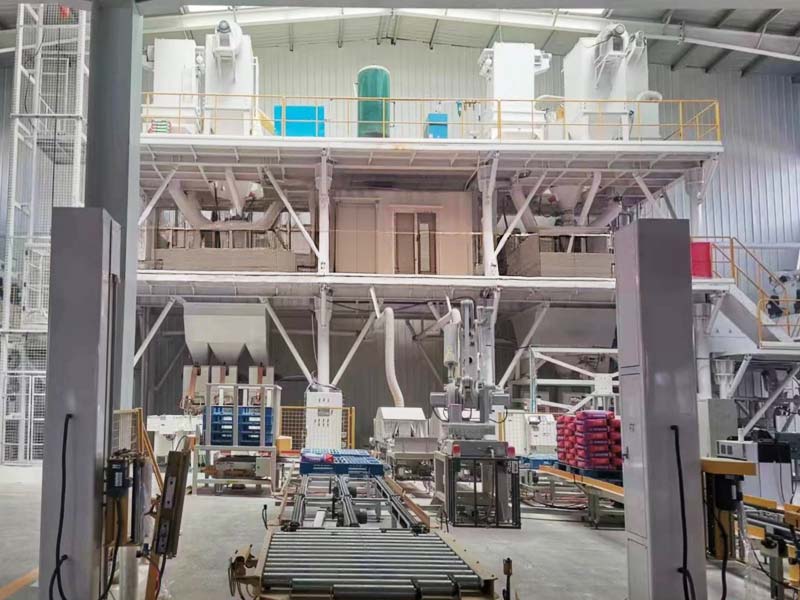
Bridging is not limited to raw materials.
Finished dry mortar can bridge above the packaging system, especially when the product is fine, cohesive or stored for too long before bagging.
This can create:
- packer starvation;
- unstable bag filling;
- long packaging cycles;
- sudden product surges;
- bag-weight variation.
हमारे मोर्टार बैग वजन भिन्नता गाइड explains how unstable hopper feed can affect the packing line.
Dust Extraction Can Affect Very Fine Powder Flow
Dry mortar plants use dust collection around transfer, weighing and packaging points.
For very fine powders, uncontrolled pressure conditions can influence how material behaves near outlets and feeders.
Hopper bridging in dry mortar plants should therefore be checked with the dust system operating under its normal production condition.
यूके स्वास्थ्य और सुरक्षा कार्यकारी स्थानीय निकास वेंटिलेशन मार्गदर्शन emphasizes commissioning extraction systems under realistic operating conditions.
The goal is not to remove dust control. It is to make sure the ventilation arrangement and bulk-solids system are designed to work together.
Vibrators Are Flow Aids, Not Universal Solutions
External vibrators can help some materials flow, but they should not be treated as the automatic solution to every bridge.
Vibration can sometimes compact a cohesive powder more tightly or create unstable surges.
For hopper bridging in dry mortar plants, decide whether a vibrator is appropriate based on:
- material behavior;
- hopper geometry;
- mounting location;
- operating sequence;
- structural design.
Continuous uncontrolled vibration is different from a properly engineered flow-aid strategy.
Air Pads and Aeration Need Material-Specific Review
Air-assisted flow devices can be effective for some fine powders, but they also change the bulk state of the material.
Too much aeration can make some powders flood or feed too quickly.
For hopper bridging in dry mortar plants, confirm:
- whether the material responds well to aeration;
- air pressure and flow requirements;
- installation location;
- dust-control interaction;
- effect on weighing stability.
Do not apply air to every sand, powder or additive hopper with the same settings.
Manual Rodding and Hopper Entry Create Serious Safety Risks
Repeated manual clearing is a sign that the flow problem needs an engineering solution. Hopper bridging in dry mortar plants should be corrected through material and equipment review rather than normalized as routine operator work.
Workers should not place themselves beneath unstable stored material or enter a hopper to break a bridge without the required hazardous-energy and confined-space controls.
ओएसएचए का खतरनाक ऊर्जा मानक का नियंत्रण requires covered servicing activities to isolate hazardous energy where unexpected startup or stored-energy release could cause injury.
NIOSH has also documented engulfment hazards associated with bridged bulk materials in bins and silos. The exact regulatory requirements depend on the facility and task, but the engineering lesson is clear: do not make routine manual entry part of normal hopper operation.
Use Time-Based Production Data to Find Bridging
Hopper bridging in dry mortar plants can be detected through production trends before operators physically inspect the bin.
Track:
| Data point | What it can reveal |
|---|---|
| Feeder run time | Longer time can indicate reduced material flow |
| Weighing time | Large variation can indicate intermittent feed |
| Screw motor load | Low load can indicate starvation |
| Low-level alarms | Can reveal a false empty condition below a bridge |
| Operator interventions | दिखाता है कि किस हॉपर को बार-बार ध्यान देने की आवश्यकता है |
यदि एक हॉपर में समान हॉपर की तुलना में खुराक का समय लगातार अधिक होता है, तो नियंत्रण प्रणाली में चक्र भत्ते बढ़ाने से पहले सामग्री प्रवाह की जांच करें।.
बदलाव छिपी हुई स्थिर सामग्री को प्रकट कर सकता है
एक हॉपर जो खाली प्रतीत होता है उसमें अभी भी दीवारों के साथ स्थिर सामग्री हो सकती है।.
जब संयंत्र उत्पादों को स्विच करता है, तो यह अवशेष बाद के बैच में प्रवेश कर सकता है और अगले फॉर्मूलेशन को दूषित कर सकता है।.
सूखे मोर्टार पौधों में हॉपर ब्रिजिंग के लिए, जांचेंः
- क्या बिन पूरी तरह से खाली हो जाता है;
- क्या सामग्री आउटलेट के ऊपर रहती है;
- क्या पुराना उत्पाद दोबारा भरने के बाद दिखाई देता है;
- क्या सफाई पहुंच स्थिर क्षेत्रों तक पहुंचती है।.
यह बहु-उत्पाद विशेष मोर्टार लाइनों में विशेष रूप से महत्वपूर्ण है।.
हमारे कार्यशाला सूखी मोर्टार संयंत्र गाइड बताते हैं कि पहुंच और बदलाव की आवश्यकताओं के साथ बहु-उत्पाद उत्पादन की योजना क्यों बनाई जानी चाहिए।.
हॉपर ज्यामिति को अंतिम रूप देने से पहले थोक प्रवाह का परीक्षण करें
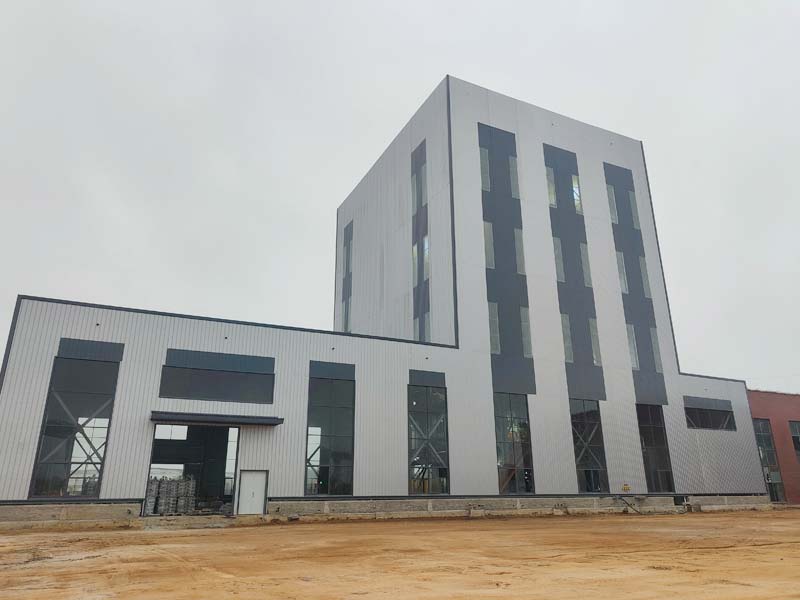
ब्रिजिंग जोखिम को कम करने का सबसे अच्छा तरीका हॉपर के निर्माण से पहले वास्तविक सामग्री को समझना है।.
प्रतिनिधि थोक-ठोस परीक्षण यह निर्धारित करने में मदद कर सकता हैः
- एकजुट ताकत;
- wall friction;
- थोक घनत्व;
- समेकन का प्रभाव;
- नमी का प्रभाव;
- संभावित प्रवाह पैटर्न।.
सूखे मोर्टार संयंत्रों में हॉपर ब्रिजिंग के लिए, इस जानकारी का उपयोग आउटलेट आयाम, दीवार कोण और अस्तर सामग्री की समीक्षा करने के लिए किया जा सकता है।.
केवल सामग्री के नाम से एक महत्वपूर्ण योजक या ठीक-पाउडर हॉपर डिजाइन न करें दो उत्पादों दोनों को “फिलर” कहा जाता है, बहुत अलग प्रवाह व्यवहार हो सकता है।.
खरीदारों को हॉपर और स्टोरेज डिज़ाइन के लिए क्या भेजना चाहिए?
एक उपयोगी थोक-सामग्री समीक्षा के लिए घटक सूची से अधिक की आवश्यकता होती है।.
प्रदान करेंः
- सामग्री का नाम;
- कण-आकार वितरण;
- थोक घनत्व;
- नमी या आर्द्रता संवेदनशीलता;
- सामान्य भंडारण समय;
- आवश्यक फ़ीड दर;
- न्यूनतम खुराक दर;
- क्या भंडारण के दौरान सामग्री संकुचित हो जाती है;
- यदि सामग्री पहले से ही उपयोग में है तो मौजूदा प्रवाह समस्याएं।.
ठीक पाउडर और योजक के लिए, अंतिम हॉपर डिजाइन की पुष्टि होने से पहले प्रवाह परीक्षण के लिए नमूनों की आवश्यकता हो सकती है।.
हमारी सहायता से अपनी कच्ची-सामग्री सूची और प्रक्रिया आवश्यकताएँ भेजें संपर्क पेज परियोजना-विशिष्ट सूखी मोर्टार लाइन समीक्षा के लिए।.
निष्कर्ष
सूखे मोर्टार संयंत्रों में हॉपर ब्रिजिंग एक थोक-प्रवाह समस्या है जो वजन, पेंच संदेश, पैकेजिंग और उत्पादन स्थिरता को प्रभावित कर सकती है ठीक पाउडर, नम रेत, छोटे आउटलेट, उच्च दीवार घर्षण, खराब संक्रमण और लंबे भंडारण सभी योगदान कर सकते हैं।.
सबसे प्रभावी समाधान राथोलिंग, केकिंग और फीडर समस्याओं से ब्रिजिंग को अलग करके शुरू होता है, फिर हॉपर ज्यामिति और डाउनस्ट्रीम उपकरण के साथ वास्तविक सामग्री की समीक्षा करता है।.
सामान्य ऑपरेशन के रूप में बार-बार मैनुअल समाशोधन पर भरोसा न करें वास्तविक सामग्री व्यवहार के आसपास डिजाइन भंडारण और प्रवाह उपकरण ताकि सूखी मोर्टार लाइन फ़ीड, वजन और पैकेज लगातार कर सके।.
अक्सर पूछे जाने वाले प्रश्न
सूखे मोर्टार पौधों में हॉपर ब्रिजिंग का क्या कारण है?
आम कारणों में शामिल हैं एकजुट ठीक पाउडर, नमी, छोटे आउटलेट, उच्च दीवार घर्षण, उथले हॉपर ज्यामिति, लंबे भंडारण और सामग्री संघनन सटीक कारण सामग्री और हॉपर डिजाइन पर निर्भर करता है।.
ब्रिजिंग और राठोलिंग में क्या अंतर है?
ब्रिजिंग एक आर्क बनाता है जो आउटलेट को पूरी तरह से अवरुद्ध करता है राठोलिंग एक संकीर्ण केंद्रीय प्रवाह चैनल बनाता है जबकि सामग्री हॉपर दीवारों के साथ स्थिर रहती है।.
क्या एक स्क्रू कन्वेयर हॉपर ब्रिजिंग को हल कर सकता है?
नहीं एक पेंच कन्वेयर केवल सामग्री को स्थानांतरित कर सकता है जो अपने इनलेट तक पहुंचता है यदि इसके ऊपर हॉपर को ब्रिज किया जाता है, तो स्क्रू की गति बढ़ने से भुखमरी चक्र खराब हो सकता है।.
क्या मुझे हर सूखे मोर्टार हॉपर पर वाइब्रेटर स्थापित करना चाहिए?
नहीं वाइब्रेटर कुछ सामग्रियों के लिए उपयोगी होते हैं लेकिन दूसरों को कॉम्पैक्ट कर सकते हैं या अचानक उछाल बना सकते हैं प्रवाह सहायता को सामग्री व्यवहार और हॉपर डिजाइन के अनुसार चुना जाना चाहिए।.
संयंत्र डिजाइन के दौरान हॉपर ब्रिजिंग को कैसे रोका जा सकता है?
निर्माण से पहले आउटलेट आकार, दीवार कोण, दीवार की सतह, भंडारण समय और फीडर इंटरफ़ेस की समीक्षा करने के लिए प्रतिनिधि सामग्री डेटा या थोक-प्रवाह परीक्षण का उपयोग करें डिजाइन निर्णय वास्तविक पाउडर या रेत संग्रहीत होने पर आधारित होना चाहिए।.


