

Mortar bag weight variation is usually not caused by one single fault. A bag can end up heavy or light because the packer scale is drifting, the feeder does not stop consistently, the product flows differently from batch to batch, the bag is not positioned correctly, or material is still falling after the cutoff command.
For a dry mortar producer, this matters because packaging is the final production stage before the product reaches storage and shipment. Even when batching and mixing are stable, inconsistent bag weight can create rework, customer complaints and poor production efficiency.
우리의 작업장형 건식 모르타르 혼합 플랜트 transfers mixed material to the packaging system by screw conveyor, while our 타워형 건식 박격포 공장 feeds finished material from the vertical process into automatic packaging or bulk delivery. This guide explains how to investigate mortar bag weight variation without assuming the weighing sensor is always the cause.
What Does Mortar Bag Weight Variation Actually Mean?
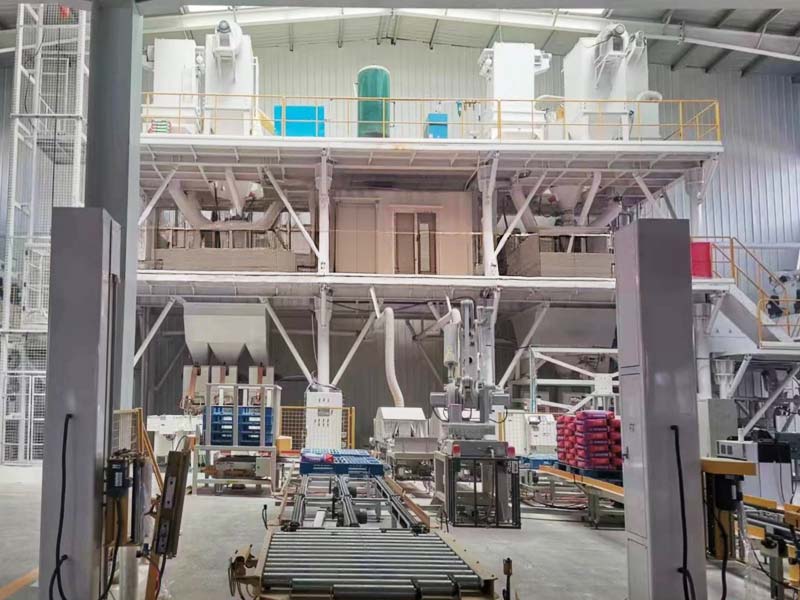
Mortar bag weight variation means the net quantity of finished dry mortar differs from the intended package quantity or varies more than the production specification allows.
The first step is to define exactly what is being measured. Gross bag weight includes the bag itself. Net content is the quantity of product inside the package.
현재 NIST Handbook 133 provides procedures for checking the net contents of packaged goods. It is primarily written for weights-and-measures compliance testing, but it is also useful to industrial packaging operations because it clearly separates package weight, test equipment and net-content evaluation.
For mortar bag weight variation, production teams should therefore define:
- target net weight;
- bag tare weight;
- actual gross weight;
- actual net weight;
- the test scale used for verification;
- the acceptance criteria required by the market or project.
Do not compare one gross weight reading directly with a net-content requirement.
Start with an Independent Check Scale
Mortar bag weight variation should first be confirmed using a suitable independent reference scale.
If the production packer says a bag contains the correct quantity but the check scale shows a different result, the problem may be in the packer weighing system. If both scales agree but the bags vary from one another, the issue may be in feeding, cutoff, product flow or bag handling.
NIST Handbook 44 covers technical requirements for commercial weighing and measuring devices, including scales and automatic weighing systems. See the current NIST Handbook 44 for the applicable device categories.
For a production investigation, record the check scale identification and verification status. Mortar bag weight variation cannot be evaluated reliably when the reference scale itself is uncertain.
Separate Packer Scale Error from Feeding Error
A common troubleshooting mistake is recalibrating the packing scale every time mortar bag weight variation appears.
The packing scale may be measuring correctly while the feeder overshoots the target. Dry powder continues moving for a short time after the feeder receives a stop command. Material already inside the screw, impeller, chute or filling tube can continue entering the bag.
For each test bag, record:
| Production value | What it tells you | Possible problem if abnormal |
|---|---|---|
| Target weight | Quantity requested by the control system | Incorrect recipe or package setting |
| Packer indicated weight | Quantity measured by the packing system | Scale or measurement issue |
| Independent net weight | Reference quantity actually in the bag | Confirms real mortar bag weight variation |
| Filling time | Time required to reach cutoff | Material-flow or feeder change |
| Final overshoot | Material entering after cutoff | Feeder response or material in flight |
This approach separates measurement from dosing. The two problems may need different corrective actions.
Coarse and Fine Feeding Affect Final Bag Weight
Many quantitative filling systems use more than one feeding stage. A fast stage moves most of the product into the bag, while a slower stage approaches the final target more carefully.
Mortar bag weight variation can increase if the transition between these stages is poorly matched to the product.
If coarse feeding continues too close to the target, too much material may remain in motion when cutoff occurs. If fine feeding begins too early, packing speed can fall unnecessarily.
For troubleshooting, compare several consecutive bags and record the weight where coarse feed changes to fine feed. Then check whether the final overshoot changes when product flow changes.
Do not copy cutoff values from another mortar product. Tile adhesive, wall putty, masonry mortar and gypsum-based products can flow differently through the same packing equipment.
Product Flowability Can Create Mortar Bag Weight Variation
The same packer can behave differently when the dry mortar formulation changes.
Particle-size distribution, bulk density, fine powder content, moisture and additives can change how quickly material flows into the bag.
A free-flowing product may continue moving rapidly after the feeder slows. A cohesive powder may bridge or feed intermittently, causing the control system to take longer to reach the target.
When mortar bag weight variation appears only on one product, compare:
- 벌크 밀도;
- 모래 등급;
- fine powder content;
- 습기;
- product temperature;
- additive content;
- filling time.
우리의 타일 접착제 생산 가이드 explains why packaging capacity and powder flow should be evaluated as part of the complete production line rather than as an isolated final step.
Bulk Density Changes Can Shift Packing Behavior
Bagging equipment fills product by mass, but volumetric behavior still matters because the bag and filling path have limited physical volume.
If a mortar becomes less dense, the same net mass occupies more volume. The bag may fill differently, vent less effectively or create more backpressure during filling.
If bulk density increases, the product can reach the target weight with less volume in the bag.
Mortar bag weight variation should therefore be reviewed together with bulk density when a product formula, sand source or mixing condition changes.
For example, if a 25 kg target product changes from an illustrative loose bulk density of 1,400 kg/m³ to 1,250 kg/m³, the same mass occupies approximately 12% more volume. This is a simplified calculation, not a product specification. It shows why a packer may behave differently even though the target weight is unchanged.
Moisture and Caking Can Disturb Feeding
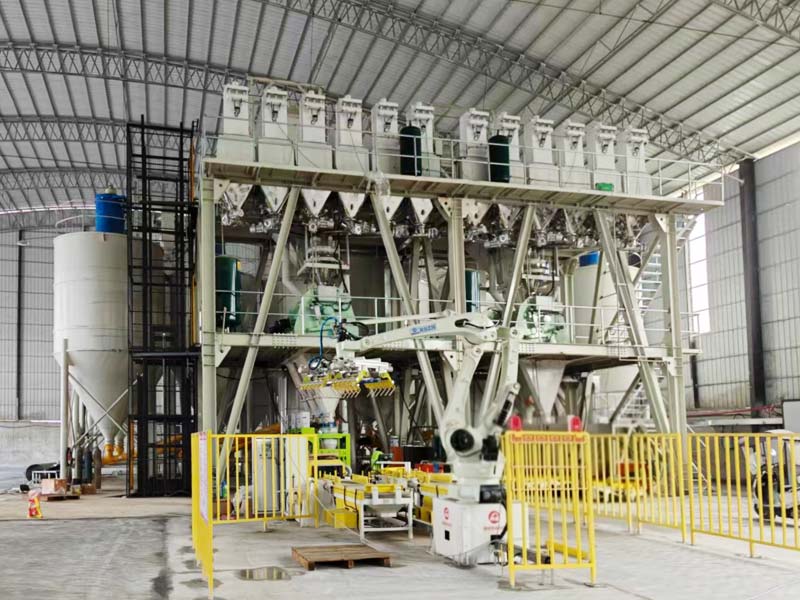
Dry mortar should reach the packaging stage in a stable, free-flowing condition. Excess moisture can create caking, buildup or inconsistent feeding.
Mortar bag weight variation may therefore be a downstream symptom of an upstream raw-material or storage problem.
Inspect whether product is:
- forming lumps;
- sticking inside the finished-product hopper;
- building up in the screw conveyor;
- bridging above the packer inlet;
- changing after long storage in a buffer bin.
Our workshop dry mortar line is designed to move uniformly mixed finished product by screw conveyor into the packaging system. If the transfer route is partially blocked or product flow becomes inconsistent, the packer can receive material unevenly.
Hopper Level Can Affect Packing Stability
The packer should receive material under reasonably stable upstream conditions.
If the finished-product hopper is nearly empty, the feed head and product flow can differ from the condition when the hopper is full. A continuously changing hopper level can therefore contribute to mortar bag weight variation, depending on the feeding mechanism.
For a production check, compare bag weights at high, medium and low hopper levels.
If variation increases near a particular level, review the hopper geometry, feeder inlet and level-control strategy. The solution may involve maintaining an operating level range rather than changing scale calibration.
The same check can reveal whether material segregation inside the finished-product hopper is affecting the packing behavior of different bags.
Bridging Above the Packer Can Cause Underweight Bags
Powder can form a stable arch or bridge inside a hopper instead of flowing evenly toward the outlet.
When this happens, the packer may receive material in pulses. Filling can slow or stop briefly, then restart suddenly when the bridge collapses.
This can create mortar bag weight variation and unstable cycle times.
Look for:
- long filling times followed by sudden fast flow;
- large variation between consecutive bags;
- visible material hanging above the outlet;
- frequent operator intervention;
- changes linked to one specific mortar product.
Do not add vibration, air pads or other flow aids without reviewing the hopper and product characteristics. Excessive assistance can create another unstable flow condition.
Bag Tare Weight Can Affect Net-Content Checks
Mortar bag weight variation can appear larger than it really is when the empty bags themselves have significant weight variation.
If a gross-weighing process is used, the bag tare must be handled correctly to determine product net weight.
NIST Handbook 133 includes procedures that account for tare when evaluating packaged goods. The appropriate compliance method depends on the package and jurisdiction, but the underlying production lesson is simple: know the actual empty-package contribution.
During a packaging trial, weigh a representative sample of empty bags. Check whether tare varies by bag supplier, material, moisture or production lot.
Do not subtract one assumed tare weight indefinitely if the packaging material changes.
Bag Position and Clamping Can Change Filling Behavior
A bag that is not seated correctly on the filling spout can affect airflow, material flow and product loss.
For valve bags, confirm that the valve is correctly positioned and remains attached throughout the fill cycle. For open-mouth bags, check that the bag is clamped consistently and does not shift during filling.
Mortar bag weight variation can increase when operators install bags differently from one cycle to another.
Observe several packing cycles from the side. Record whether underweight or overweight bags correspond with:
- poor bag position;
- bag movement;
- product leakage;
- incomplete clamping;
- air escaping differently from normal.
If the pattern is operator-dependent, the corrective action may be standardizing the bag-loading procedure rather than changing the weighing system.
Dust Extraction Can Influence the Filling Environment
Dry mortar packaging generates dust as material enters the bag and air is displaced.
Dust extraction is important for the workplace and housekeeping, but the extraction arrangement should not destabilize the weighing or filling process.
Mortar bag weight variation should be checked with the dust-control system operating under its normal production condition.
영국 보건안전 집행부의 국소 배기 환기 안내 emphasizes commissioning extraction systems under the real operating conditions they are intended to control.
If bagging is stable with the dust system off but unstable with it on, investigate the extraction connection, bag venting and pressure conditions instead of accepting operation without dust control.
Product Loss During Filling Can Create Light Bags
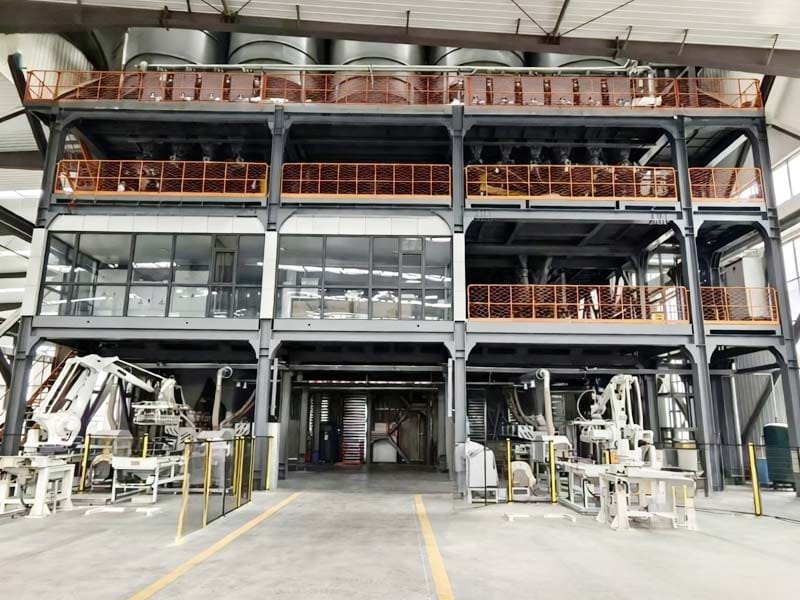
Not every gram leaving the packer necessarily enters the bag.
Dry product can escape through a poorly fitted bag valve, damaged bag, leaking filling connection or open transfer point.
This can create mortar bag weight variation even when the packer measurement appears normal.
확인:
- visible product around the filling spout;
- material collecting beneath the packer;
- dust collector pickup of product during filling;
- damaged bags;
- material loss during bag release.
Define where the packer measures the mass. If measurement occurs upstream of the point where leakage happens, the system can record the expected quantity while the finished bag is actually light.
Separate Filling Accuracy from Checkweighing
Filling accuracy and finished-package verification are related but different.
The packer controls how much material it intends to place into each bag. A downstream check scale measures the finished package independently.
A production line can use checkweighing to:
- identify underweight packages;
- identify overweight packages;
- monitor drift over time;
- separate suspect bags;
- provide data for packer adjustment.
NIST Handbook 44 includes technical requirements for automatic weighing systems. The specific legal applicability depends on the equipment and jurisdiction, but buyers should clearly define whether the proposed packing line includes only filling control or also independent finished-bag verification.
For mortar bag weight variation troubleshooting, downstream checkweighing provides especially useful evidence because it measures the final package rather than an upstream intermediate value.
Look at Weight Distribution, Not Only the Average
An average package weight can look correct while individual bags vary too widely.
Consider five hypothetical bags with net weights of 24.7, 24.9, 25.0, 25.2 and 25.2 kg. The average is exactly 25.0 kg, but the process still has a spread of 0.5 kg.
Mortar bag weight variation should therefore be evaluated using individual results and distribution, not just average production weight.
| Statistic | What it shows | 왜 중요한가 |
|---|---|---|
| Average | Center of the observed package weights | Can hide individual high and low bags |
| Range | Difference between highest and lowest result | Simple view of process spread |
| Signed deviation | Each bag’s difference from target | Shows whether the packer tends high or low |
| Trend over time | Changes across production sequence | Can reveal drift, hopper-level effects or material changes |
Use the legally or contractually required package-content criteria for pass/fail decisions. Production statistics support diagnosis; they do not replace the applicable requirement.
Check Whether the Problem Follows One Mortar Product
If mortar bag weight variation occurs only with tile adhesive but not masonry mortar, the packer hardware may not be generally defective.
Compare the affected product with stable products.
Look for differences in:
- 벌크 밀도;
- particle-size distribution;
- polymer or additive content;
- flowability;
- 습기;
- bag type;
- target weight;
- packing speed.
A product-specific packing setting may be required.
우리의 dry mortar plant types guide explains why product variety affects the design of material routes, cleaning and packaging. The same principle applies at the packer: different mortar products should not automatically use identical filling parameters.
Check Whether the Problem Follows One Bag Type
Sometimes mortar bag weight variation follows the package rather than the mortar.
If the plant uses several valve bags, open-mouth bags or bag suppliers, compare performance by bag type and lot.
Differences in bag stiffness, valve dimensions, permeability or tare can change filling behavior.
Run a controlled test using the same product and packer settings with representative bags from each source. If one bag type consistently shows more variation, review the bag specification before changing the entire packaging machine.
Packaging Speed and Weight Stability Must Be Balanced
A packer can often reduce mortar bag weight variation by slowing the final feeding stage, but excessive slowing can create a bottleneck for the dry mortar line.
Suppose a hypothetical plant needs 12 tonnes per hour of packaged output in 25 kg bags. That equals 480 bags per hour, or eight bags per minute across the complete packing system.
If weight stability is acceptable only when the packer operates at five bags per minute, the packaging section no longer matches the required plant output.
This calculation does not describe MixingPlantPro equipment performance. It shows why packaging accuracy and capacity should be evaluated together before the final line is selected.
A second packer, different feed mechanism, larger buffer or different packaging plan may need to be considered depending on the project.
Use Production Data to Identify Drift

Mortar bag weight variation can develop gradually.
The mean net weight may slowly increase as buildup changes feeder cutoff, or the spread may widen as a scale becomes unstable.
Record consecutive checkweights and review them by:
- time;
- product;
- bag type;
- hopper level;
- packer lane or filling head;
- shift;
- operator where relevant.
If the plant uses more than one packer, do not combine all data immediately. One filling head can drift while another remains stable.
A smart packaging or plant control system can make this analysis easier when package-weight data are stored with product and production information.
Calibrate Only After You Know What Is Wrong
Calibration should not be the first reaction to every mortar bag weight variation complaint.
First confirm the packer scale against the independent check scale. If the measuring system is wrong, calibration or adjustment may be appropriate according to the equipment procedure.
If the scale is correct but the bags are wrong, investigate feeding, cutoff, leakage, bag handling and transfer.
Repeatedly calibrating a correct scale to compensate for product overshoot can make the system inaccurate under other conditions.
Keep an as-found record before adjustment so the maintenance team knows whether the measuring system actually drifted.
What Should a Packing-Line Acceptance Test Cover?
A new dry mortar line should demonstrate packaging with representative product before routine operation.
For mortar bag weight variation control, the acceptance test should include:
- verification of the packing scale;
- representative empty-bag tare checks;
- repeated bags at the main target weight;
- different products where their flow behavior differs significantly;
- different bag types where applicable;
- normal dust-extraction operation;
- high and low hopper-level conditions;
- packing speed;
- finished-bag checkweighing;
- record generation.
Do not approve the line based on one well-filled bag. Repeatability matters more than one ideal cycle.
What Should Buyers Send Before Selecting the Packaging Section?
Packaging design should be part of the dry mortar plant specification.
제공하다:
- mortar product range;
- bulk density for each product where available;
- target bag weights;
- bag type and dimensions;
- required packaged output;
- number of product changes per shift;
- finished-product buffer requirements;
- dust-control requirements;
- checkweighing or rejection requirements;
- palletizing or downstream handling needs.
우리의 건식 모르타르 생산 솔루션 can then be reviewed from raw-material handling through mixing and packaging rather than treating the packer as an afterthought.
Send your product and packaging requirements through our 연락처 페이지 for a complete line review.
결론
Mortar bag weight variation is a packaging-process problem, not automatically a scale problem. The weighing system, feeder cutoff, material flow, hopper level, bag tare, bag positioning, dust extraction and product loss can all influence the final net content.
The most reliable troubleshooting method begins with an independent check scale, separates measurement error from feeding error, compares individual package results, and looks for patterns linked to product, bag type and operating condition.
For a new dry mortar line, package-weight stability should be verified together with packaging capacity. A fast mixer provides little benefit if the packing section cannot produce stable finished bags at the required line output.
FAQ
What causes mortar bag weight variation?
Common causes include scale drift, feeder overshoot, unstable powder flow, changing hopper level, bag tare variation, poor bag positioning, product leakage and differences between mortar formulations. The actual cause should be confirmed with checkweight data before settings are changed.
Should I recalibrate the packer when bag weights vary?
Only after verifying that the packer measurement is actually wrong. If an independent check scale confirms the packer scale is correct, investigate feeder cutoff, material flow, leakage and bag handling instead of recalibrating a correct scale.
Can mortar flowability affect bag weight?
Yes. Changes in particle size, bulk density, fines, moisture and additives can change filling speed and material in flight. Different mortar products may therefore need different packing parameters.
Why can average bag weight look correct while packages still vary?
High and low bags can cancel each other in the average. Review individual net weights, range, signed deviation and trends over time rather than relying only on the mean value.
How should mortar bag weight variation be tested on a new line?
Verify the packer scale, check empty-bag tare, run repeated packages with representative mortar, use normal dust extraction, test realistic hopper levels and confirm finished net weight with an independent check scale.


