

Tile adhesive production needs a line that can reproduce an approved formulation, handle product changes and deliver consistent bags—not simply a mixer with an impressive hourly rating.
Nasz warsztatowa mieszalnia zapraw suchych lists tile adhesive among its applications. For a buyer, the next step is to connect that equipment to specific materials, batch sizes, packaging requirements and finished-product tests.
This guide explains how to make those decisions for cement-based dry powder adhesive. It follows the material from incoming storage to the sealed bag, showing what belongs in a practical equipment specification.
Spis treści
What Does Tile Adhesive Production Actually Make?
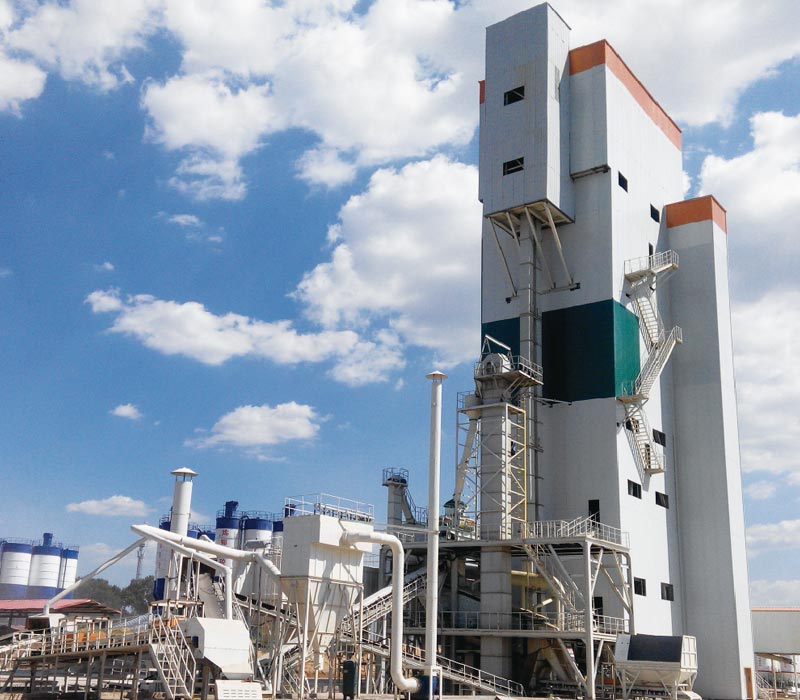
Tile adhesive production in a dry mortar plant produces a dry blend that is packaged before the prescribed mixing liquid is added for use. It is different from manufacturing ready-to-use paste or reaction-resin adhesives.
ISO 13007-1 on ceramic tile adhesives distinguishes cementitious, dispersion and reaction-resin products. That distinction matters when discussing equipment: a dry mortar line should not be assumed suitable for all three.
Define your intended product family before selecting the plant. The discussion here concerns manufacturing equipment, not a universal adhesive formula. Each formulation, preparation instruction and intended application needs approval by the responsible product-development team.
Start with the Finished-Adhesive Requirements
Start tile adhesive production planning with a product brief: intended tiles and substrates, application conditions, color, packaging format and the performance classification you intend to declare.
ISO 13007-2 describes adhesive test methods, including open time, slip, adhesion strength and transverse deformation. Have the laboratory select the tests and acceptance criteria applicable to your product rather than treating every test as mandatory for every adhesive.
A plant layout does not award a product classification. Nor does a mixer-uniformity statement establish adhesion performance. Equipment trials and finished-adhesive testing answer different questions.
For tile adhesive production, connect them through traceable samples. Record which raw material lots, recipe revision, batch size and operating settings produced the material sent to the laboratory. Otherwise, a successful sample provides little evidence about the proposed production arrangement.
Map the Process from Raw Material to Sealed Bag
A useful tile adhesive production flow is: raw material acceptance, preparation and storage, ingredient dosing, dry mixing, finished-powder transfer, and packaging. Dust extraction and production records support the relevant stages.
The published workshop-line process uses separate metering of sand, powders and additives, followed by mixing and screw-conveyor transfer to packaging. Use that arrangement as the starting point for a project-specific flow diagram.
Mark the supply boundaries on the drawing. Does sand arrive ready for use, or does the project need drying and grading upstream? Are bag handling, palletizing and laboratory equipment included or provided separately? A complete process diagram should show these interfaces even when they are outside the equipment contract.
Choose a Layout Around Your Product Schedule
For tile adhesive production, compare the material routes and production schedule before choosing the tallest or most compact structure.
Workshop layout for an existing building
Our workshop configuration uses a horizontal arrangement connected by screw conveyors, with automatic batching, mixing and pulse dust collection. Check your building’s usable height, delivery access, equipment supports and maintenance routes against the proposed drawing.
For a factory planning several adhesive recipes, include storage for each approved ingredient and space for controlled changeovers. Existing floor space is useful only when the complete workflow fits.
Tower layout for an integrated production base
The tower-type dry mortar mixing plant also lists tile adhesive as an application. Its vertical arrangement uses gravity between production stages.
Review elevated access, material replenishment and maintenance lifting before selecting it. The published range distinguishes ordinary mortar from special mortar; do not transfer an ordinary-mortar output figure directly to your adhesive formulation.
Nasz rozwiązania do produkcji zapraw suchych consider product formulations, raw materials, output and site conditions together. That is a more useful basis for selection than layout names alone.
Translate Your Formulation into Equipment Inputs
A recipe lists ingredients. An equipment specification must also describe how those ingredients arrive, flow, occupy storage and enter each batch.
Use the following schedule when planning tile adhesive production. These are information requests, not a recommended formulation or fixed ingredient proportions.
| Material group | Informacje do przekazania | Equipment decision |
|---|---|---|
| Cement and other approved binders | Grade, color, delivery format and quantity per batch. | Storage separation, feed route and weighing range. |
| Frakcje piaskowe | Particle-size distribution, moisture, temperature and delivery condition. | Preparation stages, number of bins and conveying route. |
| Mineral fillers | Particle size, bulk density and handling characteristics. | Storage volume, feeder selection and dust capture. |
| Polymer powders and cellulose ethers, where specified | Exact approved grades, minimum additions and storage instructions. | Additive handling, dosing method and trial quantities. |
| Other formulation-specific additions | Identity, dose range, compatibility and addition sequence. | Dedicated or shared equipment and changeover procedure. |
Include every intended recipe, not just the easiest one. A line specified around one high-volume blend may need different storage, dosing or cleaning arrangements for another product.
For tile adhesive production, confirm material behavior using representative samples. Do not assume that powders with similar names will discharge or meter identically.
Resolve Sand Preparation Before Ordering the Mixer
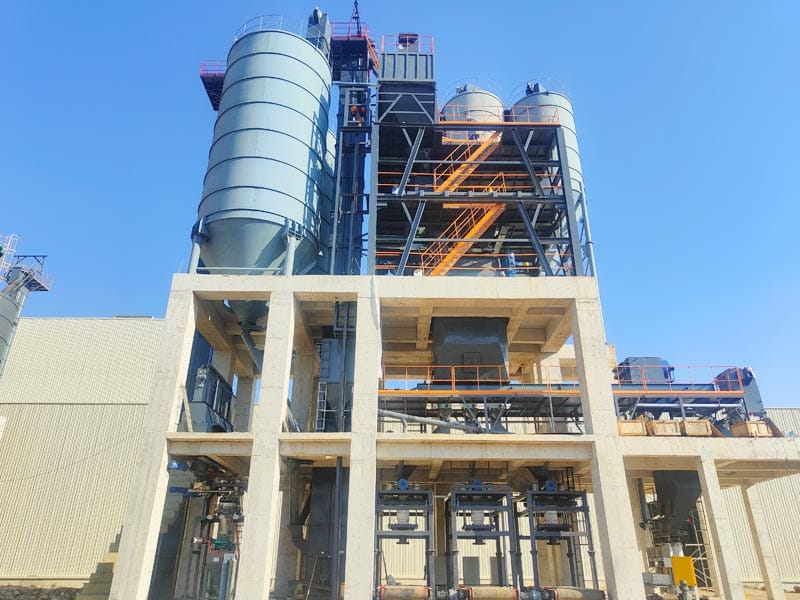
The sand entering tile adhesive production should match the formulation’s approved grading and moisture requirements. Ask for the full particle-size distribution, not only a maximum grain size.
When purchasing prepared dry sand, define incoming checks and protected storage. When receiving wet or ungraded sand, identify the preparation route and who supplies each stage. Drying, screening and any necessary cooling should be explicit project items, not assumed standard inclusions.
Set the acceptable condition at the point where sand enters dosing. A result taken earlier does not describe what happens during intermediate storage or handling.
Agree moisture and temperature limits with the formulation team and ingredient suppliers. Water is not intentionally added during this dry-blending process; moisture control therefore needs its own acceptance procedure rather than a concrete-style batch-water adjustment.
Match the Dosing System to Every Planned Addition
Tile adhesive production requires a dosing schedule covering minimum, normal and maximum quantities for each ingredient. Give these quantities per batch, together with the required production sequence.
Ask whether each addition is weighed automatically, introduced as a verified preweighed portion, or handled through another defined method. “Automatic batching” should be translated into an ingredient-by-ingredient scope.
During trials, check repeated doses using the actual powders and proposed feed rates. Include refill conditions, incomplete discharge and any material remaining in the transfer path. These checks evaluate the installed process rather than the display alone.
Keep manually introduced materials in the batch record. A precisely controlled main-ingredient system cannot establish recipe conformity when an unrecorded addition is made elsewhere.
Validate Mixing with Your Formulation and Batch Range
For tile adhesive production, ask the equipment team to demonstrate the proposed mixer with representative formulations. The minimum batch deserves attention alongside the normal production load.
Confirm both mass and working volume. Two blends with different bulk densities occupy different volumes at the same mass, so a nominal batch weight is not a complete loading instruction.
Define what uniformity means
Agree the measured constituent or validated indicator, sample locations, number of samples and evaluation method. A general uniformity percentage without this information is difficult to assess.
Do not substitute appearance for a test of additive distribution. Sample the discharged powder through an agreed procedure and retain samples from the packaging stage as well. This helps separate mixing performance from changes introduced downstream.
Measure the complete repeat cycle
Record loading, mixing, discharge and any waiting stages. For tile adhesive production, the interval between completed batches is more useful for output planning than the mixing timer alone. Show which operations can overlap instead of adding every stage indiscriminately.
Plan Recipe Changes Across the Entire Line
Recipe management should extend beyond selecting a name on the control screen. Before switching products, identify all shared contact points: feeders, mixer, conveyors, intermediate hoppers, collection systems and packer.
For tile adhesive production involving white and gray products, for example, ask the formulation team to define acceptable carryover and the verification method. Where another mortar family shares the line, review compatibility explicitly.
A material path that is emptied is not necessarily demonstrated clean. Request accessible inspection points and a documented changeover sequence. Any purge, recovered dust or rework needs an approved destination; it should not automatically return to the next recipe.
Include changeover time in the production schedule. Capacity demonstrated during an uninterrupted campaign does not describe a shift containing several product changes.
Size Tile Adhesive Production from Packed Output
Define the required output at the point you need it: accepted, packaged material. Then compare dosing, mixing, conveying and packaging on the same basis.
Consider a hypothetical line discharging a 1-tonne batch every five minutes. Its uninterrupted mixing-stage rate is:
1 × 60 ÷ 5 = 12 tonnes per hour.
Assume the packaging stage actually completes 300 bags per hour at 25 kilograms per bag:
300 × 25 ÷ 1,000 = 7.5 tonnes per hour.
Under these assumptions, sustained packed output cannot match the mixer’s 12-tonne rate. Material would accumulate upstream at 4.5 tonnes per hour until available storage was exhausted. A buffer handles temporary interruptions, not a permanent capacity mismatch.
These are planning examples, not MixingPlantPro equipment specifications. For your tile adhesive production line, request a balanced schedule using the actual formulation, package, operating hours and product-change frequency. Include sampling holds and rejected material when defining acceptable output.
Specify Packaging and Traceability Together
Packaging is part of tile adhesive production, not an accessory to select after approving the mixer. Define bag construction, nominal fill quantity, closure method, identification and handling requirements.
Test filling with the intended powder and bags. Check achieved filling rate, mass consistency, closure quality and material retained around the filling point. Establish how rejected or damaged bags are identified and handled.
Link each bag or defined packing lot to the relevant batches and raw material records. When several batches share an intermediate hopper, define how that inventory affects lot identification.
Validate the storage instructions and shelf-life claim using the actual product and packaging. A bag that looks securely closed immediately after filling has not, by that observation alone, demonstrated performance throughout storage.
Integrate Dust Control into the Proposed Layout
The workshop plant includes pulse dust collection. For the project, examine capture at ingredient charging, transfer, mixing discharge and bag filling rather than considering the collector in isolation.
HSE’s guidance on commissioning local exhaust ventilation explains the need to demonstrate control under defined operating conditions and establish performance benchmarks.
Apply that principle to tile adhesive production by requesting a documented extraction layout, commissioning checks and operating instructions. Have a qualified specialist assess the actual powders, exposure risks and applicable local requirements.
A collector specification is not proof of workplace exposure control or automatic regulatory compliance. Resolve inspection access and safe cleaning arrangements before installation, not after powder accumulates in difficult-to-reach areas.
Agree an Acceptance Plan Before Equipment Delivery
Acceptance should show that the equipment performs the agreed work. For tile adhesive production, distinguish machinery checks from formulation approval and product classification.
Use a written trial plan that identifies materials, operating conditions, responsibilities and unresolved items. The following evidence categories provide a starting point.
| Acceptance area | Dowód na żądanie | Decision supported |
|---|---|---|
| Ingredient handling and dosing | Trials across agreed quantities with representative materials. | Whether proposed feeders and weighing systems suit the recipe range. |
| Mixing and transfer | Defined sampling results, discharge observations and residual-material checks. | Whether the approved blend is reproduced and transferred acceptably. |
| Packaged output | Timed runs with actual bags, recorded interruptions and rejected material. | Whether the complete line meets the agreed delivery rate. |
| Controls and changeovers | Recipe permissions, ingredient records, alarms and a demonstrated changeover. | Whether operators can manage the intended product schedule. |
| Finished adhesive | Applicable laboratory results tied to identified production samples. | Whether the sampled product meets its declared requirements. |
Identify what can be checked before shipment and what requires the installed line, local materials or a complete production run. Passing a factory machinery test does not eliminate the need for site commissioning.
What to Send for a Tile Adhesive Production Proposal
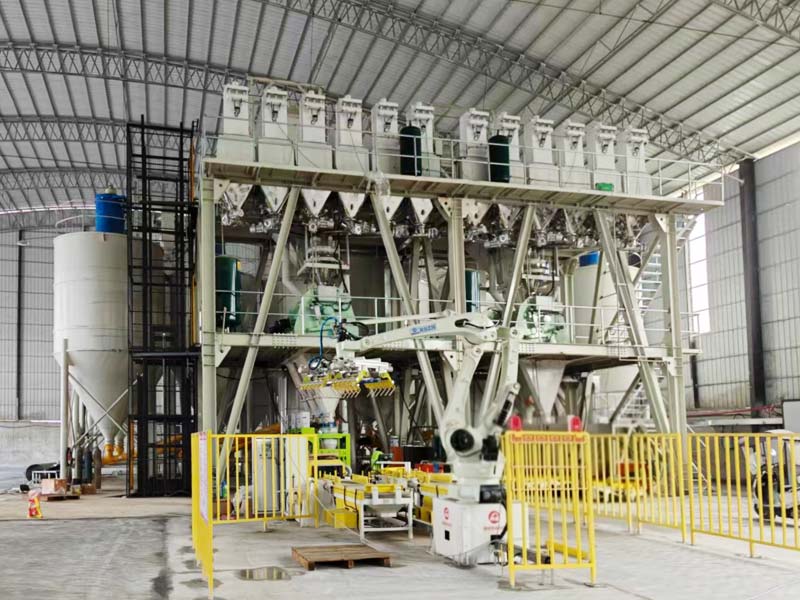
Send your product range, target packed output, shift pattern, raw material information and preferred packaging. Include a building drawing with usable height, access points and available utilities.
For a customized plant layout and equipment review, identify which preparation, storage and packing equipment already exists. Mark future products separately from immediate requirements.
Define who owns formulation development and testing. The equipment proposal should explain how tile adhesive production will be implemented with the approved materials—not imply that purchasing a line automatically provides a validated formula or finished-product certification.
Wniosek
Reliable tile adhesive production starts with the product specification and follows it through material preparation, dosing, mixing, transfer and packaging. Select the line around that complete sequence, then verify it with representative trials.
Share your adhesive product plan, raw materials and factory layout with MixingPlantPro. Request a project-specific dry mortar line review to discuss a configuration suited to your production requirements.
FAQ
Which equipment is needed for tile adhesive production?
A dry powder line needs defined storage, dosing, mixing, transfer, packaging and dust-control arrangements. Sand preparation depends on the incoming material. Confirm the full supply scope rather than assuming a mixer package includes every upstream and downstream operation.
Can a workshop-type dry mortar plant make tile adhesive?
Yes. Our workshop product page explicitly lists tile adhesive as an application. The final configuration still needs to match your approved formulation, batch quantities, building conditions and packaging schedule. Product suitability should be demonstrated through agreed trials.
Is water added during dry powder manufacturing?
Water is not intentionally added during the dry-blending and packaging route described here. The specified mixing liquid is introduced when preparing the adhesive for use. Incoming moisture should still be controlled through the approved raw material and storage requirements.
Does a higher mixer rating guarantee more packaged adhesive?
No. Dosing, transfer, packaging, changeovers and production interruptions can limit output. Compare the full line using the same formulation and operating assumptions. Request evidence of accepted packaged output, not just the mixer’s theoretical rate.
Does buying a production line guarantee an adhesive classification?
No. Equipment performance and finished-product performance require different evidence. The declared adhesive classification must be supported by the applicable tests on the product. Define formulation responsibility, sampling and laboratory requirements as part of the project.


